

Padel Rules Explained: The Complete Guide
Padel is a doubles game played on a 20 × 10 m court enclosed by glass walls and metal fence, and the ball stays in play after it rebounds off them. This guide explains every rule in the official FIP Rules of Padel, the edition in force since 1 January 2026, in plain language.
Short on time? The first section gives you enough to play in one minute. Everything after it is reference: skim the headings, diagrams and tables for the ruling you need. Rule numbers in brackets point to the FIP text, so you can check any call yourself.
Padel rules in 60 seconds
Ten rules cover almost everything that happens in a normal match.
- Two against two, inside a cage. Padel is played in pairs on an enclosed 20 × 10 m court divided by a net (The Court).
- Serve underhand. Bounce the ball behind the service line and hit it at or below waist height, diagonally into the opposite service box. You get two attempts (Rule 6).
- The return must bounce. The receiver has to let the serve bounce before hitting it (Rule 8.1). After that, anyone may volley.
- Ground first, then walls. Your shot must bounce on the opponents' floor before it touches their glass or fence. Wall or fence first means out (Rule 13g).
- After the bounce, everything is alive. The ball can hit any wall or fence and stays in play until it bounces a second time (Rule 12.3).
- Your own glass is a tool, your own fence is not. You can play the ball off the glass on your side to send it back, but never off your own fence (Rules 14b, 13l).
- One hit per team. One player hits the ball once, before the second bounce, then it is the other pair's turn (Rules 12.1, 13c, 13o).
- Hands off the net. Touch the net, the posts or the opponents' side while the ball is in play and you lose the point (Rule 13a).
- Tennis scoring. Points go 15, 30, 40, game. Six games win a set with a two-game margin, a tie-break settles 6–6, and matches are best of three sets (Rule 1).
- Three ways to settle deuce. The competition chooses classic advantage, Star Point or Golden Point (Rule 1).
The court
A padel court is a fully enclosed rectangle, 20 m long and 10 m wide, split in half by a net (The Court).
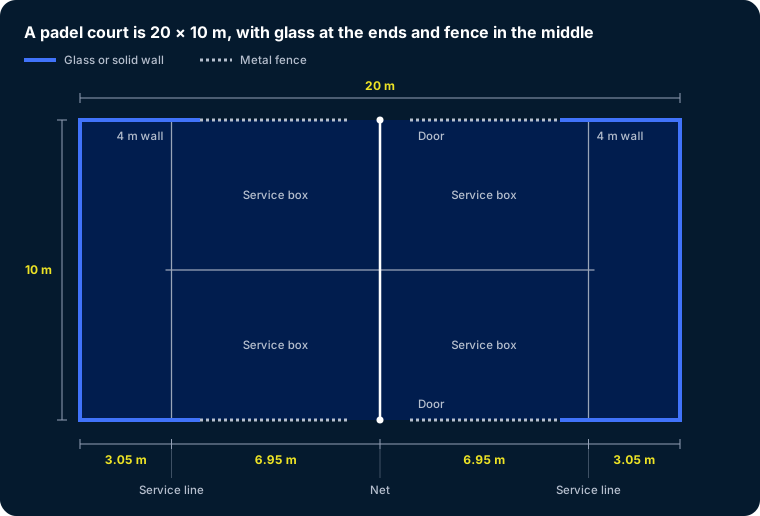
Glass covers both ends and the first 4 m of each side. The middle 12 m of each side is fence, with the doors at the net.
| Element | Official measurement |
|---|---|
| Playing area | 20 m × 10 m, measured inside the walls |
| Net | 0.88 m high at the centre, 0.92 m at the posts |
| Service lines | 6.95 m from the net, forming four service boxes of 6.95 m × 5 m |
| Back walls | 4 m high: 3 m of glass or solid wall topped by 1 m of metal fence |
| Side walls | 3 m high, rising to 4 m in the 2 m nearest each corner |
| Surface | Cement, synthetic material or artificial turf |
The enclosure uses two materials, and the rules treat them differently. Walls (glass or solid) give a true rebound. Metal fence gives an unpredictable one. That is why a serve that touches the fence is a fault, and why you may use your own glass but never your own fence. The fence frame counts as fence (Rule 12.4).
Players enter through openings beside the net, with or without doors. Where the court has enough clear space outside them, players may even run out to keep a ball alive. Special situations explains when.
Equipment: ball and racket
Padel is played with a pressurised rubber ball and a solid, stringless racket that must be tied to your wrist (The Ball, The Padel Racket).
| Item | What the rules require |
|---|---|
| Ball | Rubber, 6.35–6.77 cm in diameter, 56.0–59.4 g, in a colour that contrasts with the court |
| Racket size | Up to 45.5 cm long, 26 cm wide and 38 mm thick |
| Racket face | Flat, smooth or rough, perforated with holes |
| Wrist cord | Non-elastic, up to 35 cm long, worn around the wrist |
The wrist cord is not optional. If your cord breaks or you drop the racket during a point, your pair loses that point at once (Rule 13r).
Rackets may not carry any device that communicates with or instructs the player. You can switch rackets during a match, but not in the middle of a point (FIP case decision).
Starting a match
A coin toss decides who serves and who takes which end, and each pair then fixes its serving and receiving order for the set (Rules 3, 4, 6.8, 8).
- Warm up. A three-minute courtesy rally is obligatory before play (Rule 2.2).
- Toss. The winners pick one of three things: to serve or receive first, which end to start at, or to make the opponents choose first. The other pair gets the remaining choice (Rule 4).
- Set the serving order. Before each set, each pair decides which partner serves first. The order then stays fixed until the set ends (Rule 6.8).
- Set the receiving order. In the first game of each set, the receiving pair decides who receives the first point. That player receives the first serve of every game for the rest of the set, and the partners alternate point by point (Rules 8.2, 8.3).
The receiving order is why players are known as right-side or left-side players, but it only governs the return. Once the ball is in play, everyone may move and switch freely (Rule 3).
Nobody may stand outside the court during the serve. One partner may cover as much of the court as they like, provided both serve and receive in their turn (FIP case decisions).
Scoring in brief
Padel is scored like tennis: points make games, games make sets, and the first pair to win two sets wins the match (Rule 1).
- Points: 15, 30, 40, game. At 40–40 the score is deuce.
- Games: the first pair to six games wins the set, with a margin of two. At 5–5 the set runs to 7–5, and at 6–6 a tie-break decides it.
- Tie-break: first to seven points with a margin of two. The set goes down as 7–6.
- Match: best of three sets.
What happens at deuce depends on the format the competition has chosen. The rulebook offers three.
| Format | What happens at 40–40 |
|---|---|
| Advantage (Option 1) | A pair must win two points in a row: advantage, then game. Lose the advantage point and it is deuce again, with no limit. |
| Star Point (Option 2) | Up to two advantage points are played. If neither is converted, one deciding point settles the game. The sequence runs deuce, advantage, deuce, advantage, deuce, Star Point. |
| Golden Point (Option 3) | One deciding point is played straight away. Whoever wins it wins the game. |
On a Star Point or Golden Point, the receiving pair chooses whether the serve comes to the right or the left side. They may not swap positions to do so. In mixed doubles, the receiver must be the same sex as the server.
The Star Point is the newest option. The FIP General Assembly added it on 28 November 2025, and Premier Padel and the CUPRA FIP Tour adopted it from the start of the 2026 season (Premier Padel and FIP announcement).
Competitions may also shorten matches with sets to four games, or with a tie-break to seven or ten points in place of a third set (Rule 1, Alternative score methods). The padel scoring guide walks through every format point by point.
The serve in brief
Every point starts with an underhand serve hit diagonally into the opposite service box, and the server gets two attempts (Rule 6).
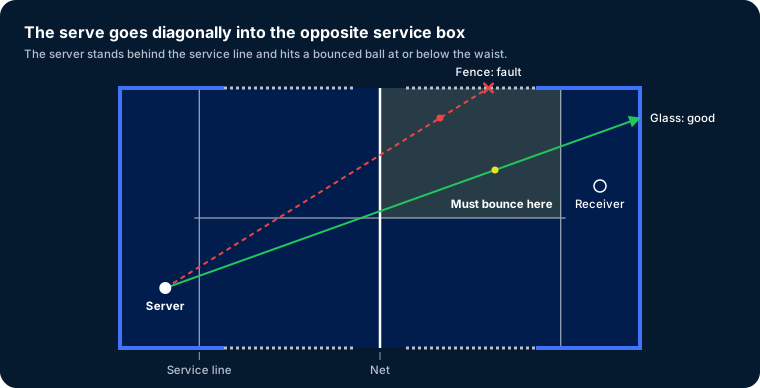
A serve that bounces in the box and then reaches the glass is good. One that touches the side fence before its second bounce is a fault.
- Stand behind the service line, between the centre line and the side wall. Each game starts from the right side, then the server alternates left and right every point (Rule 6.5).
- Bounce the ball on the floor behind the service line. The ball may not cross the service line or the centre line before you hit it (Rule 6.2).
- Hit it at or below waist height, with at least one foot on the ground (Rule 6.4). Your feet may not touch the service line or the centre line until the ball is struck (Rule 6.3).
- Send it diagonally over the net so it bounces inside the opposite service box. A ball on the line is good (Rule 7c).
- Mind the fence. After bouncing in the box, the serve may hit the glass. If it touches the metal fence before its second bounce, it is a fault (Rule 7e).
A serve that clips the net and still lands in the correct box is replayed, as long as it does not then hit the fence (Rule 9). Two faults in a row lose the point (Rule 13q).
The receiver must let the serve bounce before returning it (Rule 8.1). If the serve hits the receiver or the receiver's partner before bouncing, the server wins the point (Rule 8.5).
For where the server may stand, every service fault, lets and what happens when someone serves out of turn, see the padel serve rules guide.
Ball in play: what is in and what is out
A shot is good when the ball crosses the net and bounces on the opponents' floor before it touches anything else on their side (Rules 13g, 14b).
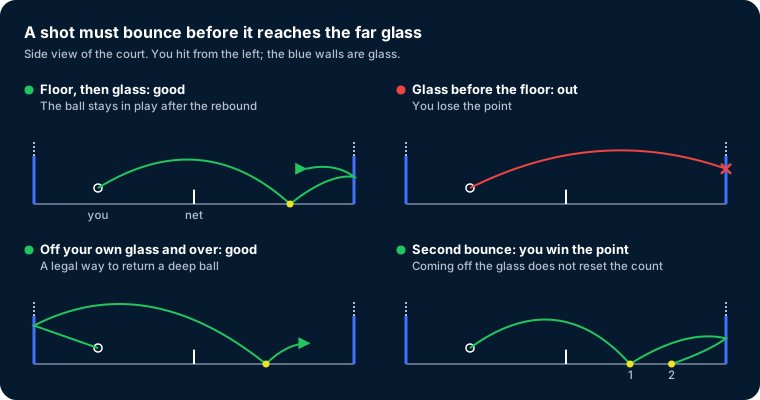
The fence on the far side follows the same logic: in play after the bounce, out before it. On your own side the glass is yours to use and the fence is not (Rules 14b, 13l).
There are no out lines in a rally. The lines only matter on the serve. During a rally the whole floor on the other side is in, and the walls and fence are the boundary.
A shot is also good if the ball:
- is volleyed by an opponent before it bounces (Rule 14a)
- clips the net or a net post and still lands on the opponents' floor (Rule 14e)
- lands in the angle where the wall meets the floor (Rule 14i)
- bounces on the opponents' floor and then flies out of the court, or hits the ceiling or lights (Rule 14d)
When the ball comes to your side, you have three ways to play it:
- Volley it before it bounces. The one exception is the return of serve, which must bounce first.
- Hit it after one bounce.
- Let it bounce and come off the wall or fence, then hit it before it bounces a second time (Rule 12.3). Balls off the glass rebound cleanly, so letting them come to you is often the easiest option.
Whichever you choose, your pair gets a single hit, made on your own side of the net (Rules 13f, 13i, 13o).
How a point is lost
Rule 13 lists every way to lose a point, and each one comes down to the ball, the hit or the player.
| You lose the point if… | Rule |
|---|---|
| The ball | |
| The ball bounces twice on your side before you return it | 13c |
| Your shot hits the opponents' glass or fence before it bounces | 13g |
| Your shot hits the net and then goes straight onto the opponents' glass or fence | 13h |
| Your shot touches the fence or the floor on your own side | 13l |
| The ball hits you, your partner or anything either of you is wearing | 13j, 13k |
| The ball bounces on your side and leaves the court over the back wall | 13d, 13e |
| The hit | |
| You hit the ball twice | 13i |
| Both partners hit the ball, together or one after the other | 13o |
| You hit the ball before it has crossed the net | 13f |
| You hit the ball with a racket you have thrown | 13m |
| You hit the ball with any part of your body outside the court, unless out-of-court play is allowed | 13p |
| The player | |
| You, your racket or your clothing touch the net, the posts or the opponents' side while the ball is in play | 13a |
| You jump over the net during the point | 13n |
| You drop your racket or your wrist cord breaks | 13r |
| You serve two consecutive faults | 13q |
Three clarifications save a lot of arguments:
- Clashing rackets is fine. If both partners swing and only one racket touches the ball, the shot stands, even if the rackets collide (Rule 13o, note).
- A scooped ball can be legal. A return counts as one hit if the contact happens in a single movement and the ball's natural path does not change much (Rule 14h).
- A hit player loses the point wherever they stand. If your shot strikes an opponent before bouncing, the point is yours (Rules 13k, 14a).
You win the point outright if the ball bounces on the opponents' side and then goes through the fence, sticks in it, or comes to rest on top of a wall (Rule 15).
Special situations
These are the rulings that come up rarely but cause the longest debates.
The ball comes back over the net
A ball with heavy spin, or one that rebounds hard off the back glass, can bounce on your side and travel back over the net on its own. You may reach over the net to hit it, provided you, your racket and your clothing touch neither the net nor the opponents' court (Rule 14g). If nobody on your side touches the ball, your pair has failed to return it and the point goes to the opponents.
This is the only time you may hit the ball on the other side of the net. In every other case, contact before the ball has crossed to your side loses the point (Rule 13f).
The ball leaves the court
A smash can bounce on your side and fly out over the walls. What happens next depends on where it goes and on the court (Rules 13d, 13e, 16).
| The ball bounces on your side and… | Court without out-of-court play | Court with out-of-court play |
|---|---|---|
| goes out over the back wall | You lose the point | You lose the point |
| goes out over the side wall or through the door | You lose the point | You may run out and return it before it bounces again or touches anything outside the court |
Out-of-court play is allowed only where each side of the court has a clear safety area outside the doors, at least 3 m wide, 4 m long and 3 m high (The Court). In Spanish padel slang, a smash out over the 3 m side wall is a por tres and one over the 4 m back wall is a por cuatro.
Lets: when the point is replayed
A point is replayed if the ball splits, if something that is not part of the game enters the court, or if play is interrupted by anything unconnected to the players (Rule 10). A stray ball rolling in from the next court is the classic case. Claim the let at once: if you play on you lose the right to it, and if the umpire finds no let you lose the point (Rules 10e, 10f).
A ball in play that strikes a spare ball lying on the opponents' floor is still a good shot, and play continues (Rule 14f). It becomes a let only if that object moves in a way that could interfere with play or endanger a player (Rule 10d).
Interference
If a player deliberately puts off an opponent who is making a shot, the opponents get the point. If it was accidental, the point is replayed. A second accidental interference by the same pair costs them the point (Rule 11).
Time rules and changing ends
Play is meant to be continuous from the first serve to the last point, with fixed limits on every pause (Rule 2).
| Situation | Time allowed | Rule |
|---|---|---|
| Warm-up | 3 minutes, obligatory | 2.2 |
| Late arrival | Walkover after 10 minutes | 2.1 |
| Between points | 20 seconds | 2.4 |
| Change of ends | 90 seconds | 2.5 |
| Change of ends after the first game of a set | No rest, play continues | 2.5 |
| Change of ends in a tie-break | 20 seconds, no rest | 2.5, 2.10 |
| Between sets | 120 seconds | 2.6 |
| Medical treatment | 3 minutes, once per player and condition | 2.14, 2.15 |
Changing ends. Pairs swap ends after the first, third and every following odd game of a set, and after every six points in a tie-break (Rule 5).
Slow play. The first time violation earns a warning. On the second, a serving pair loses its first serve and a receiving pair loses a point. Further violations cost further points (Etiquette: Continuous play).
Coaching. An accredited coach may advise players only during rest periods (Etiquette: Advice and instructions). No food or drink is allowed between points (Rule 2.5).
Conduct. Obscenities, ball or racket abuse and unsporting behaviour follow a three-step scale: a warning, then a point penalty, then disqualification (Etiquette: Table of penalties).
Padel vs tennis: the differences that trip people up
Padel borrows tennis scoring, but the walls, the serve and the racket change how every point is played.
| Padel | Tennis | |
|---|---|---|
| Court | 20 × 10 m, enclosed by glass and fence | Larger and open |
| Walls | In play once the ball has bounced | None |
| Out lines | Only on the serve | On every shot |
| Serve | Underhand, after a bounce, at or below the waist | Overhead, from a toss |
| Racket | Solid and perforated, no strings, wrist cord required | Strung |
| Players | Pairs | Singles or doubles |
| Deuce | Advantage, Star Point or Golden Point | Usually advantage |
The habit tennis players find hardest to break is hitting every ball before it reaches the back wall. In padel, letting the ball rebound off the glass is legal and often the smarter shot.
FAQ
Can the ball hit the wall before it bounces?
No. A ball that hits the opponents' glass or fence before bouncing on their floor is out (Rule 13g). After one bounce it can hit any wall or fence and stay in play.
Can a serve hit the glass?
Yes, once it has bounced in the correct service box. If it touches the metal fence before its second bounce, it is a fault (Rule 7e).
Can you volley the return of serve?
No. The receiver must let the serve bounce (Rule 8.1), even when standing outside the service box (FIP case decision). Every other shot in the rally may be volleyed, including the serving pair's first shot after the return.
Can you hit the ball against your own glass?
Yes. A ball played off the glass on your own side that then crosses the net and bounces in the opponents' court is a good return (Rule 14b). Your own fence is different: touching it with your shot loses the point (Rule 13l).
Can you reach over the net?
Only to play a ball that has already bounced on your side and travelled back over the net (Rule 14g). Otherwise you must hit the ball on your own side (Rule 13f), and you may never touch the net (Rule 13a).
What happens if the ball hits a player?
The pair of the player who was hit loses the point, wherever that player was standing (Rule 13k). On a serve, if the ball hits the receiver or the receiver's partner before bouncing, the server wins the point (Rule 8.5).
Is a ball on the line in?
Lines only apply to the serve, and there a ball on the line is good (Rule 7c). In a rally there are no out lines.
What happens if I drop my racket?
Your pair loses the point immediately, and the same applies if your wrist cord breaks (Rule 13r).
What happens if the ball hits the fence?
It depends on whose side it is. On the opponents' side, the fence is in play once the ball has bounced, but a ball that hits it before bouncing is out (Rule 13g). On your own side, a shot that touches your fence loses the point (Rule 13l). On the serve, touching the fence before the second bounce is a fault (Rule 7e).
Can you play the ball off your own side wall?
Yes, if that part of the wall is glass. You can send the ball into your own side or back glass and over the net, as long as it then bounces in the opponents' court (Rule 14b). The metal fence in the middle of the side wall is different: touching it with your shot loses the point (Rule 13l).
Can the ball bounce again after it hits the wall?
No. After its first bounce on your side, the ball may come off any wall or fence, but you must hit it before it touches the floor a second time (Rule 12.3).
Can both players hit the ball?
No. Only one player per pair may hit each ball. If both partners touch it, together or one after the other, the pair loses the point (Rule 13o). Rackets clashing is fine as long as only one of them touches the ball.
Can you jump over the net or cross to the other side?
No. Jumping over the net during a point loses it (Rule 13n), and so does touching the net, the posts or the opponents' side while the ball is in play (Rule 13a).
Is a drop serve allowed in padel?
Yes. It is the only serve in padel. You bounce the ball behind the service line and hit it at or below waist height, with at least one foot on the ground (Rule 6). Overhead serves like in tennis are not allowed.
Do you have to wear the wrist strap?
Yes. The rules require the cord to be worn around the wrist. If you drop your racket or the cord breaks during a point, your pair loses the point (Rule 13r).
Is padel harder than tennis?
Padel is usually easier to start. The racket is shorter, the serve is underhand and the walls keep the ball in play, so beginners can rally within their first session. It becomes demanding at higher levels, where wall play and positioning decide most points. See "Padel vs tennis" above for the rule differences.
Sources
Every rule in this guide comes from the International Padel Federation's own documents, read on 1 October 2026.
- FIP Rules of Padel, review of application 01.01.2026. The current official rulebook, and the source of every rule number cited above.
- FIP Documents page. Where FIP publishes the current rulebook and competition regulations.
- FIP Rules of Padel, earlier PDF with case decisions. Source of the rulings marked “FIP case decision”. The current edition no longer prints these cases.
- Premier Padel and FIP announcement of the Star Point, December 2025.
This guide follows the FIP rulebook. National federations and individual tournaments may publish additional regulations, so check those before you compete.