

Padel Scoring System Explained: Points, Games, Sets & Tiebreaks
Padel is scored like tennis: four points win a game, six games win a set and two sets win the match. The difference is what happens at 40–40, where the official rules now offer three formats. This guide follows Rule 1 of the FIP Rules of Padel, the edition in force since 1 January 2026.
The first section is all you need to keep score in a normal match. The rest covers deuce formats, tie-breaks and the edge cases. For every other rule, see the complete padel rules guide.
Padel scoring in 30 seconds
- Points run 15, 30, 40, game. The server's score is called first.
- At 40–40 the game is settled by Advantage, Star Point or Golden Point, whichever format the competition uses.
- A set goes to the first pair to win six games with a two-game lead. From 5–5, play continues to 7–5 or 6–6.
- At 6–6 a tie-break decides the set: first to seven points, two clear.
- A match is the best of three sets.
- Ends change after every odd game, and every six points in a tie-break.
Points in a game
A game goes to the first pair to win four points, unless the score reaches 40–40 (Rule 1).
| Points won | Call |
|---|---|
| 0 | Love |
| 1 | 15 |
| 2 | 30 |
| 3 | 40 |
| 4 | Game |
The server's score is called first, so 30–40 means the receiving pair is one point from the game. When both pairs have won three points, the call is deuce.
Deuce: three official formats
At 40–40 the rulebook offers three formats, and the competition chooses one (Rule 1).
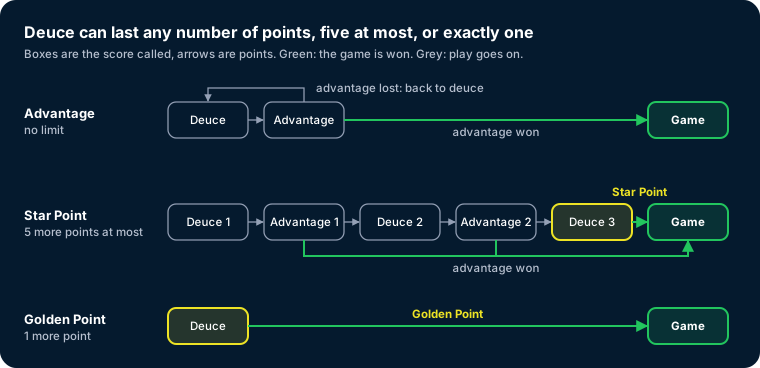
In every format the game ends as soon as a pair converts an advantage or wins the deciding point. The formats differ only in how many chances they allow.
| Format | What happens at 40–40 | Longest possible game |
|---|---|---|
| Advantage (Option 1) | A pair must win two points in a row. Lose the advantage point and it is deuce again. | No limit |
| Star Point (Option 2) | Two advantages at most. If the second is lost, one deciding point settles the game. | 11 points |
| Golden Point (Option 3) | One deciding point is played straight away. | 7 points |
Under the Star Point format the calls are numbered: deuce 1, advantage 1, deuce 2, advantage 2, deuce 3. The Star Point is the point played at deuce 3.
The Star Point is the newest option. The FIP General Assembly added it on 28 November 2025, and Premier Padel and the CUPRA FIP Tour adopted it from the start of the 2026 season (Premier Padel and FIP announcement).
The deciding point
A Star Point and a Golden Point are played the same way, and the receiving pair gets one tactical choice (Rule 1, Options 2 and 3).
- The receivers pick the side. The receiving pair chooses whether the serve comes to the right or the left service box. In practice, they choose which partner returns.
- No swapping. The receivers may not change positions to take the point. Each stays on the side they have been receiving from.
- Mixed doubles has no choice. The receiver must be the player of the same sex as the server.
- One point, one game. Whichever pair wins the point wins the game.
Games and sets
The first pair to win six games takes the set, provided it leads by two (Rule 1).
- Up to 6–4 the set ends when a pair reaches six.
- At 5–5 two more games are played. The set ends 7–5, or goes to 6–6.
- At 6–6 a tie-break decides the set, which is recorded as 7–6.
A standard set can therefore only end 6–0, 6–1, 6–2, 6–3, 6–4, 7–5 or 7–6. The first pair to win two sets wins the match.
The tie-break
At 6–6 the set is decided by a tie-break: the first pair to seven points wins, provided it leads by two (Rule 1, Tie-break). If the points reach 6–6, play continues until one pair is two ahead. Points are called as plain numbers: zero, 1, 2, 3.
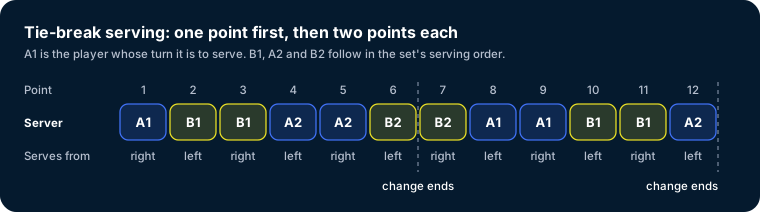
After the opening point every player serves twice, first from the left and then from the right. Odd-numbered points are therefore always served from the right.
- Who starts. The player whose turn it is in the set's serving order. That is the player who served the first game of the set (FIP case decision).
- Changing ends. Pairs swap ends every six points, with 20 seconds allowed and no rest (Rules 5.2, 2.5, 2.10).
- The next set. The pair that did not serve first in the tie-break serves first in the following set.
Match formats
The standard match is the best of three sets, each with a tie-break at 6–6. Competitions may announce one of these variations in advance (Rule 1).
| Format | How it works |
|---|---|
| Third set without tie-break | The deciding set is played until one pair leads by two games |
| Mini-set | Sets are played to four games, two clear, with a tie-break at 4–4 |
| Match tie-break | At one set all, a tie-break to 7 points, two clear, replaces the third set |
| Super tie-break | At one set all, a tie-break to 10 points, two clear, replaces the third set |
When a tie-break replaces the final set, the match's serving order carries on, but each pair may change which partner serves and receives first (FIP case decision).
Serving order and changing ends
The serve passes to the other pair after every game, and the pairs swap ends after every odd game (Rules 5, 6.8).
- Serving rotation. The four players serve in a fixed order for the whole set: A1, B1, A2, B2. Each pair decides which partner serves first when the set begins, and may change that at the start of the next set (Rule 6.8).
- Changing ends. Pairs swap ends after the first, third and every following odd game of a set (Rule 5.1). There is no rest after the first game of a set. Other changeovers allow 90 seconds, and the break between sets is 120 seconds (Rule 2).
- Between sets. Pairs swap ends at the end of a set only if its games add up to an odd number: yes after 6–3 or 7–6, no after 6–4 (FIP case decision).
- Forgot to change? Correct it as soon as someone notices. Every point already played stands (Rule 5.3).
FAQ
Is the Star Point the same as the Golden Point?
No. The Golden Point is played at the first deuce. The Star Point is played only at the third deuce, after two advantages have been played and lost.
Which format should a club match use?
The rulebook lists three options and leaves the choice to the competition. In a friendly match, agree on one before the first serve.
What is the longest possible game?
Under Advantage there is no limit. Under Star Point a game lasts 11 points at most: six to reach deuce, then five more. Under Golden Point the maximum is seven.
Who serves first in a tie-break?
The player whose turn it is to serve, which is the player who served the first game of that set. They serve one point from the right, and after that each player serves two.
Who serves first after a tie-break?
The pair that did not serve the first point of the tie-break (Rule 1, Tie-break).
Does the Golden Point decide the match?
No, only the game. The English edition of the rulebook says the pair that wins the Golden Point “wins the match”, but that is a slip: the Spanish edition says “ganará el juego”, wins the game.
What is a super tie-break?
A tie-break to 10 points, two clear, played instead of a third set when the match stands at one set all.
Sources
Every rule in this guide comes from the International Padel Federation's own documents, read on 1 October 2026.
- FIP Rules of Padel, review of application 01.01.2026. The current official rulebook. Rule 1 covers scoring, Rule 2 times and Rule 5 changes of ends.
- FIP Reglas del Pádel, revisión de aplicación 01.01.2026. The Spanish edition, used to check the Golden Point wording.
- FIP Rules of Padel, earlier PDF with case decisions. Source of the rulings marked “FIP case decision”. The current edition no longer prints these cases.
- Premier Padel and FIP announcement of the Star Point, December 2025.
The longest-game figures are counted from the rules: six points to reach deuce, plus five under Star Point or one under Golden Point.