

Padel Serve Rules: The Complete Guide
The padel serve is underhand: you bounce the ball behind the service line and hit it at or below waist height, diagonally into the opposite service box. Where you stand, where the ball lands and what it touches next decide whether the serve is good, a let or a fault. This guide follows Rules 6 to 9 of the FIP Rules of Padel, the edition in force since 1 January 2026.
The first section is enough for most matches. The rest answers the questions that come up when a serve is disputed. For everything else, see the complete padel rules guide and the padel scoring guide.
The serve in 30 seconds
- Start from the right. Serve the first point of each game from the right side, then alternate sides every point.
- Stand behind the service line, between the centre line and the side wall, without touching either line.
- Bounce, then hit low. Bounce the ball behind the line and hit it at or below your waist, with at least one foot on the ground.
- Go diagonal. The ball must bounce inside the opposite service box. The lines are in.
- Glass is fine, fence is not. After the bounce the serve may hit the glass, but not the metal fence before its second bounce.
- Two attempts. A serve that clips the net and lands in is replayed. Two faults in a row lose the point.
A legal serve, step by step
A serve is legal when five things go right in order: position, bounce, contact, direction and landing (Rule 6).
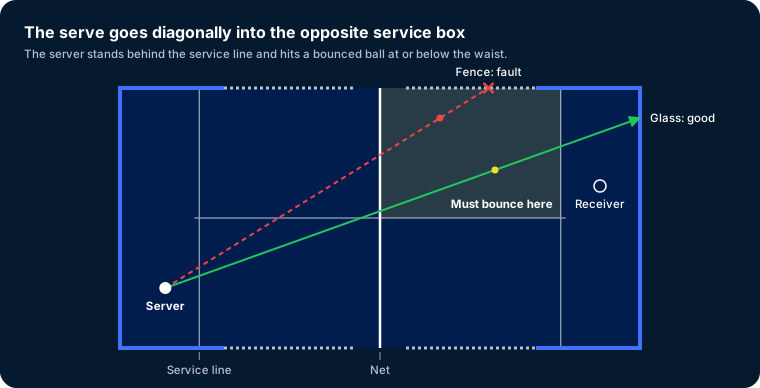
The green serve bounces in the box and reaches the glass, which is good. The red one bounces in the box but touches the side fence before its second bounce, which is a fault.
- Position. Stand behind the service line, between the centre line and the side wall, and stay there until you have hit the ball (Rule 6.1).
- Bounce. Bounce the ball on the floor behind the service line, on your side of the centre line. The ball may not cross either line before you hit it (Rule 6.2).
- Contact. Hit the ball at or below waist height, with at least one foot touching the ground (Rule 6.4). If you bend your knees, the limit is your waist at that moment (FIP case decision).
- Direction. Send the ball diagonally over the net towards the opposite service box. The first point of each game is served from the right, the next from the left, and so on (Rule 6.5).
- Landing. The first bounce must be inside that box, and a ball on the line is good (Rule 7c). After the bounce the ball may hit the glass, but if it touches the metal fence before bouncing again, it is a fault (Rule 7e).
A swing counts as a serve. Once you hit the ball, or try to and miss, the serve has been taken (Rule 6.6). The rules set no other limits on the stroke, so forehand, backhand, slice and spin are all allowed.
Where the server may stand
Until the ball is struck, the server's feet and the ball must stay in one zone: behind the service line, on the correct side of the centre line (Rules 6.1 to 6.3).
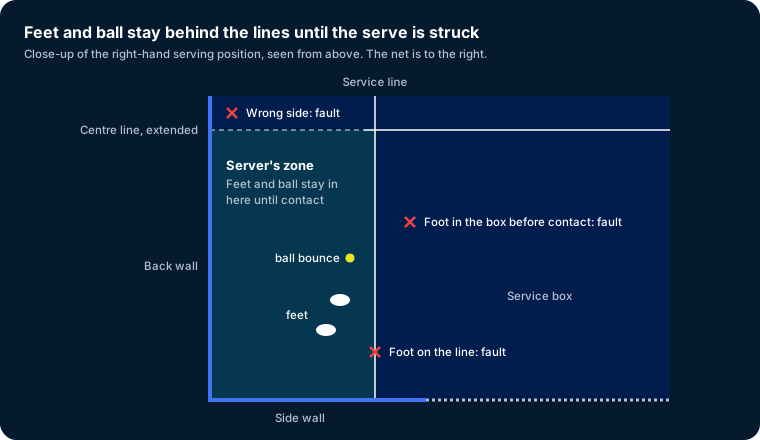
The zone runs from the service line back to the wall, and from the imaginary extension of the centre line across to the side wall.
- Feet. Neither foot may touch the service line, the extension of the centre line or the service box in front of you until you have hit the ball (Rule 6.3).
- Ball. The ball must bounce inside the same zone and may not cross either line before you hit it (Rule 6.2).
- Contact. At least one foot must be on the ground when you hit the ball, so a serve struck with both feet in the air is a fault (Rule 6.4).
- After contact. Once the ball is struck the restrictions end, and you are free to move forward.
Good, let or fault?
Every serve ends one of three ways, and four questions settle which (Rules 7, 9).
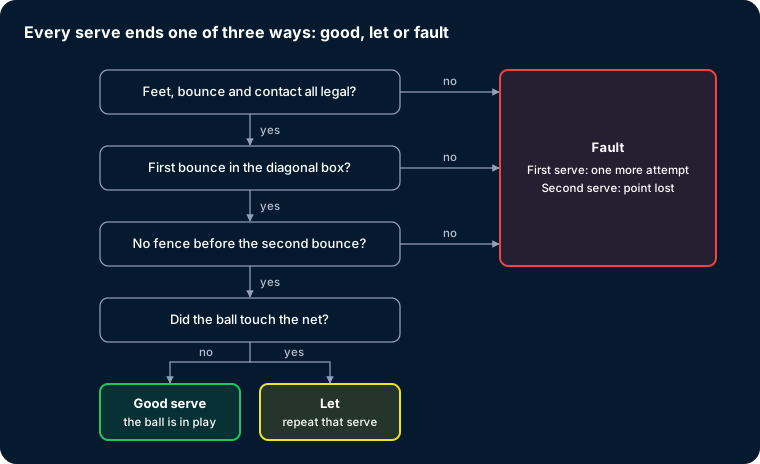
A let costs nothing, because the same serve is taken again. A fault on the first serve leaves one more attempt. A fault on the second loses the point (Rule 13q).
The let rules in full (Rule 9):
- Net, then in. A serve that touches the net or a post and lands in the correct box is a let, as long as it does not reach the fence before its second bounce.
- Net, then a player. A serve that touches the net or a post and then hits any player, or anything a player wears or carries, is also a let.
- Receiver not ready. The serve is replayed. A receiver who tries to return the ball cannot claim to have been unready (Rule 6.11).
- How many serves you get. After a let on the first serve you still have two serves. After a let on the second you repeat only the second.
- Net, box, then fence. This is a fault, not a let (Rules 9.1a, 7e).
Service faults: the full list
A serve is a fault if it breaks any of the serving conditions in Rule 6 or meets any of the cases in Rule 7.
| The serve is a fault if… | Rule |
|---|---|
| You stand outside the serving zone, or leave it before hitting the ball | 6.1 |
| The ball does not bounce behind the line, or crosses a line before you hit it | 6.2 |
| A foot touches the service line, the centre-line extension or the service box before contact | 6.3 |
| You hit the ball above your waist | 6.4 |
| Both feet are off the ground at contact | 6.4 |
| The first bounce is outside the diagonal service box | 6.5, 7c |
| You swing at the ball and miss | 7b |
| The ball hits you, your partner or anything either of you wears or carries | 7d |
| The ball bounces in the box and touches the metal fence before its second bounce | 7e |
| The ball bounces in the box and leaves through the door, on a court without out-of-court play | 7f |
Two older FIP case decisions settle common arguments:
- Your own walls are off limits. A serve that touches the wall, the fence or a light on your side before crossing the net is a fault, even if it then lands in the correct box.
- A lob serve over the top is fine. A serve that bounces in the box and goes straight out over the fence is not a fault.
Returning serve
The receiver must let the serve bounce in the service box and hit it before it bounces a second time (Rule 8.1).
- No volleys. The receiver may not volley the serve, even when standing outside the service box (FIP case decision).
- Before or after the glass. After the bounce the receiver may hit the ball straight away or wait for it to come off the glass. If it bounces twice, even with a wall in between, the server wins the point (FIP case decision).
- Hit by the serve. If the ball strikes the receiver or the receiver's partner, or their rackets, before it bounces, the server wins the point (Rule 8.5).
- Position. The receiver may stand anywhere on their own side of the court. So may the receiver's partner and the server's partner (Rule 3.2).
- Receiving order. In the first game of each set the receiving pair decides who receives first. That player receives the first serve of every game in the set, and the partners alternate point by point (Rules 8.2, 8.3).
Serving order, sides and mistakes
The four players serve in a fixed rotation for the whole set, and each game starts from the right (Rules 6.5, 6.8).
- Rotation. The order is A1, B1, A2, B2. Each pair decides which partner serves first when the set begins, and the order cannot change until the next set.
- Sides. The first point of every game is served from the right, the second from the left, and so on.
Mistakes happen. The rules keep the points already played and fix the order going forward.
| Mistake | What happens | Rule |
|---|---|---|
| Served from the wrong side | Corrected as soon as it is noticed. All points stand, and so does a fault already served | 6.7 |
| Served out of turn | The correct player takes over as soon as it is noticed. All points stand, but a single fault served before the discovery is cancelled | 6.9 |
| A whole game served out of turn | The changed order stays until the end of the set | 6.9 |
| Receivers swapped sides | They finish that game or tie-break as they are, then return to their original sides | 8.4 |
Readiness and the clock
The server may not serve until the receiver is ready, and the receiver must keep to the server's reasonable pace (Rule 6.10).
- Not ready. If the receiver was not ready, the serve is replayed and no fault can be called. A receiver who attempts a return cannot then claim to have been unready (Rules 6.11, 9.2a).
- 20 seconds. That is the maximum time between points (Rule 2.4).
- No pause between serves. After a first-serve fault the second serve follows without a break (FIP case decision).
- Slow play. The first time violation earns a warning. On the second, the serving pair loses its first serve (Etiquette: Continuous play).
Deciding points and tie-breaks
Two situations change who receives or how many points you serve. The serving action itself stays the same.
- Star Point and Golden Point. On a deciding point the receiving pair chooses whether the serve goes to the right or the left box. In mixed doubles the receiver must be the same sex as the server (Rule 1).
- Tie-break. The player whose turn it is serves the first point from the right. After that each player serves two points in a row, the first from the left and the second from the right (Rule 1, Tie-break).
The padel scoring guide covers both in detail.
How to serve well
The rules leave the stroke itself open, so the aim is a serve that is reliable, deep and hard to attack, not a fast one.
- Keep the first serve in. There is little to gain from gambling: a fast serve still has to bounce low and below waist height, and a missed first serve only gives the receiver an easier second one.
- Aim deep, towards the glass. A serve that bounces near the back of the box and runs into the side or back glass makes the receiver play off the wall, which is harder to attack.
- Vary the target. Serving into the middle or at the receiver's body cuts the angles available on the return. Serving wide towards the side glass pulls the receiver out of position.
- Add slice. Backspin keeps the bounce low and makes the ball come off the glass less predictably. A high, floating serve sits up and is easy to attack.
- Follow it to the net. The serving pair normally takes the net straight after the serve, so finish the stroke moving forward and get ready to volley.
FAQ
Can you serve overhand in padel?
No. The ball must be bounced and then struck at or below waist height (Rules 6.2, 6.4), which rules out a tennis-style overhead serve.
Is a drop serve legal in padel?
Yes. Every padel serve is a drop serve: you drop the ball, let it bounce behind the service line and hit it at or below waist height (Rules 6.2, 6.4).
Can you volley a serve in padel?
No. The receiver must let the serve bounce in the service box before hitting it (Rule 8.1). If the serve touches the receiver or the receiver's racket before it bounces, the server wins the point (Rule 8.5).
What counts as the waist?
The rulebook only says the ball must be at or below waist level when you hit it. If you bend your knees, the limit is your waist at that moment, not your standing height (FIP case decision).
Can the serve hit the glass or the fence?
Glass, yes: once the serve has bounced in the correct box it may hit the glass. Fence, no: if it touches the metal fence before its second bounce, it is a fault (Rule 7e).
What happens if the serve hits the net?
If it then lands in the correct box and stays off the fence until its second bounce, it is a let and you serve again. If it lands anywhere else, it is a fault (Rule 9.1).
Is there a limit on lets?
No. The rules set no limit, so a serve is replayed every time it is a let.
Can you jump or walk while serving?
At least one foot must be on the ground when you hit the ball, and your feet must stay in the serving zone, off the lines, until then (Rules 6.1, 6.3, 6.4).
Where can the server's partner stand?
Anywhere on their own side of the court (Rule 3.2). Nobody may stand outside the court during the serve (FIP case decision).
Sources
Every rule in this guide comes from the International Padel Federation's own documents, read on 1 October 2026.
- FIP Rules of Padel, review of application 01.01.2026. The current official rulebook. Rule 6 covers the serve, Rule 7 faults, Rule 8 the return and Rule 9 lets.
- FIP Documents page. Where FIP publishes the current rulebook and competition regulations.
- FIP Rules of Padel, earlier PDF with case decisions. Source of the rulings marked “FIP case decision”. The current edition no longer prints these cases.
This guide follows the FIP rulebook. National federations and individual tournaments may publish additional regulations, so check those before you compete.