


FIP World Cup 2026 Qualifiers: Who Made It to Doha and How
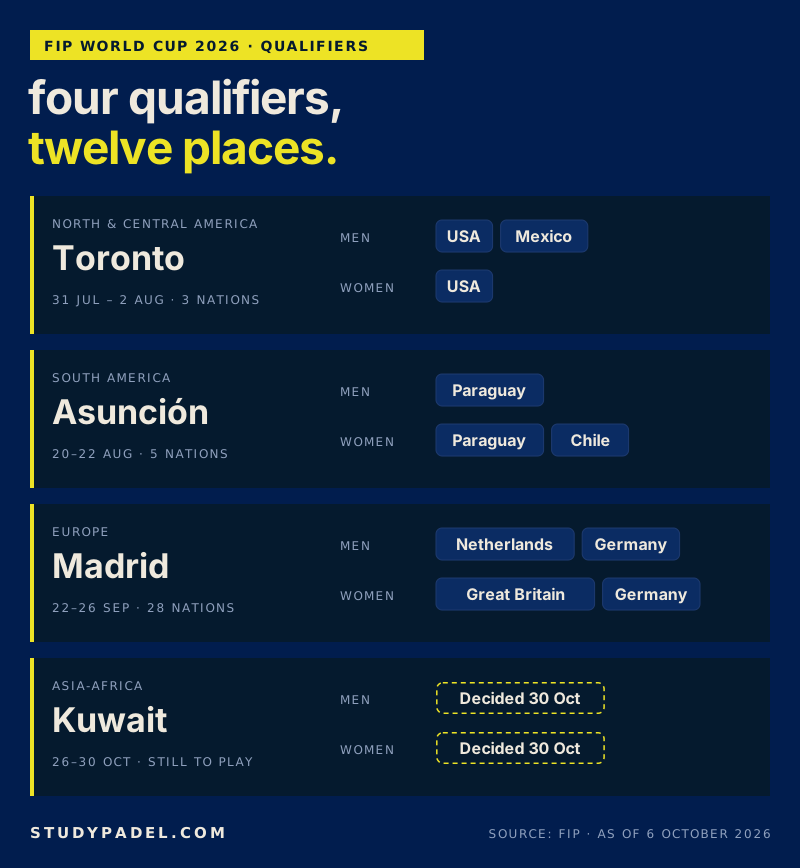
Four qualifying tournaments on four continents, twelve places at stake, ten of them now filled. Germany needed almost six hours of play to get past Great Britain, the same Paraguayan pair won three deciding matches in three days, and Chile qualified on a night they lost. This is how each region chose its teams for Doha, and what is still to play.
The 2026 FIP World Cup runs from 2 to 7 November in Doha with 16 men’s and 16 women’s national teams. It is the tournament known until 2024 as the World Padel Championships, and its history goes back to 1992.
Teams qualified for the 2026 Padel World Cup
Men (15 of 16): Argentina, Spain, Portugal, Italy, UAE, Brazil, France, Chile, Sweden, Qatar, USA, Mexico, Paraguay, Netherlands and Germany. The last place goes to the winner of the Asia-Africa qualifier on 30 October.
Women (15 of 16): Spain, Argentina, Italy, Portugal, Netherlands, Sweden, France, Brazil, Belgium, Qatar, USA, Paraguay, Chile, Great Britain and Germany. The last place goes to the winner of the Asia-Africa qualifier on 30 October.
How qualification for the 2026 World Cup works
Ten of the sixteen places in each draw were handed out before a ball was hit: nine to the best-placed nations of the 2024 edition and one to Qatar as host. The other six were spread across four regional qualifiers.
| Route | Men | Women |
|---|---|---|
| Top nine of 2024 | Argentina, Spain, Portugal, Italy, UAE, Brazil, France, Chile, Sweden | Spain, Argentina, Italy, Portugal, Netherlands, Sweden, France, Brazil, Belgium |
| Host | Qatar | Qatar |
| North & Central America (Toronto, 31 July to 2 August) | USA, Mexico | USA |
| South America (Asunción, 20 to 22 August) | Paraguay | Paraguay, Chile |
| Europe (Madrid, 22 to 26 September) | Netherlands, Germany | Great Britain, Germany |
| Asia-Africa (Kuwait, 26 to 30 October) | One place, still to be decided | One place, still to be decided |
The split is not the same for men and women. North and Central America had two men’s places and one women’s, and South America the reverse. FIP has not published the reasoning. The US federation says the number of places per qualifier is set by how each region’s nations finished at the previous World Cup.
One thing is common to every qualifier. A tie between two nations is three doubles matches, and in the round-robin groups a team earned two points for winning a tie and one for losing it.
North and Central America: the USA take both, Mexico’s women miss out again
Mississauga, near Toronto, 31 July to 2 August. Canada, Mexico and the USA in both draws.
| Men | Women |
|---|---|
| USA 3–0 Canada | Mexico 3–0 Canada |
| Mexico 3–0 Canada | USA 3–0 Mexico |
| USA 2–1 Mexico | USA 3–0 Canada |
The women’s draw was the one with real jeopardy: three teams, one place. The USA took control on the Saturday by beating Mexico 3–0 and finished the job on the Sunday with a 3–0 win over Canada. The match that mattered most was the second of the Mexico tie, where Daniela Ruiz Alvarez and Sofia Adamowich beat Natalia Blanco and Renata Martínez 6-4, 1-6, 6-3. That middle set was the only one the American women lost all weekend.
There was a subplot in the first match of that tie. Brittany Dubins of the USA and Camila Ramme of Mexico are partners on the professional tour. In Mississauga they stood on opposite sides, and Dubins won.
“I couldn’t be more proud of this team and having the honor to represent the USA by wearing Red, White, and Blue!” Dubins told FIP.
For Mexico’s women, bronze medallists in 2002, it is a second World Cup in a row watched from home. Both times the place has gone to the USA.
The men’s draw was decided a day early. Both the USA and Mexico beat Canada 3–0, so both had qualified before they met on the Sunday. That tie, for first place only, was still the best of the weekend. Mexico won the opening match. Matias Segura and Nico Agritelley levelled from a set down, 6-7, 6-1, 6-1. Raul Ruiz Alvarez and Jose Antonio De Armas, who is 45, then won the third match 6-4, 6-7, 7-6. USA Padel reports the final tie-break as 8–6.
It reversed the result of the 2024 qualifier in Monterrey, where Mexico’s men beat the USA 3–0.
South America: a double for Paraguay, and Chile qualify while losing
Asunción, 20 to 22 August. Four men’s teams for one place, five women’s teams for two.
Argentina, Brazil and Chile’s men were already in Doha on the strength of 2024, which left Paraguay, Uruguay, Ecuador and Venezuela to play for a single men’s place.
The men’s event became a straight final. Paraguay and Uruguay each won their first two ties 3–0 and met on the last day. Pierre Petit and Sebastián Rodríguez won the only close match, 7-6, 6-4, and Martín Abud and Samuel Miltos finished it 6-2, 6-0. FIP’s report says Paraguay qualified “without conceding a single match”. One of their players, Facundo Dehnike, won his match on day two 6-0, 6-1. According to his FIP profile, it was his 18th birthday.
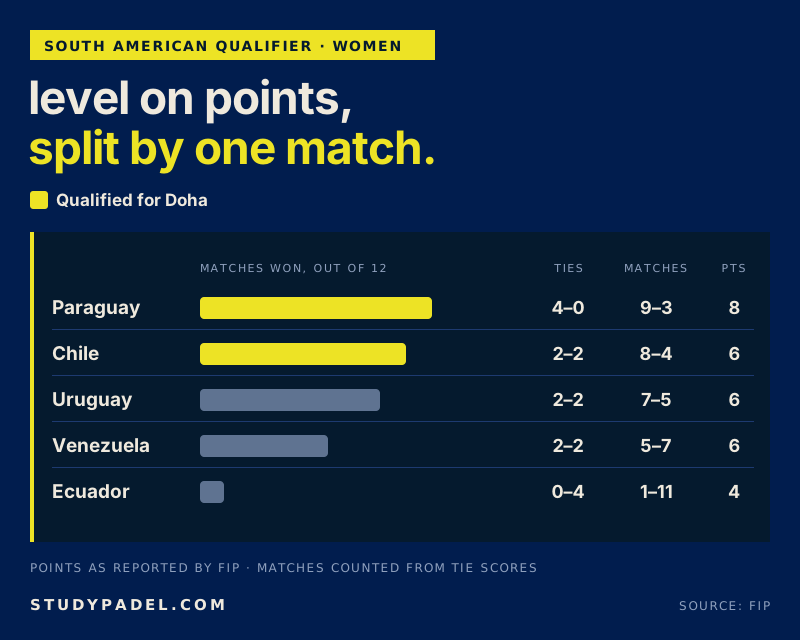
The women’s event was far tighter.
| Final table, women | Ties won–lost | Matches won–lost | Points |
|---|---|---|---|
| Paraguay | 4–0 | 9–3 | 8 |
| Chile | 2–2 | 8–4 | 6 |
| Uruguay | 2–2 | 7–5 | 6 |
| Venezuela | 2–2 | 5–7 | 6 |
| Ecuador | 0–4 | 1–11 | 4 |
Points are as reported by FIP. Matches are counted from the tie scores.
Paraguay won all four ties, but three of them 2–1, and the same pair won the deciding match every time. Mariana Salsamendi and María Alejandra García Vera beat Uruguay 6-7, 7-6, 6-4, beat Chile 4-6, 6-1, 7-6 and beat Ecuador 6-0, 6-1. They also won the match against Venezuela that secured first place.
Second place came down to arithmetic. Chile, Uruguay and Venezuela all finished on six points, and FIP says Chile went through “thanks to the better score across the individual matches”. The twist is how it ended. Chile’s last tie was against Uruguay, and Chile lost it 2–1. On the numbers in the table, a 3–0 win would have sent Uruguay to Doha. The one match Chile won that night was the difference.
So Paraguay qualified both teams at home, eight years after Asunción staged a World Championship whose men’s final was never played. The women return to the World Cup for the first time since 2022. Their squad included Verónica Cepede Royg, the former tennis international. “¡Estamos clasificados para el Mundial!” Abud told FIP. “Todo el equipo hizo un gran trabajo.” We have qualified for the World Cup, and the whole team did a great job.
The loser of the week was Uruguay. The country that won bronze medals in the first editions, and finished 12th in both draws in 2024, will not be in Doha at all.
Europe: 47 teams, four places and one tie with almost six hours of play
Madrid, 22 to 26 September. Twenty-seven men’s teams and twenty women’s teams, two places in each draw.
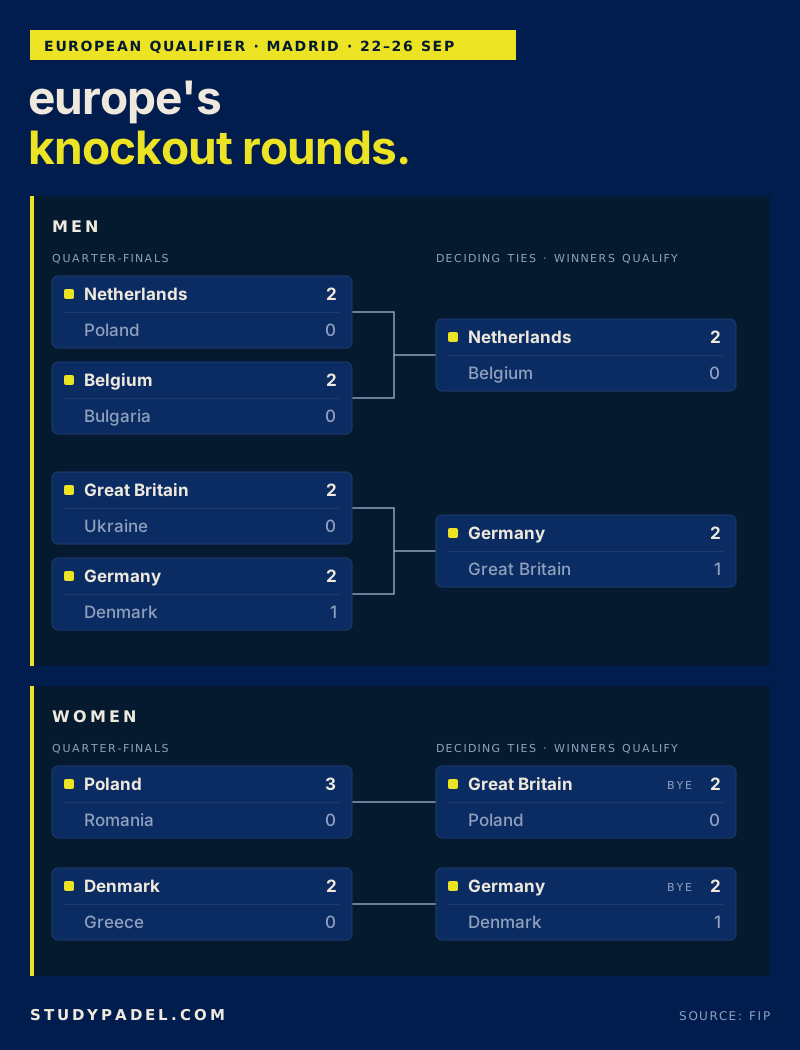
Europe’s qualifier was by far the biggest. FIP announced 55 teams in August, and 47 took the court at Pádel G24. Only group winners went through. The eight men’s group winners played quarter-finals and then two deciding ties. In the women’s draw, Great Britain and Germany won the two seeded groups and went straight to the deciding ties.
| Quarter-finals | Deciding ties | |
|---|---|---|
| Men | Netherlands 2–0 Poland; Belgium 2–0 Bulgaria | Netherlands 2–0 Belgium |
| Men | Great Britain 2–0 Ukraine; Germany 2–1 Denmark | Germany 2–1 Great Britain |
| Women | Poland 3–0 Romania | Great Britain 2–0 Poland |
| Women | Denmark 2–0 Greece | Germany 2–1 Denmark |
The Netherlands: ten matches, ten wins
The Dutch men did not lose a match all week. They opened by beating Azerbaijan without dropping a game, three matches of 6-0, 6-0. The deciding tie was against Belgium, who had not lost a match either. Sten Richters and Thijs Roper lost the first set to Maxime De Roose and Clément Geens and won 5-7, 6-4, 7-6 after an hour and fifty minutes. Youp de Kroon and Julian Prins closed it out 6-3, 6-4.
The Netherlands finished 10th in 2024, their best result. Belgium, 9th, 6th and 11th at the last three editions, miss out.
Germany’s men: two deciders in two days
Germany won both knockout ties 2–1, and both times the third match was won by Christian Böhnke and Nick Merten.
The tie against Great Britain will be remembered. All three matches went to three sets, with close to six hours of play. Sam Jones and Chris Salisbury won the first set of the opener and served for the match at 6–5 in the second. Germany’s Johannes Lindmeyer and Benjamin Fitzon took the tie-break and then the third set. Alex Loughlan and Louie Harris levelled the tie by winning two tie-breaks, 4-6, 7-6, 7-6. Then Böhnke and Merten came from a set down to beat Alfonso Patacho and Christian Medina Murphy 4-6, 7-6, 6-4.
There was history in it. At the 2022 qualifier in Derby, Great Britain beat Germany for the last World Championship place, and Medina Murphy and Jones won the deciding match against Vincent Jülich and Daniel Lingen. In Madrid, Medina Murphy and Jones were on the losing side. Jülich was in the German squad. And Lingen had already had a good day.
Germany’s women: from 0–1 down
Lingen now coaches Germany’s women, and they had qualified earlier the same day. Denmark won the first match. Victoria Kurz and Milla Blaschke levelled, 6-3, 6-7, 6-4, after the Danes had saved a match point in the second-set tie-break. Lena Plümer and Katharina Hering then won the decider 6-0, 6-2.
“Mit der Aufstellung heute habe ich einen Glücksgriff gelandet, aber es fühlt sich umso besser an, wenn der Plan aufgeht,” Lingen said. Roughly: I struck lucky with today’s line-up, but it feels all the better when the plan works.
It is the first time since 2021 that both German teams have reached the finals. Germany knocked out both Danish teams on the way. Denmark’s women were 10th in 2024. “Der har stået Qatar længe i min kalender, så at skulle slette den, gør da ondt,” said Maria García-Rasmussen. Qatar has been in my calendar for a long time, and having to delete it hurts.
Great Britain’s women: back after five years, with a famous coach
Great Britain’s women needed three tie wins and got them without losing a match. In the deciding tie against Poland, Aimee Gibson and Catherine Rose won 6-0, 6-2, and Chloe de la Mare and Victoria Nicholas won 6-3, 3-6, 6-4. De la Mare is 16, from Guernsey, and was making her debut.
It is their first World Cup since 2021 and, according to the LTA, the first time they will go without the men’s team. On the bench, alongside Libby Fletcher, was Icíar Montes, the five-time world pairs champion who coached Spain’s women to the title as recently as 2024. “It’s not easy to make it into the top 16 teams in the world,” Montes said.
Also in Madrid
- A Wimbledon semi-finalist. Poland’s men were captained by Jerzy Janowicz, who reached the last four at Wimbledon in 2013. He lost his quarter-final match against the Dutch.
- The team that was not on the list. Bulgaria did not appear among the teams FIP announced in August. Their men won a group with Finland and Norway, both ties 2–1, before losing to Belgium.
- The Nordic picture. Sweden were already qualified in both draws. Denmark’s men lost to Germany in the quarter-finals and Denmark’s women lost to Germany in the deciding tie. Norway’s men lost 2–1 to both Finland and Bulgaria. Norway’s women beat Serbia 3–0 and lost 3–0 to Great Britain.
- A complaint about timing. The Danish and Finnish federations both criticised how late the dates and venue were confirmed, on 7 August, six and a half weeks before play. Finland’s federation said it was the reason it could not send a women’s team.
Asia-Africa: the last two places
Kuwait, 26 to 30 October. One men’s place and one women’s place.
The last qualifier ends three days before the World Cup starts. FIP has not yet published the list of teams.
On the men’s side, two of the region’s leading teams are not involved. The UAE finished fifth in 2024 and Qatar are hosts, so both are already in Doha. That removes the winner of the 2024 qualifier and opens the door to the teams behind them. In 2024 the UAE beat Australia 2–1 in the final, with Iran third and Egypt fourth.
On the women’s side there is a squeeze. In 2024 the region had two places, and Japan and Egypt took them. This time there is one, so at most one of them can return. Japan won that 2024 qualifier and arrive in form: Kae Tokumoto and Saki Tsukamoto won the women’s gold medal at the Asian Games in Nagoya on 3 October.
Who is new and who is out
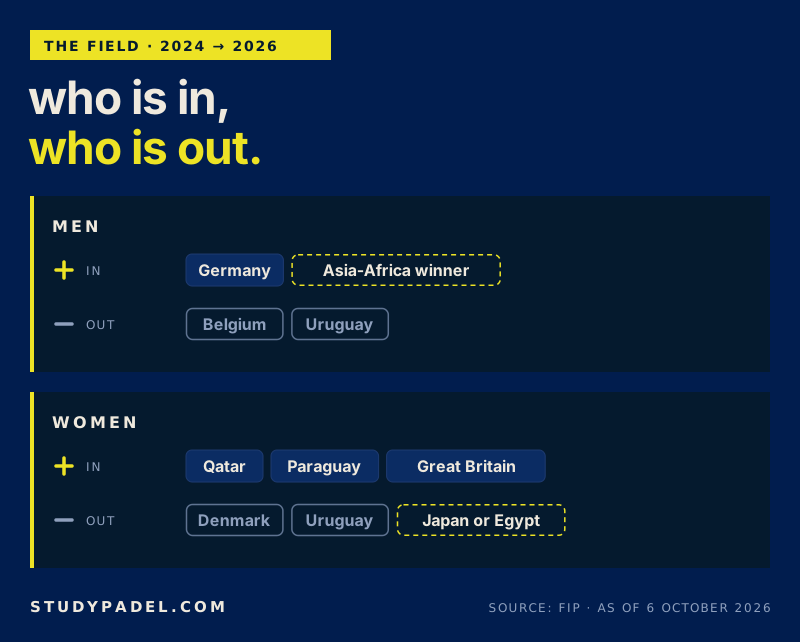
Compared with 2024, the men’s field barely changes. Fourteen of the sixteen teams are the same. Germany come in, Belgium and Uruguay drop out, and whoever wins in Kuwait will be new as well.
The women’s field changes more. Qatar, Paraguay and Great Britain come in. Denmark and Uruguay drop out, along with at least one of Japan and Egypt.
What happens next
The Asia-Africa qualifier completes the field on 30 October. FIP has not yet published the groups. Sweden’s federation says there will be four groups of four in each draw, with the top two going through, and that the draw will be made the day before play begins.
Squads are being named. Spain, France, Italy, Portugal, Sweden, Brazil and Paraguay have announced theirs. Argentina, the defending men’s champions, had not as of 6 October.
Follow the Padel World Cup 2026 on StudyPadel for the draw, schedule and results as they are published.
Sources
- International Padel Federation: qualification system and Americas qualifiers; Toronto reports for day 1, day 2 and day 3; Asunción reports for day 1, day 2 and day 3; Madrid preview and final report; European qualifier event page and official results; Asia-Africa announcement; 2024 Asia-Africa qualifier final; Asian Games finals; 2024 North American qualifier.
- USA Padel: report from Toronto and qualifier preview.
- LTA Padel: results from Madrid, the women’s qualification, Icíar Montes and the 2022 qualifier.
- Deutscher Padel Verband: qualification report. tennisnet: German teams qualify.
- NL Padel: the Dutch men qualify. Actu Padel: Belgium eliminated.
- Dansk Padel Forbund: the women’s defeat and the qualifier announcement. Suomen Padelliitto: player selections. Norges Tennis- og Padelforbund: Norway’s qualifier.
- The Padel Paper: Great Britain in Madrid. El Neverazo: 2024 final standings.
- Svenska Padelförbundet: Sweden’s women’s squad, the format and the draw date.
- International Padel Federation, background: roll of honour, 2024 men’s standings, 2024 women’s standings, 2024 Asia-Africa women’s qualifier, the August announcement of the European qualifier.
- Polska Federacja Padla: Poland’s men’s team. Comité Olímpico Paraguayo: Paraguay’s double qualification.
- Squad announcements: Spain, France, Italy, Portugal, Paraguay.