


Padel World Cup History: All Winners and Finals Since 1992
The 2026 FIP World Cup starts in Doha on 2 November. It will be the 18th edition of padel’s national-team world championship, an event that began with a glass court stuck in Spanish customs and has since produced boycotts, a tournament its own federation disowned, a final nobody played and 34 years of Argentina against Spain. This is the full story.
One name first. From 1992 to 2024 the event was officially the World Padel Championships, and in Spanish it has always simply been el Mundial. For 2026 the International Padel Federation (FIP) has rebranded it as the FIP World Cup. It is the same tournament: national teams, men and women, normally every two years.
Padel World Cup winners at a glance
- First edition: 1992, in Madrid and Seville.
- Editions played: 17. The 2020 edition was postponed and played in 2021.
- Men’s titles: Argentina 12, Spain 4. The 2018 title is vacant.
- Women’s titles: Spain 9, Argentina 8.
- Other champions: none. No other nation has ever won a team title.
- Ever-present: Argentina has finished first or second at every edition, men and women.
- Next edition: 2 to 7 November 2026 in Doha, Qatar.
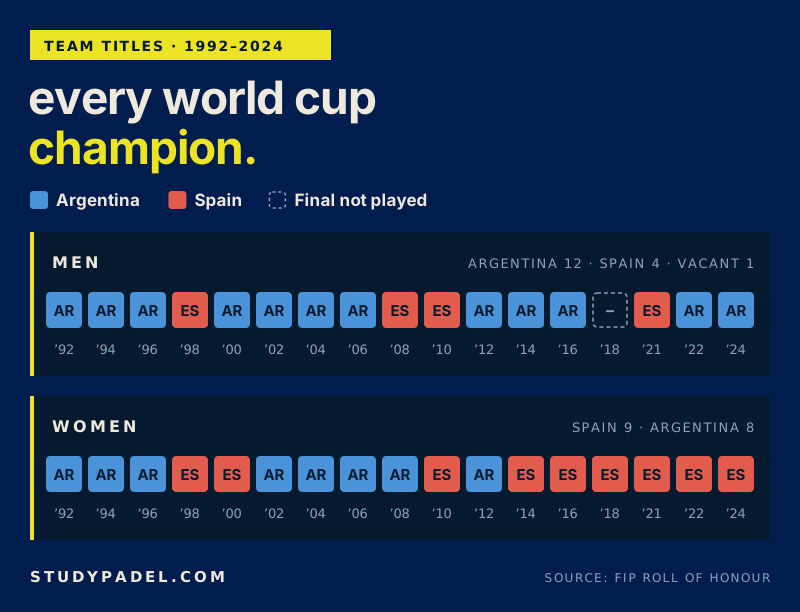
Every Padel World Cup final since 1992
A tie is three doubles matches. In the earlier editions all three were played even when the tie was already won. In recent finals play has stopped once a team had two wins, which is why some scores read 2–0.
| Year | Host | Men’s final | Women’s final | Third place (men / women) |
|---|---|---|---|---|
| 1992 | Madrid and Seville, Spain | Argentina 3–0 Spain | Argentina 3–0 Spain | Uruguay / Uruguay |
| 1994 | Mendoza, Argentina | Argentina 3–0 Spain | Argentina 3–0 Spain | Uruguay / Uruguay |
| 1996 | Madrid, Spain | Argentina 3–0 Spain | Argentina 3–0 Spain | Brazil / Uruguay |
| 1998 | Mar del Plata, Argentina | Spain beat Argentina* | Spain ahead of Argentina (final group) | Brazil / Uruguay |
| 2000 | Toulouse, France | Argentina 3–0 Spain | Spain 3–0 Argentina | Brazil / Brazil |
| 2002 | Mexico City, Mexico | Argentina 3–0 Spain | Argentina 2–1 Spain | Brazil / Mexico |
| 2004 | Buenos Aires, Argentina | Argentina 3–0 Spain | Argentina 2–1 Spain | Brazil / Brazil |
| 2006 | Murcia, Spain | Argentina 3–0 Brazil | Argentina 2–1 Spain | Spain / Brazil |
| 2008 | Calgary, Canada | Spain 3–0 Argentina | Argentina 3–0 Spain | Brazil / Brazil |
| 2010 | Riviera Maya, Mexico | Spain 2–1 Argentina | Spain 2–1 Argentina | Brazil / Brazil |
| 2012 | Riviera Maya, Mexico | Argentina 2–1 Brazil | Argentina beat Brazil | Paraguay / France |
| 2014 | Palma de Mallorca, Spain | Argentina 2–1 Spain | Spain 3–0 Argentina | Paraguay / Portugal |
| 2016 | Cascais, Portugal | Argentina 2–1 Spain | Spain 3–0 Argentina | Brazil / Brazil |
| 2018 | Asunción, Paraguay | Not played, title vacant | Spain 2–0 Argentina | Brazil / Portugal |
| 2021 | Doha, Qatar | Spain 2–0 Argentina | Spain 2–0 Argentina | Brazil / Italy |
| 2022 | Dubai, UAE | Argentina 2–1 Spain | Spain 2–0 Argentina | France / Italy |
| 2024 | Doha, Qatar | Argentina 2–1 Spain | Spain 2–0 Argentina | Portugal / Italy |
*The contemporary bracket shows 2–1. Some later lists print 3–1, which is not a possible score in a three-match tie.
Before the World Cup: a holiday game becomes Argentina against Spain
Padel started as a private pastime. Enrique Corcuera built the first court at his house in Acapulco in 1969. His friend Alfonso de Hohenlohe took the idea to the Marbella Club in the 1970s, and one of Marbella’s regulars, the Argentine Julio Menditeguy, carried it home. By the late 1980s Argentina was the sport’s powerhouse.
The rivalry that defines the World Cup began in January 1988, when a Spanish party of 16 travelled to Argentina for the first Spain v Argentina series. Argentina returned the visit that August. The other key invention came from Argentina a year later: a transportable court with glass walls, which let padel be played in front of proper crowds.
On 12 July 1991 the associations of Argentina, Spain and Uruguay founded the International Padel Federation in Madrid. Its first president was Julio Alegría, from Bilbao, and the first item on his list was a world championship. “Me puse cabezón y conseguimos sacar adelante el Mundial,” he told the Spanish federation years later. Roughly: I dug my heels in and we got the World Cup off the ground.
1992: a glass court stuck in customs
The first World Cup was squeezed into the week of 21 to 27 September 1992, six weeks after the Barcelona Olympics and during Expo '92. The early rounds were played at Club de Golf La Moraleja outside Madrid. The semi-finals and finals moved to Seville and onto a glass court brought over from Argentina.
That court nearly did not arrive. It was held by customs in Seville. According to Alegría, tournament director Arturo Jiménez paid 800,000 pesetas out of his own pocket to release it and was repaid later. A gin brand, Beefeater, put up 10 million pesetas, and Prince Felipe, now King Felipe VI, was honorary president.
Eight men’s teams took part: Argentina, Spain, Uruguay, Great Britain, Paraguay, France, Mexico and Italy. Six of them sent women’s teams. Argentina won both finals 3–0 against Spain, between glass walls that the Argentines knew and the Spaniards did not. In the pairs event, all four men’s semi-final pairs were Argentine, and Alejandro Lasaigues and Roby Gattiker took the title. The surprise of the week was Great Britain, fourth in both team events.
1994 and 1996: the Lasaigues and Gattiker years
The second edition went to Mendoza in October 1994, at the height of Argentina’s padel boom. Brazil, Chile, Canada and the United States joined the field. Argentina won both team titles 3–0 again.
The match people remembered was the pairs final, brother against brother. Alejandro Lasaigues and Gattiker beat Hernán Auguste and Mariano Lasaigues in a third-set tie-break, inside a covered stadium. Mariano remembers “4,500 people packed into a bubble”. In the semi-finals the champions had beaten a pair that included a teenage Argentine named Juan Martín Díaz. Remember the name.
Madrid hosted in 1996, at Club de Campo Villa de Madrid. Argentina completed a third straight double, Brazil’s men reached the podium for the first time, and Spain finally put a pair in a world final. Pablo Semprún and Alberto Rodríguez Piñón took Lasaigues and Gattiker to a third set. Lasaigues remembers it as 6–4, in front of 5,000 people, and has called it the title he enjoyed most.
1998: the Mar del Plata shock
For three editions Argentina had won every title on offer, team and pairs. Then the World Cup went to Mar del Plata, to the Ocean Club, one of the first clubs in Argentina to have padel courts, and Spain won almost everything.
Spain’s men beat Argentina in the final for their first world title. Spain’s women finished top of the four-team final group, ahead of Argentina, for theirs. Araceli Montero and Icíar Montes became the first Spanish pair to win the women’s pairs title. Only the men’s pairs stayed Argentine.
There was a reason. Argentina’s leading professionals were in dispute with their national federation and did not play the team event, although they did play the pairs. Alejandro Lasaigues was blunt about it three years later: “El mundial lo perdió Argentina.” Argentina lost that World Cup.
The detail that stung most was who won it for Spain. Juan Martín Díaz was born in Mar del Plata, had moved to Spain in 1997 and now played under the Spanish flag. He won the team title, with Raúl Arias, in his home town. In the same week he lost the pairs final to Gattiker and Cristian Gutiérrez, who was also born in Mar del Plata. A 19-year-old called Fernando Belasteguín went out of that pairs draw in the last 16.
2000: France’s power play and a court on the Place du Capitole
The fifth edition was the first outside Spain and Argentina, and France had to fight for it. Claude Baigts, then head of French padel, has described how his federation traded its vote in a rules dispute about serve-and-volley for a hearing on its bid, and then, in Mar del Plata, threatened to stage a rival world championship with the players who were at war with their federations. That is his account. FIP gave Toulouse the 2000 edition.
The finals were played on courts built on the Place du Capitole, the city’s main square. Argentina’s professionals were back, and the men beat Spain 3–0. Spain’s women kept their title in style, dropping only twelve games across the three matches of the final.
Argentina’s captain made one call that looks remarkable today. He left out his country’s number two pair for lack of experience. One half of it was Belasteguín, then 21. “Por un lado te da bronca,” Belasteguín said a few months later, “y por el otro te da el incentivo para seguir entrenando y mejorar día a día.” It makes you angry, and it gives you a reason to keep training and improving. He would go on to win six team titles.
Two more curiosities from Toulouse. The former French Open tennis finalist Henri Leconte was listed in France’s squad. And the men’s pairs title went to a pair who had been on opposite sides in the team final: Díaz of Spain and Auguste of Argentina.
2002 and 2004: thieves, thin air and partners on opposite sides
Mexico City 2002 was hard work. The venue was Club Lomas Sporting, at altitude, with temperatures that the on-site reporter from Padelcenter recorded as swinging from 0°C at dawn to 25°C at midday. Players paid a 10-dollar entry fee and there was no prize money. According to the same reporter it was the first World Cup to charge admission, and the early days drew almost nobody. Three Spanish players, including María Silvela, had passports, money and jewellery stolen from the hotel safe.
On court, Argentina’s men won 3–0 against a Spanish team weakened by a dispute between players and federation. It was Belasteguín’s first team title. The women’s final was the closest yet: Argentina beat Spain 2–1, and the deciding match went to a third-set tie-break. In the pairs, Icíar Montes won with the Brazilian Neki Berwig, the first world champion who was neither Argentine nor Spanish.
Buenos Aires 2004 only had its stars because of a late deal. The players’ association had warned it would stay away without prize money, and a sponsor was signed the day before entries closed. Argentina won both team titles at the Hindú Club. The men’s final carried a twist. Díaz and Belasteguín were by then partners on the professional tour and the best pair in the world. In the team final they stood on opposite sides of the net, Díaz for Spain and Belasteguín for Argentina. Belasteguín won. The next day they won the pairs title together.
2006: Brazil stun Spain in Spain
Until Murcia 2006, Argentina and Spain had filled the top two places in both events at every edition. Brazil ended that, and did it on Spanish soil. Marcello Jardim and Pablo Lima came from a set down to win the first match of the semi-final, Gervasio Del Bono and Chico Gomes won the second, and the hosts were out before the third was played. Padelcenter’s headline began with one word: “Histórico”.
Argentina beat Brazil 3–0 in the final. According to Padelcenter’s report, it had beaten Chile in the semi-final without losing a single game. Spain, in dispute with the leading professionals and without Díaz, finished third. It remains the only time Spain’s men have missed a final they entered.
The week was just as lively off the court. Padelcenter reported that the players’ association had announced 53 professionals would stay away. And on 24 October, in the middle of the tournament, FIP president Eduardo Góngora resigned. According to Spanish federation president Miguel Medina, he spoke of an “evident incompatibility” between the two bodies.
2008: a World Cup in a dome in Calgary
The ninth edition is the strangest on the list. The event went to Calgary and was played in August 2008 under an air dome at a soccer centre, to almost no spectators. Padelcenter reported that the organisers cut the internet connection during the men’s final because the event was scheduled to have finished by then.
Argentina’s stars stayed with the professional tour. By the same outlet’s account, a second squad was stood down ten days before the start over paperwork, visas and flight costs, and the team that travelled was described at home as a third selection. Spain won 3–0 for their second title. Their squad included a 19-year-old from Seville, Paquito Navarro. Belasteguín did not regret staying away. In 2010 he said the players had all agreed it was “un gran error” to play a World Cup in Canada.
Argentina’s women did better in harder circumstances. Three of them were stranded in London on the way, reached the venue at about 9.30 pm on match day, and the team still won the title 3–0.
2010: Spain sweep the board
Two years later nobody could say Argentina had stayed at home. Belasteguín, the world number one, led a squad billed at home as a Dream Team to a hotel resort on Mexico’s Riviera Maya. Spain beat them anyway.
Juani Mieres and Willy Lahoz beat Belasteguín and Maxi Grabiel 6–3, 6–1. Aday Santana and Jordi Muñoz won the second match by the same score, and the title was Spain’s at 2–0. Argentina took the dead third match. Mieres, like Díaz before him, was Argentine by birth. He comes from Bahía Blanca. Spain’s women beat Argentina 2–1 in a final decided by the third match, their first title in ten years, and Spanish pairs won both pairs events. Four titles out of four.
2012: the World Cup its own federation disowned
The 2012 edition was first due to be played in Houston, moved to the Riviera Maya, and then fell into a political fight that nearly split the sport.
Spain, the defending champion in both events, refused to send teams. A week before the start, a FIP circular told member federations the Mexican event was “not official”. The Mexican organisers replied that the circular was unsigned and had no board approval. On the eve of play, the 13 federations with voting rights that were present met at the tournament hotel and ratified the event as a World Championship. Spain and Great Britain were the two federations against it. FIP vice-president Bill Stamile said the event had always been official and the vote simply confirmed it.
So it was played, without Spain and without the tour’s stars. Argentina, with a 15-year-old Martín Di Nenno in the squad, beat Brazil 2–1 in a men’s final decided by the third match. Argentina’s women beat Brazil too, in the first women’s final without Spain. France’s women took bronze, the country’s first medal, and Brazil’s Julio Julianoti and Gervasio Del Bono won the men’s pairs.
On 19 December, at a FIP assembly in Madrid, the president resigned and the head of the Spanish federation announced that Spain was leaving FIP. It did not last. Within two years Spain was hosting the next World Cup, and FIP’s roll of honour lists 2012 like any other edition.
2014: from 1–5 down in Palma
Spain’s absence in 2012 seems to have had a side effect. Spain and Brazil were drawn into the same group in 2014, with only one team per group going through, and Padelnetwork’s explanation was that the hosts had lost their seeding by missing the previous edition. Brazil, the reigning runner-up, was out on the second day. “Nos hemos sentido bastante perjudicados,” Chico Gomes said. We feel we have been badly treated.
The final, at the Son Moix arena in Palma, was the first Argentina v Spain final since 2010, and it went the distance. Spain won the first match in three sets. Belasteguín and Cristian Gutiérrez levelled, 6–1, 6–2. In the decider, Grabiel and Sebastián Nerone won the first set on a tie-break, fell 1–5 behind in the second, came back to 5–5 and won another tie-break. Belasteguín had waited since the defeat of 2010. “Me saqué una espina de cuatro años,” he said. A thorn that had been there for four years was out.
Spain’s women beat Argentina 3–0, the first of a run that is still going. Portugal’s women took bronze.
2016: a storm, a comeback and a disqualification over a shirt
Cascais produced the best final so far. Juani Mieres and Matías Díaz won the first match for Spain 6–0, 6–1. In the second, Díaz and Navarro led Belasteguín and Sanyo Gutiérrez 5–4 in the third set and, at 15–30, were two points from the title. Argentina escaped and won 7–5. The decider went to Miguel Lamperti and Cristian Gutiérrez as a storm broke over the venue. Lamperti had been named in the 2014 squad and was ruled out at the last minute with appendicitis. It was Argentina’s tenth title.
The women’s event had its own drama. Majo and Mapi Sánchez Alayeto, the world number two pair, were disqualified before their pairs semi-final because they wanted to wear their own sponsor’s kit and not the Spanish federation’s. According to their sponsor, the match went down as a 6–0, 6–0 defeat without a ball being hit. The next day the twins won the third match of the team final as Spain beat Argentina 3–0. Sweden’s women reached the semi-finals for the first time.
2018: the final that was never played
Paraguay hosted for the first time, and the week went wrong almost from the start. Players reported food poisoning. A glass panel broke on court. A power cut stopped a semi-final in a third-set tie-break. FIP had no president when the event began, because Daniel Patti had resigned weeks earlier; Luigi Carraro was elected in Asunción during the tournament.
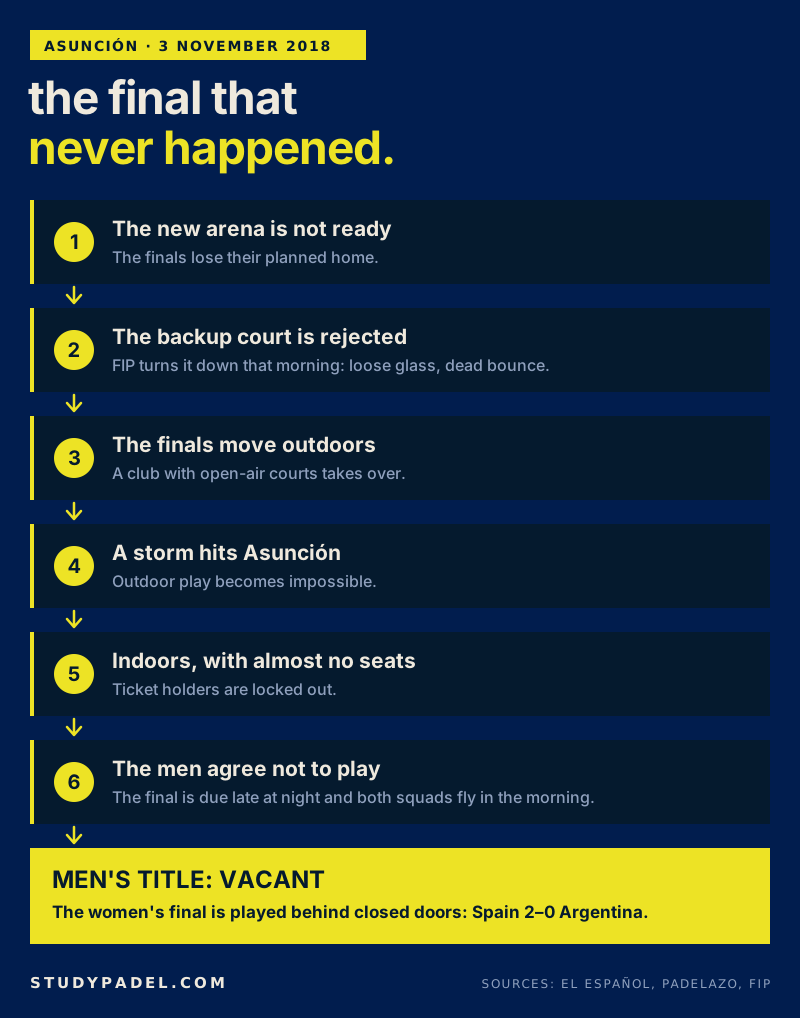
Finals day, 3 November, finished the job. The arena that was meant to host the finals was not ready. Its replacement, a court in the Olympic Committee pavilion, was rejected by FIP that morning: loose glass and a dead bounce. The finals moved to an outdoor club, a violent storm arrived, and they moved again to an indoor club with almost no seating. Reportedly more than 2,000 people who had bought tickets were locked out.
The men’s final was now due to start late at night, and both squads had morning flights to Buenos Aires for the tour’s next event. The Spanish and Argentine men agreed not to play. “Sentimos vergüenza ante tal despropósito,” said José Luis Amoroto of the Spanish federation. We felt ashamed at such a shambles.
The women’s final did go ahead, behind closed doors. Argentina’s women had wanted to join the protest, Spain’s chose to play, and Spain won 2–0. In 2020 FIP’s appeals committee confirmed a fine of 3,000 euros and a public reprimand for each federation and declared the men’s title vacant. It is the only blank line in the roll of honour.
2021: Doha, a postponement and Spain’s gamble
The next edition was due in Doha in November 2020. The pandemic pushed it back a year, and it became the first World Cup played in Asia.
Spain’s coach, Juanjo Gutiérrez, went into the final with a surprise. He split the world’s number one pair, Ale Galán and Juan Lebrón. Galán and 19-year-old Arturo Coello won the first match 6–1, 7–5. In the second, Navarro and Lebrón trailed Belasteguín and Di Nenno 2–5 in the third set and won five games in a row to take it 7–5, with Navarro fighting cramp by the end. It was Spain’s first men’s title since 2010 and its fourth in all.
Spain’s women beat Argentina 2–0, although the second match lasted about three hours. Italy’s women won bronze, the country’s first World Cup medal.
2022: Dubai, a late switch and Belasteguín’s last act
The 2022 edition was awarded to Doha and then moved to Dubai in mid-September, about seven weeks before the start, with FIP citing force majeure. Qatar’s men, no longer hosts, were given a place anyway, and both draws ended up with 17 teams. It was also the first World Cup with prize money: 500,000 euros.
The men’s final began in the late afternoon and finished at about one in the morning. Lebrón and Navarro won the first match for Spain in three sets. Di Nenno and Franco Stupaczuk levelled. That left the title to Belasteguín, aged 43, and Sanyo Gutiérrez, who won 6–4, 5–7, 6–3. “No sé si éste es mi último Mundial,” Belasteguín said. I don’t know if this is my last World Cup. It was.
Elsewhere, Portugal’s men beat Brazil to reach a first semi-final, France’s men won a first medal, and Spain’s women won a fifth title in a row to draw level with Argentina on eight.
2024: two youngsters past midnight
Back in Doha, Argentina left Belasteguín out in his retirement year and put its faith in youth. The final was level at 1–1 when Valentino Libaak, 19, and Leo Augsburger, 20, both playing their first World Cup, walked out for the decider against Navarro and Mike Yanguas. They lost the first set. Late in the third set, Augsburger began cramping in both legs. They won the tie-break anyway, after midnight, for Argentina’s twelfth title.
Spain’s women played their final in black ribbons, days after the floods in Valencia. Paula Josemaría and Ari Sánchez lost the first set of the second match and watched Argentina serve for the match at 5–4 in the second. They won in almost three hours and dedicated the title to the Comunidad Valenciana. It was Spain’s ninth, one more than Argentina, and its sixth in a row.
The rest of the field supplied the colour. Portugal’s men won their first medal. Italy’s women took a third straight bronze. The UAE picked four Spanish-born players, drew criticism from rival federations and finished fifth. And France’s men, after a 6–0, 6–0 finish against Uruguay, celebrated by miming bicycle wheels, were widely criticised for it, and were then knocked out by Italy. Every tie, squad and match from that week is on our Padel World Cup 2024 page.
The records
- Argentina have finished in the top two of both events at every edition. That is seventeen out of seventeen for the men, counting the unplayed final, and seventeen out of seventeen for the women.
- Spain’s men have never won at home. They hosted in 1992, 1996, 2006 and 2014. All four of their titles came abroad: Mar del Plata, Calgary, the Riviera Maya and Doha.
- Spain’s women are on the longest streak in the event’s history: six titles in a row, from 2014 to 2024.
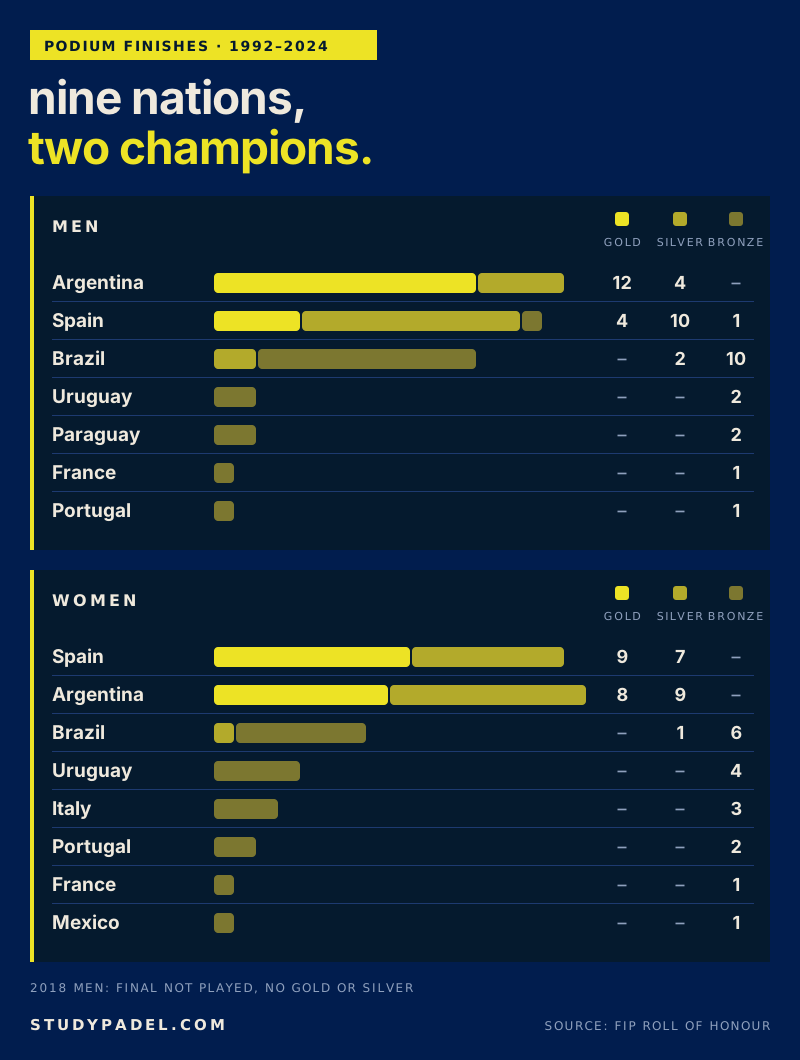
- Brazil have 19 medals on FIP’s roll of honour and no gold. The men have two silvers and ten bronzes, the women one silver and six bronzes.
- Most team titles: there is no official list. Alejandra Salazar has been in seven title-winning Spanish teams, from 2010 to 2024, by Padel Addict’s count. Roby Gattiker was in Argentina’s squad for seven titles between 1992 and 2006, going by Padelnetwork’s archive, and Fernando Belasteguín won six between 2002 and 2022.
- Only nine nations have won a medal: Argentina, Spain, Brazil, Uruguay, Paraguay, France, Portugal, Italy and Mexico.
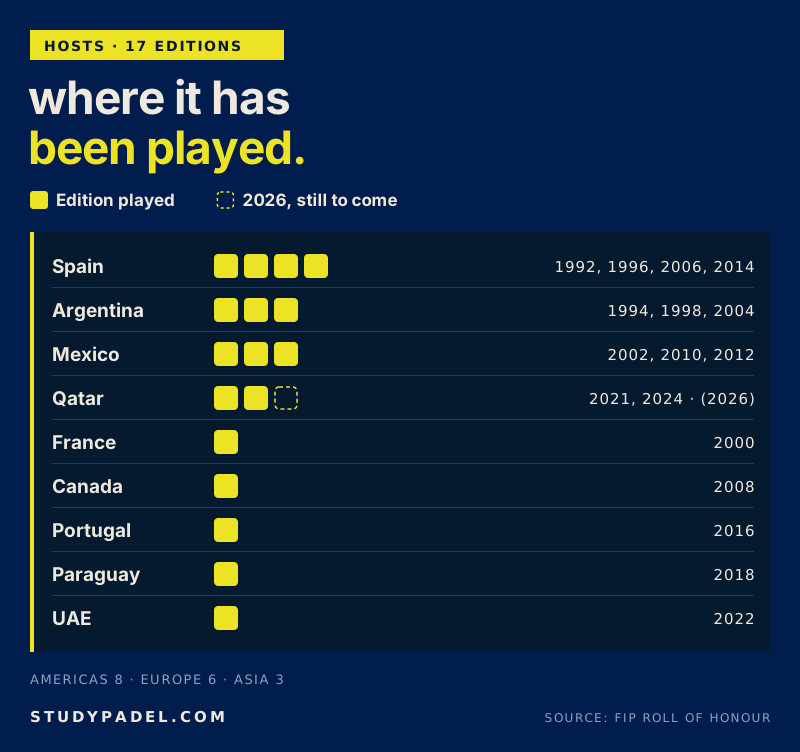
- Hosts: eight editions in the Americas, six in Europe and three in Asia. Doha 2026 will be Qatar’s third.
What happened to the pairs title?
For most of its history the World Cup also crowned world champion pairs. In the early editions the draw was open, so partners from different countries could win together. Later, pairs had to share a nationality, the tour’s top names often skipped the event, and after 2018 it disappeared from the programme.
Two names dominate the list. Roby Gattiker won four men’s titles in the first four editions. Icíar Montes won five women’s titles with five different partners, the last in 2010, and later coached Spain’s women to several of their team titles.
The pairs title returned in 2025 as a separate tournament, the FIP World Cup Pairs, in Kuwait. Ale Galán and Federico Chingotto won the men’s event and Ari Sánchez and Paula Josemaría the women’s.
Next: Doha 2026
The 2026 FIP World Cup runs from 2 to 7 November at the Khalifa International Tennis and Squash Complex in Doha, with 16 men’s teams, 16 women’s teams and a record 1.2 million euros in prize money, split equally between the two events. Qatar will host again in 2028.
Argentina defend the men’s title. Spain’s women are going for seven in a row, and Spain’s men for a first title since 2021 after losing the last two finals to Argentina. Fifteen of the sixteen places in each draw are filled. The last two will be decided at the Asia-Africa qualifier in Kuwait from 26 to 30 October. How every team qualified for Doha, region by region.
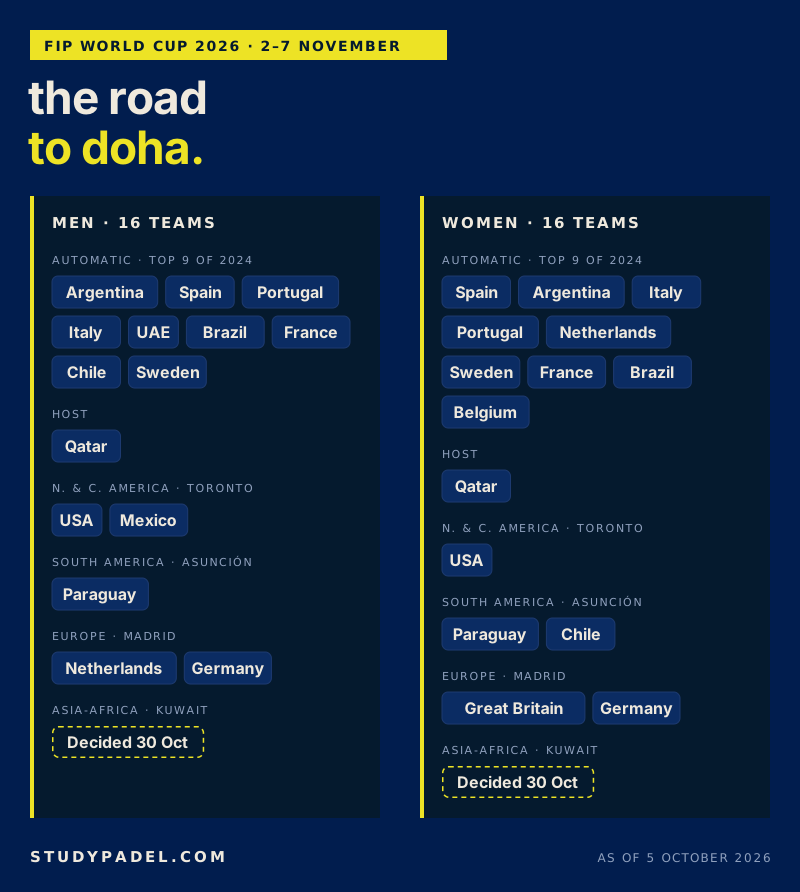
Follow the Padel World Cup 2026 on StudyPadel.
Padel World Cup FAQ
Who has won the most Padel World Cups?
Argentina. Its men have won 12 of the 17 editions and its women 8, for 20 team titles in all. Spain has 13: four for the men and nine for the women, including the last six women’s titles in a row.
How often is the Padel World Cup played?
Every two years, normally in October or November. The 2020 edition was moved to 2021 because of the pandemic, and the next one after Doha 2026 is in 2028, also in Qatar.
Has any country other than Argentina or Spain won it?
No. Brazil reached the men’s final in 2006 and 2012 and the women’s final in 2012, and lost all three. Nine nations have won a medal, but only Argentina and Spain have won a title.
Is the FIP World Cup the same as the World Padel Championships?
Yes. It is the same national-team event, renamed for 2026. The FIP World Cup Pairs, first played in Kuwait in 2025, is a separate tournament for pairs.
Sources
- International Padel Federation: roll of honour, history, how padel grew out of Argentina and Spain, 2026 and 2028 host announcement, reports on the 2024 men’s final and 2024 women’s final.
- Federación Española de Pádel: 30 years since the first World Championship and its 1996 annual report.
- Padelcenter / Padelnetwork archives for 1992, 1998, 2000, 2002, 2004, 2006, 2008, 2010, 2012, 2014, 2016 and 2022, and its interviews with Alejandro Lasaigues, Mariano Lasaigues and Fernando Belasteguín (2001, 2010), plus its 2002 profile of Roby Gattiker.
- Padel Magazine: Claude Baigts on how France won the 2000 edition.
- PadelSpain on 2012: event declared “not official”, ratified as official, Spain leaves FIP.
- El Español on the 2016 disqualification, the 2018 final and the 2022 host switch.
- Padelazo on finals day in 2018 and the FIP sanctions.
- La Nación on the 2016, 2022 and 2024 finals.
- Padel Addict on the 2021 finals and on Alejandra Salazar’s record.
- Padel Good: Juan Martín Díaz career notes. El Neverazo on Argentina’s 2024 squad.
- PadelAlto on the UAE squad in 2024; Padel Magazine on France’s celebration.