


Padel vs Pickleball: Key Differences, Rules & Which to Play
Padel and pickleball are two different sports. Padel is played inside a glass-walled court with a tennis-style ball, tennis scoring and walls that stay in play. Pickleball is played on a small open court with a hard plastic ball, games to 11 and a no-volley zone at the net. Pickleball is quicker to learn and far easier to find in the US, while padel is more physical and rewards wall play and teamwork.
Padel vs pickleball at a glance
| Padel | Pickleball | |
|---|---|---|
| Court | 65.6 × 32.8 ft (20 × 10 m), enclosed | 44 × 20 ft (13.4 × 6.1 m), open |
| Walls | Glass and metal mesh, in play after the bounce | None |
| Net height | 34.6 in at the center | 34 in at the center, 36 in at the sidelines |
| Racket or paddle | Solid, perforated racket up to 17.9 in long, with a wrist cord | Solid paddle up to 17 in long, no holes |
| Ball | Pressurized, felt-covered rubber ball, much like a tennis ball | Hard plastic ball with 26 to 40 holes |
| Serve | Underhand after a bounce, two attempts | Underhand, one attempt |
| Scoring | Tennis scoring: 15, 30, 40, sets to six games | Games to 11, win by 2 |
| Signature rule | The walls are in play | No volleys inside the 7 ft kitchen |
| Format | Almost always doubles | Singles or doubles |
| Learning curve | Rallying within a session or two, the walls take longer | Playing real games within the first hour |
| Finding a court in the US | Roughly 1,000 courts, mostly at private clubs | More than 80,000 courts, many public and free |
Is padel the same as pickleball?
No. They are separate sports with different courts, equipment, rules and governing bodies. People mix them up because both are doubles-friendly, both use a solid racket or paddle and an underhand serve, and both are spreading across the US at the same time.
Three differences separate them the moment you step on court:
- The walls. A padel court is a glass and mesh box, and the ball stays live after it rebounds off the walls. A pickleball court has no walls at all.
- The ball. Padel uses a pressurized ball that bounces like a tennis ball. Pickleball uses a light plastic ball with holes that slows down quickly in the air.
- The scoring. Padel is scored like tennis. Pickleball games go to 11 points.
Pickleball was invented in 1965 on Bainbridge Island, Washington. Padel was invented in Acapulco, Mexico, in 1969, grew up in Spain and Argentina, and reached the US much later, which is why most Americans meet pickleball first.
Padel, paddle tennis, platform tennis or pickleball?
Four different sports share nearly the same name in the US, and the word “paddle” can mean any of them depending on where you live.
| Sport | Court | Walls | Ball | Serve | Scoring |
|---|---|---|---|---|---|
| Padel | 65.6 × 32.8 ft | Glass and mesh, in play | Felt-covered, like a tennis ball | Underhand, after a bounce | Tennis scoring |
| Pickleball | 44 × 20 ft | None | Plastic with holes | Underhand | Games to 11 |
| Platform tennis | 44 × 20 ft, on a raised 60 × 30 ft deck | 12 ft wire screens, in play | Solid rubber, flocked | Overhand allowed, one attempt | Tennis scoring |
| Paddle tennis (POP Tennis) | 50 × 20 ft | None | Depressurized tennis ball | Underhand | Tennis scoring |
- Padel is the glass-court sport this site covers. It is spelled with one “d” and no “le”, and its equipment is officially a racket, even though many Americans say “padel paddle”.
- Platform tennis is what Northeast country clubs usually mean by “paddle”: a cold-weather game on a heated deck wrapped in wire screens.
- Paddle tennis, now marketed as POP Tennis, is a scaled-down tennis game with no walls, best known from California beach courts.
- Pickleball is the only one of the four with a plastic ball and a no-volley zone.
Padel is also sometimes compared with racquetball and squash because of the walls. Those are played in a closed room with no net. Padel has a net, and the ball must cross it and bounce on the floor before it touches a wall.
The court
A padel court is 65.6 ft long and 32.8 ft wide (20 × 10 m) and fully enclosed. A pickleball court is 44 ft long and 20 ft wide (13.4 × 6.1 m) and has no walls.
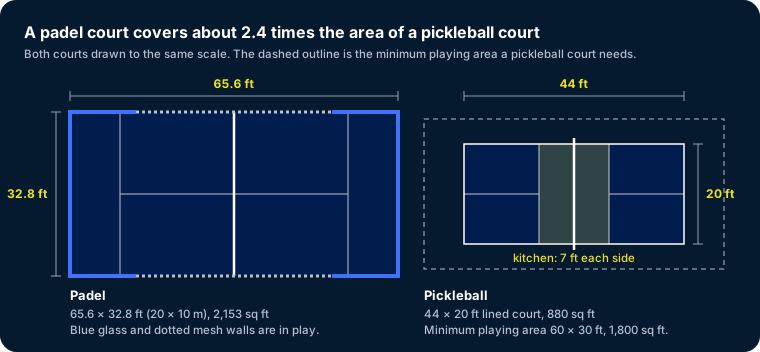
- Padel. The back walls are about 13 ft (4 m) high: glass or solid wall topped with metal mesh. The side walls are glass at each end and mesh in the middle. The ball may hit any of them after it has bounced, and play continues. Most courts use sand-dressed artificial turf.
- Pickleball. A hard court with a non-volley zone, known as the kitchen, that runs 7 ft (2.1 m) back from the net on each side. USA Pickleball requires a playing surface of at least 60 × 30 ft around the lines.
The footprint math. By lined area a padel court is about 2.4 times bigger: 2,153 sq ft against 880 sq ft. That number flatters pickleball, because a pickleball court also needs room to run. With its minimum 60 × 30 ft playing area, one pickleball court takes 1,800 sq ft, so a padel court needs only about 20% more ground.
You will sometimes read that three pickleball courts fit inside one padel court. They do not. A padel court is 32.8 ft wide, so only one 20 ft wide set of pickleball lines fits inside it.
The comparison that does hold is with tennis. On the footprint of one tennis court, clubs typically fit four pickleball courts, or two to three padel courts.
Equipment: racket, paddle, ball and shoes
The racket and the paddle look alike from a distance, but the two balls behave completely differently.
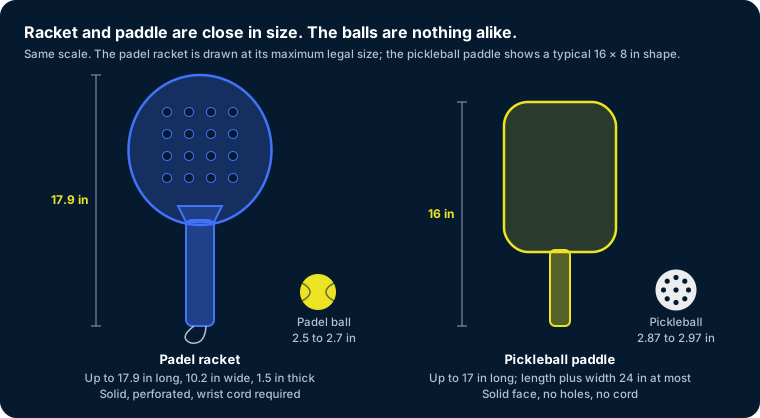
- Padel racket. Solid, with no strings and holes drilled through the hitting face. It can be up to 17.9 in long, 10.2 in wide and 1.5 in thick (45.5 cm, 26 cm, 38 mm), and it must have a wrist cord that you wear during play. Officially it is a racket, although many US players call it a padel paddle.
- Pickleball paddle. Solid and flat, with no holes and no cord. The rules cap the length at 17 in and the length plus width at 24 in, with no limit on thickness or weight.
- Padel ball. A pressurized rubber ball covered in felt, 2.5 to 2.7 in across (6.35 to 6.77 cm) and about 2 oz. It looks like a slightly smaller tennis ball and bounces like one.
- Pickleball. A one-piece hard plastic ball with 26 to 40 holes, 2.87 to 2.97 in across and under 1 oz. It is lighter, slows down quickly in the air and bounces lower.
- Shoes. Padel is usually played on sand-dressed turf, so padel shoes have a herringbone or omni sole that grips sand. Pickleball is played on hard courts, so standard court shoes work. Running shoes are a poor choice for either, because both sports are full of sideways movement.
If you are shopping for a padel racket, our padel racket brands guide is the place to start.
Rules and scoring
Padel borrows its scoring from tennis and adds walls. Pickleball has its own scoring and replaces walls with a no-volley zone.
| Padel | Pickleball | |
|---|---|---|
| Serve | Underhand: bounce the ball, then hit it at or below waist height. Two attempts. | Underhand, hit out of the air or after dropping the ball. One attempt. |
| Where the serve goes | Diagonally into the opposite service box | Diagonally into the opposite service court, beyond the kitchen |
| After the serve | The return must bounce. After that anyone may volley. | The serve and the return must each bounce before anyone volleys. |
| At the net | Volley from anywhere | No volleys while standing in the 7 ft kitchen |
| Boundaries | Walls are in play once the ball has bounced | A ball landing outside the lines is out |
| Points | 15, 30, 40, game | 1, 2, 3 and so on |
| Winning | Six games win a set, two sets win the match | First to 11, win by 2 |
| Who can score | Either pair, on any point | In standard scoring, only the serving side |
Two details are worth knowing:
- Deuce in padel. At 40-40 a competition uses one of three formats: Advantage, Star Point or Golden Point. Our padel scoring guide explains each one.
- Rally scoring in pickleball. The 2026 USA Pickleball rulebook keeps traditional scoring as the standard, where only the serving side scores. It also allows rally scoring, where every rally scores a point, as a provisional option that tournament directors may choose.
For the full padel rulebook in plain language, see the complete padel rules guide and the serve rules guide.
Which is harder, padel or pickleball?
Pickleball is easier to start. Padel takes a little longer, mainly because of the walls, but it is still far quicker to pick up than tennis. How it feels depends on where you are coming from.
- Complete beginners. Pickleball gets you playing real games within the first hour: the court is small, the ball is slow and the paddle is light. In padel you can rally in your first session or two, but reading a ball off the back glass takes a few weeks.
- Tennis players. Padel will feel familiar: the scoring, the volleys and the overheads all carry over. The adjustments are the underhand serve and learning to let the ball pass you and come back off the wall. Pickleball asks for a bigger change: softer hands, shorter swings and patience at the kitchen line.
- Pickleball players trying padel. Your net game and your doubles instincts transfer well. Expect a bigger court, a livelier ball, no kitchen, and a new habit to learn: turning to play the ball after it hits the glass behind you.
- Older players. Both sports are doubles-first with an underhand serve, which keeps them accessible. Pickleball has less ground to cover. Padel involves more running, turning and overhead shots.
This section is our own assessment from how the two games are built, not the result of a study.
Fitness, injuries and age
Padel is the more physical of the two, and the published research does not show that either sport is safer than the other.
- Intensity. A padel court is bigger and the walls keep the ball alive, so rallies run longer and involve more running and turning. Pickleball points are shorter and are often decided by quick exchanges at the kitchen line.
- Padel injuries. A 2023 systematic review of eight studies and 2,022 players found about 3 injuries per 1,000 hours of padel training and 8 per 1,000 matches. The elbow was the most common site, followed by the knee, shoulder and lower back, and most injuries involved tendons or muscles.
- Pickleball injuries. A ten-year study of US emergency department visits from 2013 to 2022 found pickleball injuries rising sharply. Falls caused 65.5% of them, fractures were the most common diagnosis at 32.7%, and older players were overrepresented.
- Why you cannot compare them directly. The padel figure counts all injuries among players per hour of play. The pickleball figure counts only emergency room visits. They measure different things, and the pickleball data reflects an older player base.
For either sport the sensible precautions are the same: warm up, wear court shoes, and build up gradually. If you have a joint or heart condition, ask a doctor before you start.
Popularity and growth in the US
Pickleball is far bigger in the United States, and padel is far bigger in the rest of the world. In 2026, though, padel is the one growing faster in the US.
| Padel | Pickleball | |
|---|---|---|
| US players in 2025 | About 1.07 million | 24.3 million |
| US courts | About 690 in mid-2025, about 1,000 by April 2026 | 82,613 at 18,258 locations in 2025 |
| Worldwide | More than 35 million players and 77,300 courts in 2025 | Played mostly in North America |
The player figures come from the Sports & Fitness Industry Association, which tracked padel for the first time in its 2026 report. Pickleball grew 22.8% in 2025 and was the fastest-growing sport in the US for five years running. That changed in 2026: in SFIA's mid-year report, padel was the fastest-growing activity at +14.5%, while pickleball grew 1.3%, its first sign of slowing down. Court counts are less exact: the padel figures come from an industry report and a club directory, and the pickleball figure from USA Pickleball's court database as reported by several outlets.
Padel is smaller in the US for practical reasons, not because Americans dislike it:
- Courts cost more. A padel court needs glass walls, steel and turf. A pickleball court can be painted onto an existing tennis court.
- It is a club sport. Most US padel courts are at private or pay-to-play clubs, while pickleball spread through free public parks.
- It started later. Pickleball has been played in the US since 1965. More than half of the US padel courts counted in mid-2025 had been built since January 2024.
The professional scene shows the same gap. On StudyPadel's USA page we currently track 25 ranked American professionals. The highest ranked are Brittany Dubins at number 70 in the women's ranking and Vinny Nahuel Di Francesco at number 213 in the men's. Premier Padel, the sport's top tour, held its first US event in Miami in 2025 and returned for the Miami P1 2026. Pickleball's pro circuits, the PPA Tour and Major League Pickleball, are based in the US.
Cost and access
Pickleball is cheaper to build and cheaper to play. Padel costs more per court and usually more per hour.
| Padel | Pickleball | |
|---|---|---|
| Building a court | $40,000 to $80,000 for a new outdoor court | $10,000 to $30,000 to convert one tennis court into four |
| Booking a court | About $60 to $100 an hour in South Florida, $110 to $225 in the New York area | $10 to $30 an hour, and often free at public parks |
| Gear to start | Racket, balls, court shoes | Paddle, balls, court shoes |
Padel booking prices are rates listed on booking sites in September and October 2026. The build costs and pickleball booking prices are estimates published in 2026 by a club-software company. None of these are audited figures, and prices vary a lot by city and time of day. Padel courts are booked by four players who split the fee, so the cost per person is a quarter of the hourly rate.
Many US clubs now build both. Pickleball fills courts all day with a large, existing player base. Padel brings a higher hourly rate, and it gives tennis and pickleball members something new to try without leaving the club.
Can you play pickleball on a padel court?
Not properly. You can hit a pickleball around inside a padel court for fun, but it is not a real game of pickleball.
- The lines are wrong. A padel court has no kitchen line and no pickleball baselines or sidelines, and its service boxes are a different size.
- The surface is wrong. Most padel courts are sand-dressed turf. A hollow plastic pickleball needs a hard, smooth surface to bounce true.
- The walls get in the way. In pickleball a ball that leaves the court is out. In a padel court it comes back off the glass.
The nets are close in height, 34.6 in at the center for padel and 34 in for pickleball, so that part works. The reverse does not work at all: padel cannot be played on a pickleball court, because there are no walls.
Which should you choose?
Choose by what you want from the sport and by what is near you.
- Choose pickleball if you want to be playing games today, you have public courts nearby, you want the cheapest way in, or you prefer less running.
- Choose padel if you come from tennis or squash, you want a harder workout, you like the idea of using the walls, or you have a regular group of four and a club within reach.
- Play both if your club offers both. The net skills carry over in each direction, and many players do.
If you already play pickleball and are curious about padel, book one hour with three friends before you buy anything. Most clubs rent rackets, and one session is enough to tell whether the walls are for you. Our guides on how to play padel and playing your first padel tournament cover what comes next.
FAQ
What is padel called in America?
Padel. The name is the same everywhere, and the national governing body is the United States Padel Association. Many Americans pronounce it like “paddle”, which is where the confusion with paddle tennis and platform tennis comes from.
Which is more popular, padel or pickleball?
In the US, pickleball by a wide margin: 24.3 million players against about 1.07 million in 2025. Worldwide, padel is the larger sport, with more than 35 million players according to the International Padel Federation.
In which country is padel most popular?
Spain, which has more than 15,000 courts. Read more on our padel in Spain page.
Is pickleball growing or dying?
Growing, but more slowly. US participation rose 22.8% in 2025 to 24.3 million players, after five straight years as the country's fastest-growing sport. In the first half of 2026 it grew just 1.3%, according to SFIA.
What sport is replacing pickleball?
None. Padel is now growing faster than pickleball in the US (+14.5% against +1.3% in the first half of 2026, according to SFIA), but from a base about twenty times smaller, and many clubs are adding it next to pickleball courts instead of replacing them.
Why is padel suddenly so popular?
It is easy to start, it is almost always doubles, and four people fit on a small court, which makes it sociable and gives clubs a strong return per court. It has been big in Spain and Argentina for decades, and the US is catching up now that courts are being built.
Is padel safer than pickleball?
There is no evidence either way. The two sports have been studied differently, and their injury patterns differ: mostly elbow, knee and shoulder strains in padel, and mostly falls among older players in pickleball.
Is padel bad for the knees?
The knee is the second most common injury site in padel after the elbow, according to a 2023 review. That does not mean padel is bad for knees. It does mean the turning and lunging are real, so proper shoes and a gradual start matter.
Is padel for older people?
Yes. It is played as doubles with an underhand serve, and the walls give you a second chance at the ball. It does involve more running and turning than pickleball.
Why do so many F1 drivers play padel?
Several drivers, including Max Verstappen, Lando Norris, Carlos Sainz and Pierre Gasly, are regularly reported playing together between races. Gasly has said they play often and that it gets competitive. It suits a travelling group: four players, one hour, courts in most cities on the calendar.
Do I need different shoes for padel and pickleball?
Ideally, yes. Padel shoes are made for sand-dressed turf and pickleball shoes for hard courts. A general court shoe will get you through your first sessions of either.
Sources
Figures were checked on 3 October 2026.
- FIP Rules of Padel, in force since 1 January 2026. Padel court, net, ball and racket specifications, serve and scoring.
- USA Pickleball Official Rulebook 2026. Court, playing area, paddle and ball specifications, scoring and the provisional rally-scoring option.
- SFIA: US pickleball participation. 24.3 million pickleball players and about 1.07 million padel players in the US in 2025.
- Pickletile: pickleball participation statistics. USA Pickleball's 2025 count of 82,613 courts at 18,258 locations.
- Private Club Marketing: padel courts in the US. 688 padel courts at 180 facilities in mid-2025, and courts per tennis-court footprint.
- Padel Browser: growth of padel in the US, 2026. More than 1,000 US padel courts in April 2026.
- Bounce: pickleball vs padel popularity. FIP's 2025 figures of more than 35 million players and 77,300 courts worldwide.
- Book & Go: padel vs pickleball for clubs. Court construction and pickleball booking price estimates.
- CatchCorner: New York and New Jersey padel courts and Playtomic: Miami-area club. Listed padel court rates, September and October 2026.
- SFIA press releases. 2026 First Half Game Plan: padel +14.5%, pickleball +1.3% in the first half of 2026.
- Dahmen et al., BMJ Open Sport & Exercise Medicine, 2023. Systematic review of padel injuries.
- Pickleball injuries in US emergency departments, 2013 to 2022. Ten-year analysis of mechanisms and trends.
- Wikipedia: Platform tennis and POP tennis. Court sizes and rules for the two other “paddle” sports.
- San Diego Business Journal: padel in the US. Spain's court count.
- GPblog: Gasly on F1 drivers and padel. In Dutch.
- StudyPadel: padel in the USA. Our own ranking data for American players, week 40 of 2026.