

What Happened to Padel in Sweden? The Boom, the Crash and What Is Left
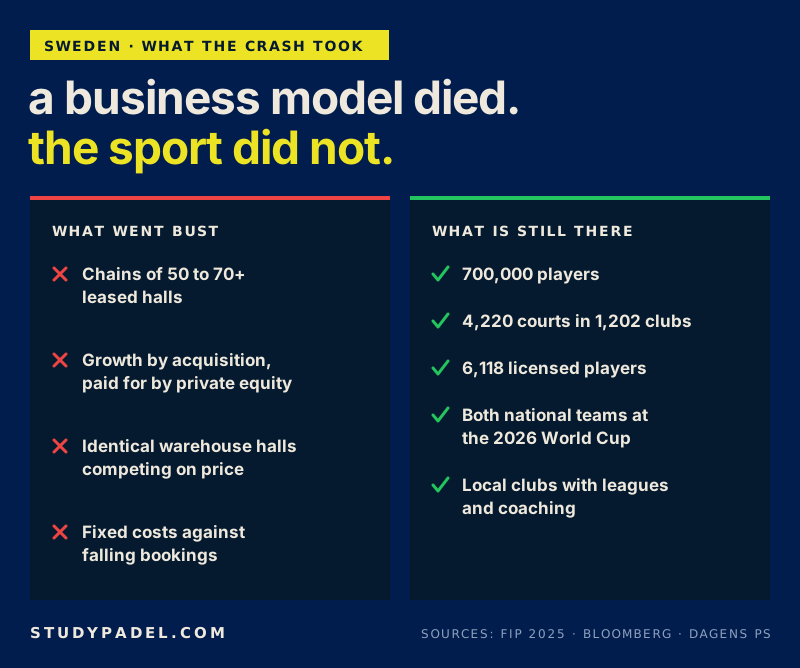
In about five years Sweden went from fewer than 100 padel facilities to more than 4,000 courts. Then its two biggest chains ran out of money, almost 90 padel companies went bankrupt in eight and a half months, and empty halls were turned into supermarkets. The headlines said padel had died in Sweden. It had not. An estimated 700,000 Swedes still play, on more courts per inhabitant than Spain has. What died was a business model.
The short version
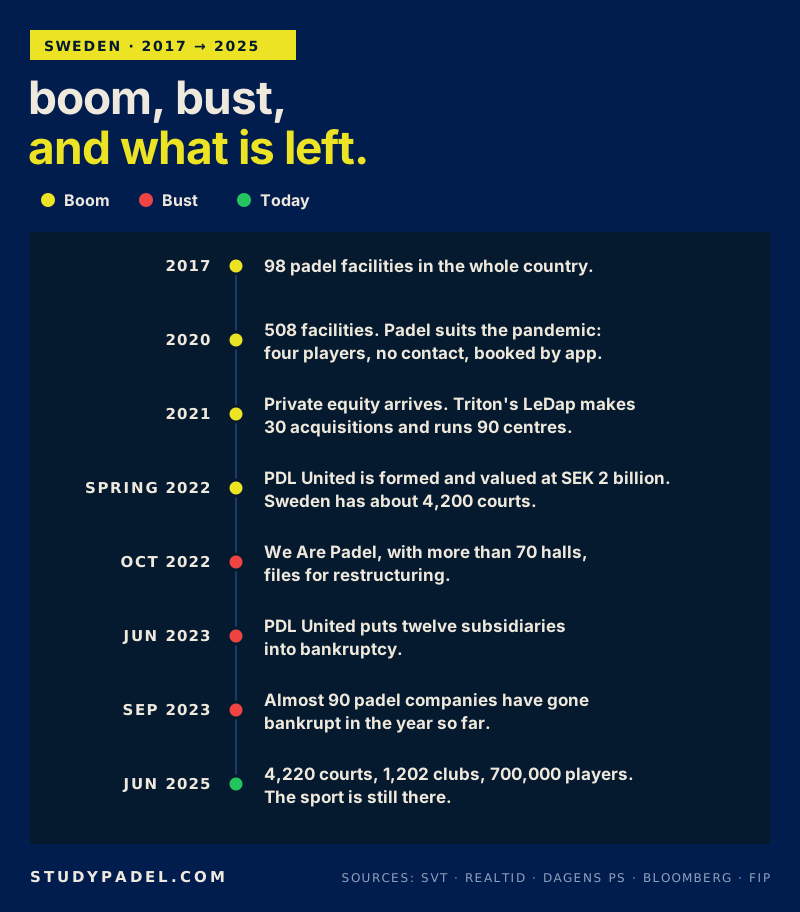
- The boom: Sweden had 98 padel facilities in 2017 and 508 in 2020. By 2022 it had about 4,200 courts, the third-largest stock in Europe after Spain and Italy.
- The bust: We Are Padel, with more than 70 halls, filed for restructuring in October 2022. PDL United, the other giant, put twelve subsidiaries into bankruptcy in June 2023. Almost 90 padel-related companies went bankrupt in the first eight and a half months of 2023.
- The cause: courts were built much faster than new players appeared. Energy prices, rents and interest rates then rose at the same time.
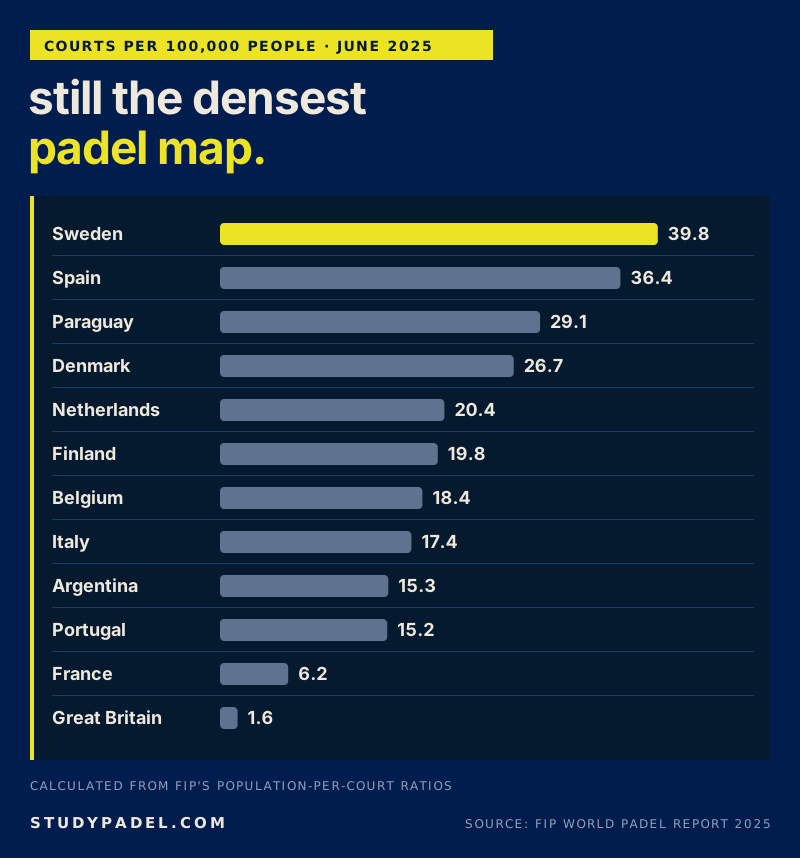
- Today: the International Padel Federation (FIP) estimates 4,220 courts, 1,202 clubs and 700,000 players in mid-2025. That is one court for every 2,515 people. Spain has one for every 2,745.
- Not over yet: FIP says Sweden is “not yet showing signs of recovery”. Analysts still describe a market that is shrinking to fit its demand.
How the boom happened
Padel was growing in Sweden well before the pandemic. The Swedish federation was founded in 2010. PDL, which became the country’s best-known chain, was started in 2015 by a group that included the singer Måns Zelmerlöw and the former tennis professional Jonas Björkman. Zlatan Ibrahimović co-founded another chain, Padel Zenter.
The numbers from the federation and the booking app Matchi show how fast things moved: at least 98 facilities in 2017, 508 in 2020. Swedish public television reported at the time that the number of courts had more than quadrupled in four years, and that neighbours were starting to object to new halls.
Then came the pandemic. Padel is four people on a court of their own, with no physical contact, booked and paid for by phone. A later study by Monitor Deloitte and Playtomic listed what made Sweden different: pandemic restrictions on other activities, light regulation, plenty of suitable buildings, Swedish sporting habits and a large middle class. It added that those conditions could not simply be copied to other countries.
Building was easy. An operator leased an industrial hall on the edge of town, put in six or eight courts and connected them to a booking app. A long-time Uppsala club owner told Bloomberg the city went from 14 to 100 courts in a single year. A Matchi report at the time said more than half a million Swedes had taken up the sport.
Then the money arrived
Up to this point most halls were owned by local entrepreneurs. In 2021 that changed.
The private equity firm Triton built a padel group called LeDap almost unnoticed. When it was announced, it had already made 30 acquisitions and ran more than 90 centres and 600 courts in seven countries. Its biggest part was the Swedish chain We Are Padel. The stated goal was more than 200 locations and 1,700 courts by the end of 2022.
Its rival took the same route. Padel United, backed by the fund manager Coeli, bought PDL Group in the spring of 2022. The merged company, PDL United, was valued at 2 billion kronor (about €190 million at the time) and raised 350 million kronor to expand into Britain and Germany. PDL called itself the world’s largest padel operator, with 57 centres, more than 800 courts and 49 further centres planned.
The Swedish business site Realtid reported that Nordic company deals rose 56 percent in 2021, and named padel halls as one of the reasons.
So within about 18 months, two investor-backed groups came to control well over a hundred Swedish halls between them, and both were still buying.
The bust, step by step
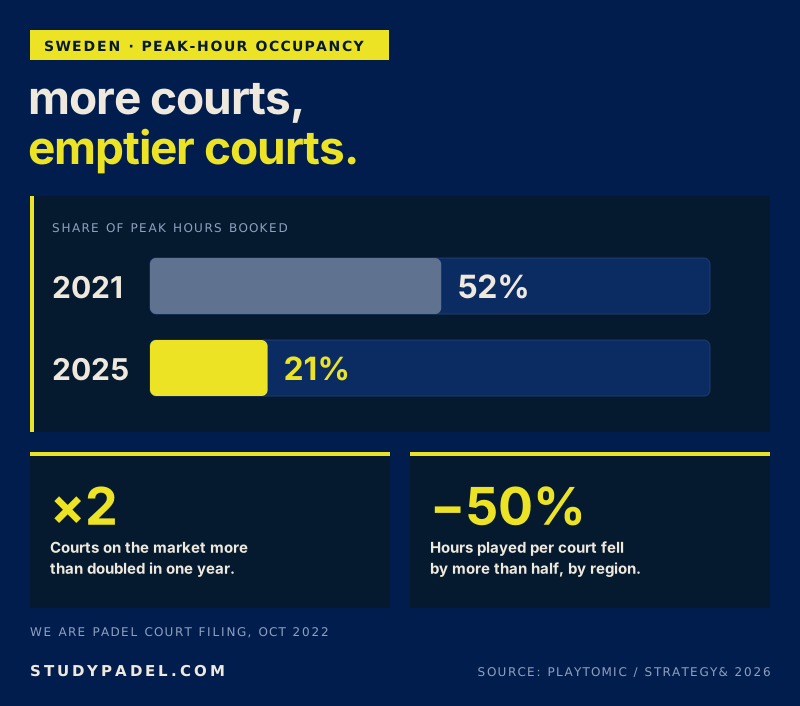
October 2022. We Are Padel filed for restructuring at the district court in Örebro. It had more than 70 halls and about 300 employees. Its own filing, quoted by the Swedish press, explained the problem in two sentences: the number of courts on the market had more than doubled in a year, and the hours played per court had fallen by more than half in some regions. Between January and August 2022 the company had revenue of about 165 million kronor and an operating loss of 88 million. Twelve days after the filing, eleven of its companies, with 16 halls between them, went bankrupt.
Winter 2022 to 2023. PDL United reported a loss of about 244 million kronor for 2022. It asked investors for 368 million kronor and received 271 million, plus 40 million in loans. A Danish credit fund, Capital Four, became one of its main financiers.
May and June 2023. The new money was not enough. PDL United applied for restructuring of nine of its 90 subsidiaries, and in June put twelve others into bankruptcy. Swedish business press reported that Capital Four later took over the assets that had been pledged as security.
September 2023. Bloomberg counted the damage. Almost 90 padel-related companies had filed for bankruptcy since January, according to the credit agency Creditsafe. We Are Padel had closed around 50 of its Swedish clubs and kept 13, and its owners had booked a loss of 716 million kronor for 2022. A former hall in Västerås was being turned into a discount supermarket. Others stored solar panels and tyres. Malmö Padelcenter, open since 2013, had converted four of its ten courts to pickleball.
The head of Triton’s padel group told Bloomberg the Swedish boom had been a “gold rush”.
The timing made everything worse. Swedish bankruptcies across all industries rose 29 percent in 2023, to the highest level since the 1990s.
Why it broke: too many courts, not too few players
A padel court only earns money when it is booked. Rent, heating, lighting and staff cost the same whether it is full or empty. That makes a hall very profitable when courts are scarce and loss-making soon after they are not.
Four things went wrong at once.
- Supply. Court numbers more than doubled in a year while the number of players grew much more slowly. Each court was simply used less.
- Costs. Energy prices jumped in the winter of 2022, and We Are Padel’s filing also named inflation and higher rents. A large indoor hall has to be lit and heated all winter.
- Debt. The big chains had grown by buying other operators with borrowed and invested money, on the assumption that demand would keep rising. When interest rates went up, new money stopped coming.
- Sameness. Many halls were near-identical buildings a few minutes apart, selling the same hour of court time. The only way to compete was on price.
The Global Padel Report 2026, by Playtomic and the consultancy Strategy&, puts a number on the result: the share of peak hours that were booked in Sweden fell from 52 percent in 2021 to 21 percent in 2025.
None of this says Swedes stopped liking padel. It says the courts were built for a level of demand that only existed while they were scarce.
What is still standing
Here the picture is very different from the headlines.
| Sweden, mid-2025 (FIP estimates) | |
|---|---|
| Courts | 4,220 (4th in the world) |
| Clubs and facilities | 1,202 |
| Players | 700,000 |
| People per court | 2,515 (Spain: 2,745) |
| Licensed players (2024) | 6,118, of whom 1,900 are women |
Sweden has about 10.6 million inhabitants. On FIP’s figures, roughly one Swede in fifteen plays padel, and the country still has the densest court network of any major padel nation.
Estimates of the court count have barely moved since the peak: about 4,200 in the 2023 Deloitte and Playtomic report, 4,220 in FIP’s mid-2025 figures. The two reports count in different ways, so the comparison is rough. But neither shows the courts vanishing. Halls closed, and others changed hands. The 2026 Playtomic report describes stronger operators buying the best sites, and says used Swedish courts are being sold on to Eastern Europe.
The sporting side has kept growing through all of it. At the 2024 World Championships in Doha, Sweden’s women finished sixth and the men ninth, which qualified both teams directly for the 2026 FIP World Cup. Sweden’s boys were runners-up at the 2023 Junior World Championships, behind Spain and ahead of Argentina. 49 Swedish players hold a world ranking. The best-placed man, Adam Axelsson, was born in 2005 and has won FIP events in Dubai and Europe. Sweden also hosts its own FIP tour stop, in Gothenburg.
And at ground level, the clubs that are left look more like sports clubs than property investments. A small-business magazine visited Sjöbo Padelcenter in southern Sweden in 2025: seven courts, no employees, a league with players aged from 7 to over 70, and schools and local associations among the regulars. “We knew from the start that padel’s gold rush would die out,” one of the owners said. Their aim was to be local and always open.
Is the correction over?
Not yet. FIP’s 2025 report says Sweden is “not yet showing signs of recovery” because the boom has still to be absorbed. The 2026 Playtomic report puts Sweden, Finland and Chile in a group it calls “Post-Boom Adjustment”: markets where court numbers are flat or falling, with growth of about 1 percent a year. It describes Sweden as the deepest correction of the three, with clubs still closing and operators still merging.
An independent analysis of that report makes the point worth keeping: these markets are returning to normal, not collapsing.
What other countries took from it
Sweden is now the example every new padel market is warned about.
- Chile went through the same cycle a year later. More than 80 clubs closed in 2024 and bookings at major operators fell 27 percent, yet the country still has about 2,300 courts.
- Finland has peak-hour occupancy of about 41 percent in commercial clubs, among the lowest anywhere.
- France added more courts than any other country in 2025 and still fills them. The Playtomic report credits the way new clubs are spread across the whole country, where Sweden’s were piled into the same towns.
- Britain and Germany are in the middle of their own building rush. In British clubs peak-hour occupancy is around 85 percent, and about half of players say they struggle to book a court at prime time.
The lesson the industry has drawn is simple. The number of courts a town can support depends on how many people play every week, not on how full the first hall was in its first winter. For more on where courts are being built now, see our guide to padel courts around the world. For why people keep coming back to the sport in the first place, see why padel is growing so fast. For Denmark, Norway and Finland, see padel in Scandinavia, and for the longer story, the history of padel in Sweden.
Quick answers
Is padel dead in Sweden? No. FIP estimates 700,000 players and 4,220 courts in mid-2025. Many operators went bankrupt, but about one Swede in fifteen still plays.
How many padel companies went bankrupt in Sweden? Almost 90 between January and mid-September 2023, according to Creditsafe data reported by Bloomberg. Of the two largest chains, We Are Padel went through court restructuring, while PDL United restructured nine subsidiaries and put twelve more into bankruptcy.
Why did Swedish padel companies go bankrupt? Too many courts were built too quickly. We Are Padel told a court in 2022 that the number of courts had more than doubled in a year and that hours played per court had halved in some regions. Higher energy costs, rents and interest rates did the rest.
Does Sweden still have more padel courts than most countries? Yes. It ranks fourth in the world behind Spain, Italy and Argentina, and first among large padel nations for courts per inhabitant.
Sources
- International Padel Federation: World Padel Report 2025 (court, club and player estimates for June and October 2025, licensed players, population-per-court ratios, the assessment of Sweden).
- SVT Nyheter: facility numbers from the Swedish federation and Matchi, 2017 to 2020.
- Realtid: Triton sets up LeDap Group, the Deloitte and Playtomic Global Padel Report 2023, and its padel archive (deal volumes in 2021, the lender taking over PDL’s pledged assets).
- Dagens PS: We Are Padel applies for restructuring (7 October 2022), PDL United’s rescue funding (4 January 2023), twelve PDL United subsidiaries in bankruptcy (22 June 2023).
- Padel Alto: 16 We Are Padel facilities in bankruptcy (18 October 2022).
- Bloomberg: Sweden Holds Grim Warning for the $4 Billion Padel Craze (16 September 2023) and Swedish bankruptcies in 2023.
- PDL Group: company figures. Padel Zenter: company site. The Padel Paper: the Matchi padel report.
- Playtomic and Strategy&, Global Padel Report 2026, as reported by Padel Magazine, PADEL1969 and Padel Addict.
- Företagarna: a visit to Sjöbo Padelcenter (27 June 2025).
- StudyPadel: professional padel in Sweden (rankings read in week 41 of 2026).