

Why Is Padel So Popular? 5 Reasons It Is Growing So Fast
Padel is played by an estimated 35 million people in 150 countries, and Britain alone went from 15,000 players to a million in seven years. It is routinely called the fastest-growing sport in the world. The reason is not marketing. It is the way the game is built: a beginner can keep a rally going in the first hour, there are always four people on court, and the same court works for a 12-year-old and a 70-year-old. Tennis cannot offer the first of those, and squash lost its place by lacking the second.
The short answer
- It is easy to start. Walls keep the ball in play, the serve is underarm and the racket is short. Recreational padel players average 4 to 6 strokes a rally. Men’s tennis doubles averages 2.5.
- It is social by design. It is always doubles. In surveys of players, friendship ranks above fitness and competition as the reason to play.
- It suits every age. Players cover less ground at lower speeds than in tennis, with a similar heart rate.
- It stays interesting. The walls that help a beginner also give experts a tactical game with no real ceiling.
- Clubs want it. Three padel courts take less ground than one tennis court with its run-offs, and hold twelve players instead of four.
Is it really the fastest-growing sport in the world?
Nobody keeps an official table, so the phrase is a claim, not a title. But the numbers behind it are real.
| Measure | Then | Now |
|---|---|---|
| Players worldwide (FIP estimate) | 30 million (2024 report) | 35 million (2025 report) |
| Countries where it is played | 130 | 150 |
| Courts worldwide | 63,000 (April 2024) | 77,355 (June 2025) |
| Licensed competitive players | – | 850,000, up 42% |
| Players in Great Britain (played in the last 12 months) | 15,000 (2019) | 1,000,000 (May 2026) |
| Padel licences in France | – | 100,000 (June 2025), up 42.7% in a year |
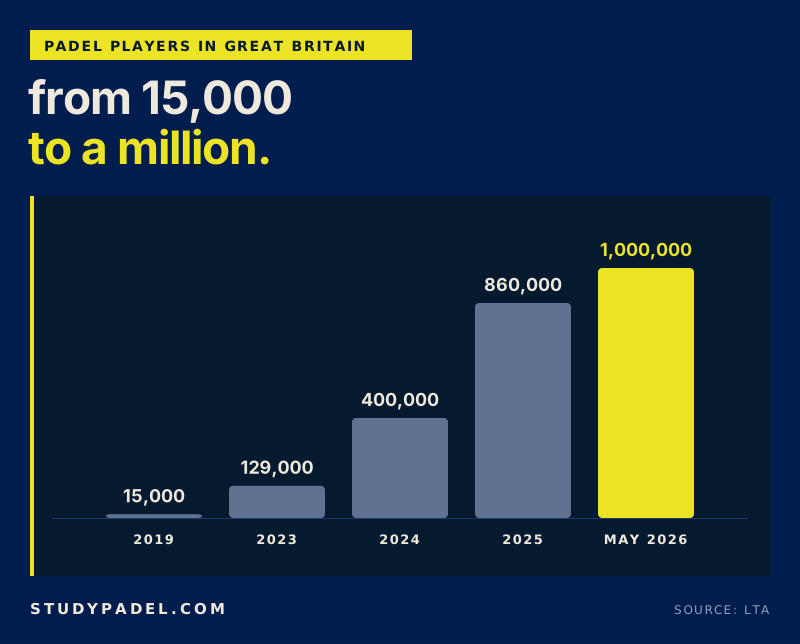
One caveat is worth stating. In the United States the title belonged to pickleball for five years running. In SFIA’s mid-2026 data, padel grew fastest (+14.5%) while pickleball slowed to +1.3%, although pickleball is still far bigger there. The two sports are often confused and are quite different. We compare them in padel vs pickleball.
So why padel, and why now? There are five reasons, and the first one matters most.
Reason 1: you can rally in your first hour
Most racket sports make beginners suffer first. In tennis the court is long, the racket is long, the serve is the hardest shot in the game, and a ball that gets past you is gone. Two beginners on a tennis court spend much of their first lessons collecting balls.
Padel removes almost every one of those obstacles.
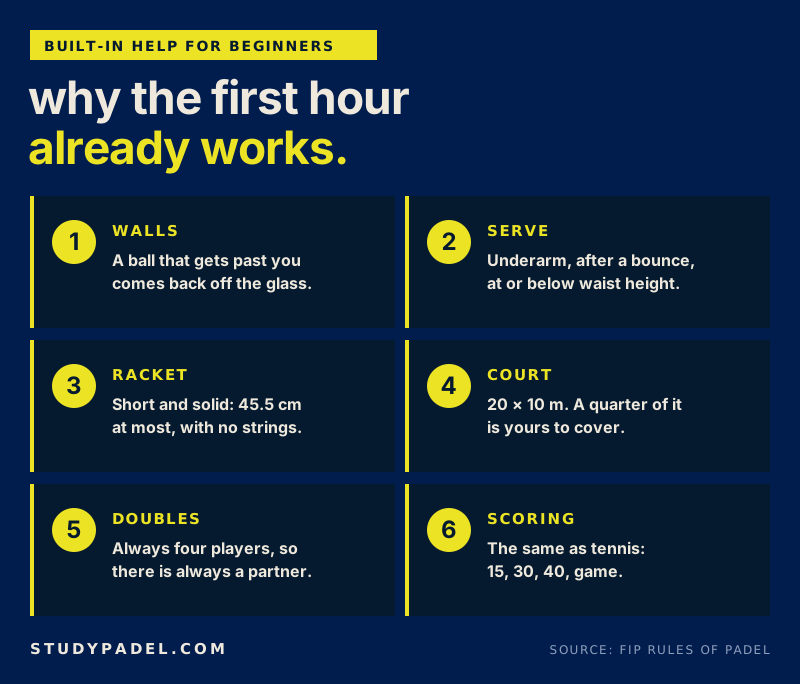
- The walls. A ball that passes you is not lost. It hits the glass and comes back, and you get a second chance at it.
- The serve. You bounce the ball and hit it underarm, at or below waist height. A beginner can start a point properly on day one.
- The racket. A padel racket is solid, has no strings and is at most 45.5 cm long. A tennis racket can be 73.7 cm. A shorter racket puts the ball closer to your hand, which makes it far easier to hit cleanly.
- The court. It is 20 metres by 10, and you share it with a partner. There is much less ground to cover than in tennis.
The effect shows up when rallies are counted. A 2025 study in the journal Frontiers in Sports and Active Living compared padel with tennis doubles and summarised earlier research.
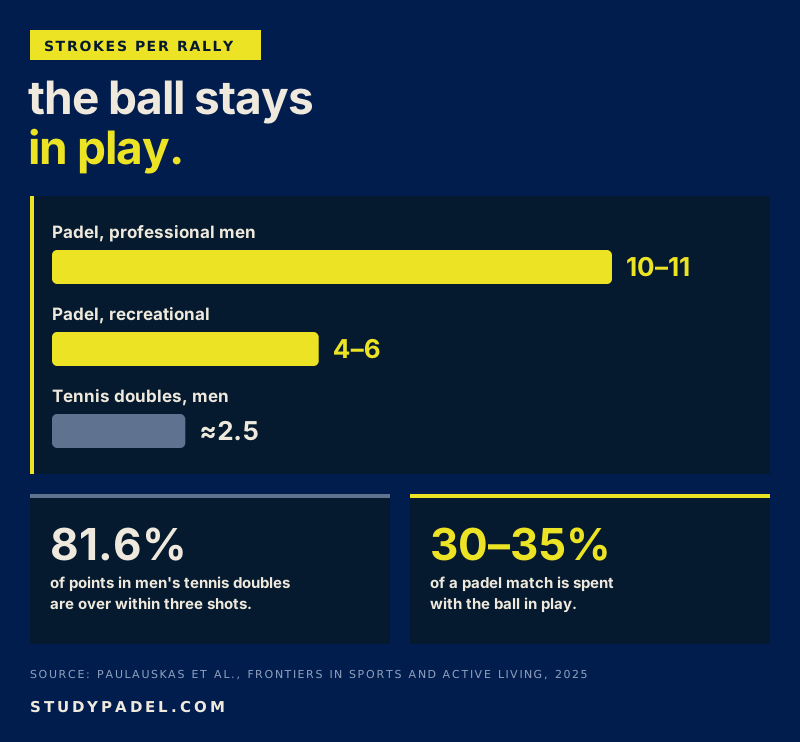
Professional men’s padel averages 10 to 11 strokes per rally. Recreational players manage 4 to 6. Men’s tennis doubles averages about 2.5 strokes a point, and more than four points in five are over within three shots. Those figures come from different levels of play. In the study’s own matches, with the same players in both sports, padel rallies averaged 4.5 strokes and tennis doubles 3.6.
That is what people mean when they say padel is fun straight away. The thing you came to do, hitting the ball back and forth, happens from the first session.
Reason 2: it is always four people
Padel is doubles only. You cannot book a court without three other people, and you stand a few metres from all of them. Conversation between points is normal. So is a drink afterwards, and many clubs are designed around that.
Researchers who have asked padel players why they play get the same answer each time.
- In a Spanish study of 146 players, the strongest reason was friendship and belonging to a group. Social status ranked last.
- A second study of 104 players found the same order.
- In a third, enjoyment scored 6.07 out of 7, ahead of fitness, competition and sociability. Appearance came last.
The mix of players is unusual too. FIP estimates that 40 percent of the world’s padel players are women. Because serves are underarm and power counts for less than placement, mixed doubles works at club level in a way it often does not in tennis.
Booking apps removed the last obstacle. If you have no partner, you join an open match at your level and meet three strangers. For many adults it is the easiest way they have found to make new friends through sport.
Reason 3: it works at every age
The same Frontiers study measured what the two sports ask of the body, using a small group of national-level players. Tennis doubles involved more distance, higher speeds, more sprints and longer rests. Padel had more rallies, more volleys and more time with the ball in play. Average heart rate was about the same.
Put simply, padel gives a similar workout with less sprinting. That helps explain why people keep playing it well into middle age and beyond.
The professional rankings show the same range. In FIP’s 2024 top 300, about one woman in five was 33 or older, and about one in nine was under 18. The oldest ranked man in that group was born in 1975. FIP runs world championships for under-14s and for over-55s.
At club level, one Swedish centre we came across in our article on Sweden runs a league with players aged from 7 to over 70.
Reason 4: easy to learn, hard to master
A sport that is only easy gets boring. Padel avoids that because of the same walls that help beginners.
At a higher level the walls turn every point into a problem of angles. You can let a hard shot go past you and play it off the back glass. You can lob to push opponents off the net. A smash is not automatically a winner, because the ball can come back off the wall. Professional rallies are long because attacking is difficult, not because nobody is trying.
So the game rewards patience and positioning more than raw power, and players keep finding new layers for years. If you want to see how the rules create that, start with the rules of padel.
Reason 5: the numbers work for clubs
Players can only take up a sport if somebody builds the courts. Padel courts get built quickly because the arithmetic is attractive.
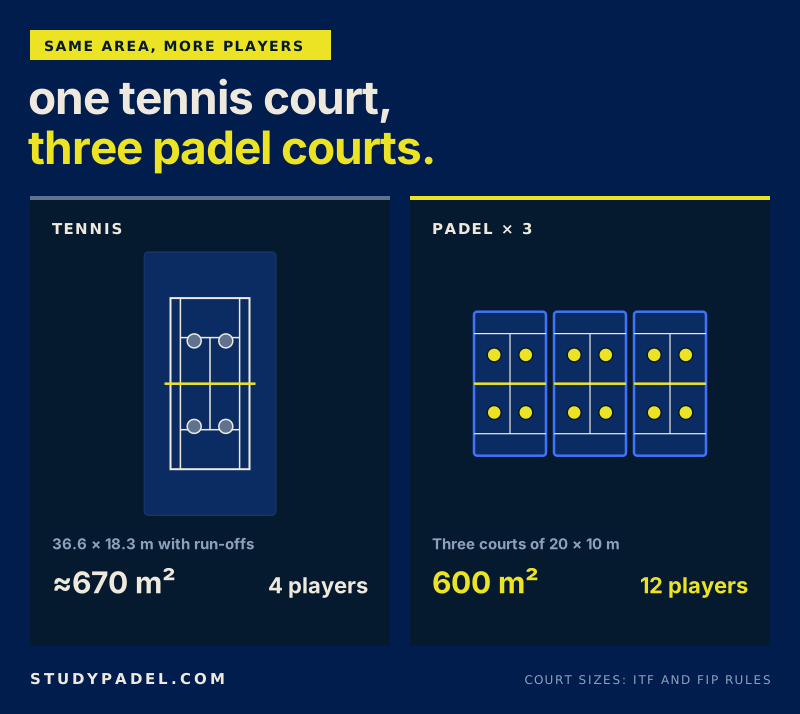
A tennis court with full run-off areas takes up about 670 square metres and holds four people at most. Three padel courts take 600 square metres and hold twelve. The comparison is by area. On real sites the shapes differ, so clubs usually turn two tennis courts into three padel courts. For a tennis club with a quiet court, that is an easy decision.
The national tennis federations have noticed. France’s federation lends clubs the cost of new padel courts at zero interest. Britain’s LTA has offered interest-free loans of up to £250,000 for the same purpose. In France, the federation says nearly half of its padel licence-holders had never held a licence with it before. Padel is bringing new people into clubs, not just moving tennis players across the car park.
The result is the building rate described in our guide to padel courts around the world: about 26 new courts a day.
Padel and tennis: a rival or a way in?
Tennis is not being replaced. The International Tennis Federation counts about 106 million players, three times FIP’s figure for padel, and the two sports share clubs, federations and many players.
What padel has changed is the first step. Tennis asks for months of practice before a match feels like a match. Padel offers the match first. Plenty of people now arrive at racket sports through padel who would never have signed up for tennis lessons, and some of them later try tennis too. The British federation describes the two as complementary, and has a commercial reason to: it runs both.
The full comparison of courts, rackets, rules and difficulty is in padel vs tennis.
Padel vs squash: the same story, forty years apart
The sport padel most resembles in its history is squash.
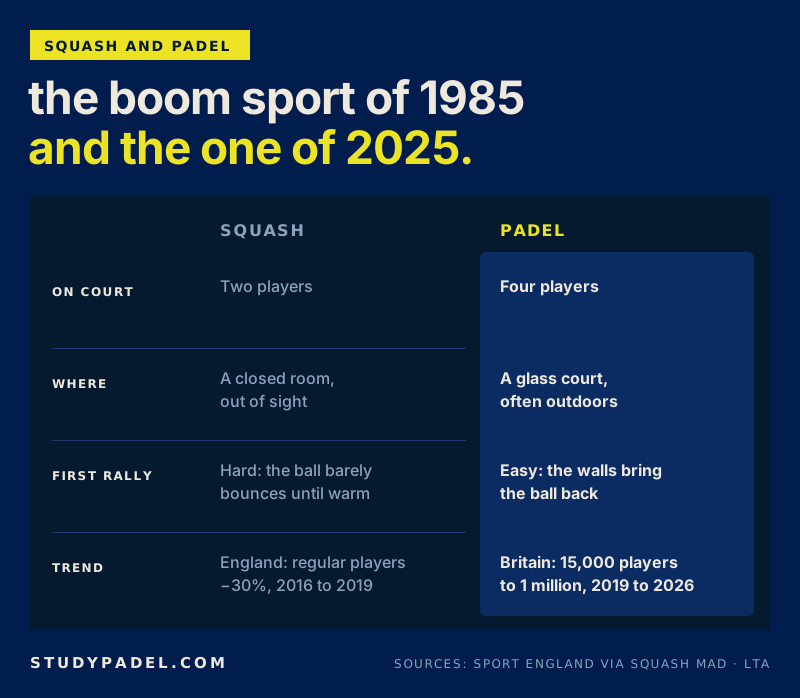
In the 1970s and 1980s squash was the boom sport. Britain had almost three million players at the peak, and clubs were built everywhere on the back of a fitness craze. Then the numbers fell. England had about 290,000 regular players in 2010 and fewer than 200,000 a few years later. Sport England’s surveys showed a further 30 percent drop in regular players between 2016 and 2019. The British government’s own property valuation manual notes that many squash courts have been converted into gyms because the space earns more that way.
Squash is a superb game. Its problem was never quality. It was the first hour and the setting.
- Two players, not four. A squash court holds two people. There is no partner and no group.
- A closed room. Courts were often in basements or at the back of a building, where nobody passing could see the game. A padel court is a glass box, usually in plain view.
- A hard start. A standard squash ball barely bounces until it has been hit hard enough to warm up. Beginners struggle to get a rally going at all.
- A hard game. Squash is one of the most physically demanding sports there is, which is part of its appeal and part of why people stop.
The handover between the two sports is visible inside the industry. The man who chaired the World Squash Federation’s courts and technical commission left in 2018 to start a padel court company. Squash court builders have added padel to their business. A squash coach and club manager who took up padel in Valencia wrote that his squash courts were buried in a basement while the padel courts were the first thing he saw on entering the club.
It is not all one-way. According to the squash press, clubs that already offered tennis and squash have become busier and more viable after adding padel. And squash will make its Olympic debut in Los Angeles in 2028, something padel has not yet achieved.
Squash also carries a warning. Its boom ended partly because too many courts were built for a fashion. Padel has already seen the same thing happen in Sweden.
What could slow padel down
- Overbuilding. Where courts outrun players, clubs close. Sweden, Finland and Chile are living through that now.
- Noise. A padel ball on glass is loud. France’s federation now requires an acoustic study for subsidised courts within 100 metres of housing.
- Price and access. Where courts are scarce, court time is expensive and booked days ahead. British clubs run at about 85 percent occupancy at peak times.
None of these touches the reason people play. As long as a first hour of padel is more fun than a first hour of almost any other sport, the courts will keep filling.
Quick answers
Why is padel so popular? Because beginners can rally straight away, it is always played in doubles, and it suits a wide range of ages and fitness levels. The walls keep the ball in play and the serve is underarm.
Is padel easier than tennis? To start, yes. The court is smaller, the racket is shorter, the serve is underarm and the walls return balls that would be lost in tennis. At a high level both are very hard.
Is padel the fastest-growing sport in the world? There is no official ranking, but FIP’s estimates went from 30 million players in 130 countries to 35 million in 150 countries between its 2024 and 2025 reports, and the number of courts is growing by about 15 percent a year.
Is padel replacing squash? In some clubs, yes. Squash participation in England fell 30 percent between 2016 and 2019 while padel grew from 15,000 British players in 2019 to a million in 2026. Some clubs that offer both report that padel has helped squash.
How many people play padel? More than 35 million by FIP’s estimate. Playtomic, counting only active players, puts the figure at 19.4 million.
Sources
- SFIA: mid-year 2026 US participation data.
- International Padel Federation: World Padel Report 2025 (players, countries, courts, share of women, licences, age of the top 300, senior and junior championships) and the FIP rules of padel, summarised in our rules guide. FIP World Padel Report 2024 figures as summarised by PADEL1969.
- Paulauskas, Šakinis and Figueira, Padel vs. tennis doubles: a comparison of performance demands and game attributes, Frontiers in Sports and Active Living, 2025.
- Courel-Ibáñez, Sánchez-Alcaraz and Cañas, Game performance and length of rally in professional padel players, Journal of Human Kinetics, 2017.
- Motivation studies: Rodríguez Cayetano and others, Retos, 2020; Rodríguez Cayetano and Aliseda, Padel Scientific Journal, 2023; Sánchez-Alcaraz and others, SPORT TK, 2018.
- LTA: one million padel players in Britain (May 2026). The Padel Paper: LTA participation figures.
- Fédération Française de Tennis: Boost Padel programme. L’Express Franchise: the French padel market in 2026.
- Squash Mad: the fall in English squash participation. Squash Worldwide: padel and the gulf between the two sports and Lee Witham on reviving squash.
- UK Valuation Office Agency: rating manual, squash courts.
- PADEL1969: tennis and padel player counts compared (ITF and Playtomic figures). Padel Addict: Global Padel Report 2026.