

Best Padel Countries After Spain, Argentina and Italy (2026)
Spain and Argentina have won every world team title since 1992, and Italy has built the second-largest court network on earth. Behind them a second group is forming. France has doubled its share of the world’s top 300 in two years. Portugal’s men beat Italy to a world bronze medal. Sweden’s boys reached a junior world final. This is who is closing the gap, how their young players are doing, and what money can and cannot buy on the way up.
The chasing pack at a glance
| Country | Courts | Players | 2024 Worlds (men / women) | Best-ranked man / woman |
|---|---|---|---|---|
| France | 4,000 | 800,000 | 7th / 7th | #71 / #38 |
| Sweden | 4,220 | 700,000 | 9th / 6th | #114 / #100 |
| Netherlands | 3,570 | 600,000 | 10th / 5th | #122 / #81 |
| Mexico | 2,560 | 1,100,000 | 14th / – | #166 / #72 |
| Chile | 2,300 | 1,000,000 | 8th / 13th | #104 / #253 |
| Belgium | 2,150 | 480,000 | 11th / 9th | #70 / #139 |
| Portugal | 1,560 | 500,000 | 3rd / 4th | #97 / #9 |
| Great Britain | 1,080 | 400,000 | – / – | #145 / #90 |
| Brazil | 1,000 | 500,000 | 6th / 8th | #15 / #75 |
| UAE | 950 | 450,000 | 5th / – | #26 / #397 |
| Germany | 875 | 350,000 | – / 16th | #174 / #61 |
Courts and players are FIP estimates for mid-2025. Rankings are from StudyPadel’s country pages in the first week of October 2026. A dash means the team did not qualify.
For scale: Spain has 17,300 courts and more than 6 million players, Italy 10,220 courts and Argentina 7,000.
How far ahead the big three still are
The honest starting point is the size of the gap. At the end of 2024, 200 players held a place in the men’s or women’s top 100. Spain had 140 of them, Argentina 27 and Italy 10. Portugal had six, France and Brazil four each, and nobody else more than two.
Widen the view to the top 300 and the second group becomes visible.
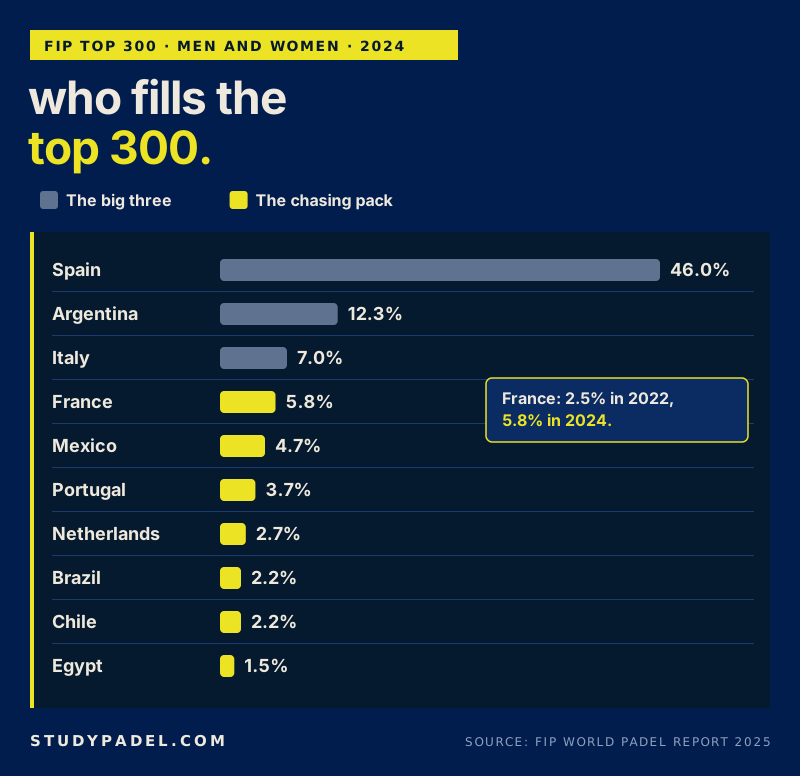
Two movements matter here. Spain’s share of the top 300 fell from 50 percent in 2022 to 46 percent in 2024. And France’s went from 2.5 to 5.8 percent over the same two years, the biggest rise FIP reports.
The top 300 is also getting more international in general. Its players came from 31 countries in 2024, nine more than a year earlier.
France: the biggest federation project in the sport
France is the country FIP singles out. It installed more courts than anyone in the 18 months to mid-2025, about 1,850, and passed 4,000 in total. A French market study counts 3,800 courts at 1,150 sites in 2026, up from 60 courts at 10 clubs in 2014.
What makes France different is who runs padel. It belongs to the French Tennis Federation (FFT), the organisation that owns Roland-Garros. In 2020 its €35 million Covid relief plan was reported as more than a tenth of its annual budget.
That weight shows in four places.
- Licences. The FFT counted 100,000 padel-only licence-holders in June 2025, up 42.7 percent in a year, and 250,000 once tennis players with a multi-racket licence are included.
- Courts. A programme called Boost Padel lends affiliated clubs the cost of new courts at zero interest. More than nine in ten FFT-affiliated clubs sit on land owned by local councils, so courts are added to public sites that already exist.
- A showcase. The Paris Major, one of the four biggest tournaments of the Premier Padel season, is played at Roland-Garros.
- A national academy. In September 2025 the FFT opened a national padel training centre in Vichy, with six indoor and six outdoor courts next to a state high-performance sports centre. The first intake is twelve boarders aged 13 to 16, eight boys and four girls, who combine school with daily training. The stated aim is to close the gap on Spain and Argentina.
The results are starting to follow. France’s men and women both finished seventh at the 2024 World Championships. Its boys took bronze at the 2025 Junior World Cup, beating Brazil. 129 French players hold a world ranking, led by Alix Collombon (38th) among the women and Dylan Guichard (71st) among the men.
One oddity: France’s women broke through before its men. In 2024 it had three women in the top 100 and one man.
Portugal: the closest to the podium
Portugal is the proof that court numbers are not everything. With 1,560 courts, fewer than Belgium, it did what no other country in this group managed in 2024: its men won bronze at the World Championships, ahead of Italy, and its women finished fourth.
In 2024 Portugal had three men and three women in the top 100. Sofia Araújo is now ranked ninth in the world. And the next generation has arrived: Portugal’s girls beat Argentina in the semi-finals of the 2025 Junior World Cup and lost only to Spain in the final.
The explanation is geography as much as structure. Portuguese players train and compete in Spain as a matter of routine, against the strongest standard in the sport. Interest at home is high too. By FIP’s measure of online interest, Portugal has the third-largest padel following in Europe, behind only Spain and Italy.
The Netherlands and Belgium: built on the tennis club
By licences per head, these two are the best-organised padel countries in Europe.
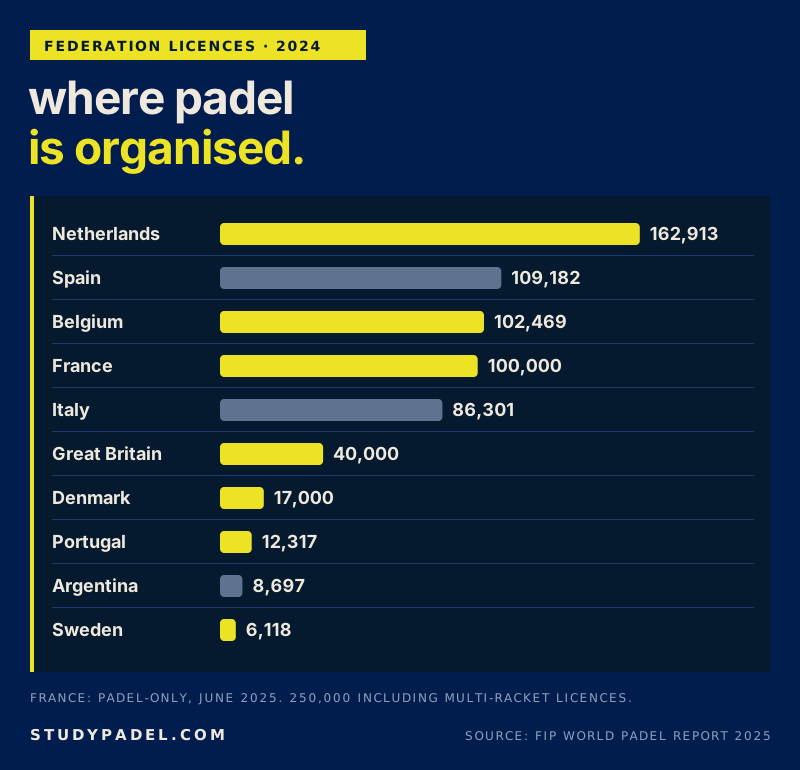
The Netherlands has 162,913 licensed padel players. Spain has 109,182. Belgium, with 11 million inhabitants, has 102,469. In the Netherlands, Belgium and France, padel was taken in by the tennis federation and inherited its clubs, its membership system and its leagues.
The Dutch teams are ahead of the Dutch professionals. The women finished fifth at the 2024 Worlds, the men qualified for Doha 2026 through the European qualifier, and both teams reached the final eight of the 2025 European championship. Yet no Dutch man was in the top 100 in 2024.
In Belgium the engine is interclub, the graded team competition that every Belgian tennis player knows. It moved across to padel almost unchanged. The country’s number one, Clément Geens, sits around 70th in the world, and Belgium is sixth in the world for the number of juniors holding a FIP ranking.
Sweden: results from the boom years are arriving now
Sweden’s story is told at length in our article on the Swedish crash. The short version for this article is that the players who started as children during the boom are now reaching the international stage.
Sweden’s boys were runners-up at the 2023 Junior World Championships in Asunción. Going by FIP’s roll of honour, that made Sweden the first European country other than Spain to reach a junior world team final. In 2025 both the boys and the girls finished sixth. Adam Axelsson, born in 2005, is the top-ranked Swedish man at 114th.
Brazil, Paraguay, Mexico and Chile: Latin America after Argentina
Brazil has history. Pablo Lima was world number one for years. Today Lucas Campagnolo is 15th, the highest-ranked man from any country in this article, and Brazil’s men finished sixth at the 2024 Worlds. Its juniors finished fourth in both the boys’ and girls’ draws in 2025, and Brazil supplies about 7 percent of all juniors with a FIP ranking.
Paraguay punches far above its size: 2,000 courts for fewer than 7 million people. Its boys won the 2021 Junior World Championship, finished fifth in 2025, and both senior teams qualified for the 2026 World Cup.
Mexico has the most players of any country here, 1.1 million by FIP’s estimate, and a Major in Acapulco. It also had 4.7 percent of the top 300 in 2024, more than Portugal. Most of that depth is in the women’s game.
Chile has about a million players and 7 percent of the world’s ranked juniors, but its club market is going through a Swedish-style correction and its professional list still depends on one name, Javier Valdés, who left for Spain as a teenager.
Britain, Germany and the Gulf: new money, short history
Great Britain had 69 courts in 2020 and passed 1,000 in July 2025. By May 2026 its federation, the LTA, counted 1,825 courts and a million players. Its women qualified for the World Cup for the first time this year, and its men lost the deciding tie of the European qualifier to Germany. Almost every ranked British player took up padel as an adult.
Germany will send both teams to Doha, and is the market investors are watching most closely. Its best player, Victoria Kurz, came from the professional tennis tour.
The United Arab Emirates finished fifth at the 2024 Worlds, ahead of Brazil and France. That says more about recruitment than about a domestic pathway. The UAE has about 1,300 licensed players, and its top-ranked man, Iñigo Jofre, 26th in the world, is one of several who arrived from established padel countries.
The youth pipeline: who is coming
The best single measure of the next ten years is the Junior World Cup. The 2025 edition in Reus had 36 countries, up from 20 two years earlier.
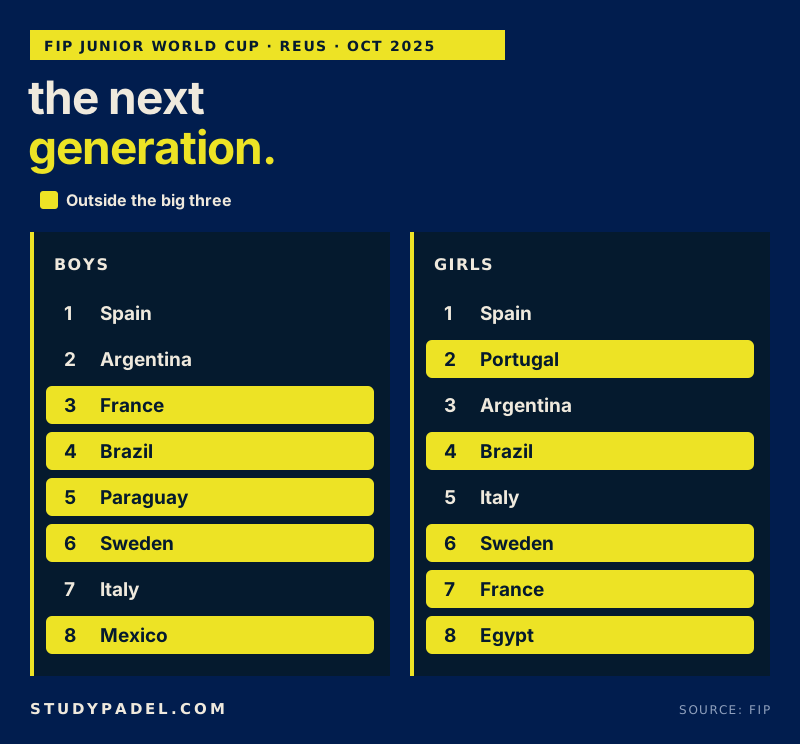
Three things stand out.
- Spain is not being caught at the top. It won both titles, as it did in 2023, and its boys won their quarter-final and semi-final without dropping a set.
- The places behind Spain are open. Portugal’s girls and Sweden’s boys have each reached a final in the last two editions. Italy’s juniors, by contrast, finished seventh and fifth.
- Volume and results are different things. Of the 2,385 children who played FIP’s junior circuit in 2024, 823 were Spanish, 299 Italian, 167 Brazilian and 166 Chilean. France had 25. French juniors mostly come up through the FFT’s own national championships for under-14s, under-16s and under-18s, and still took a world bronze.
The number of juniors with a FIP ranking doubled in a year, to 2,477 in 2024, and the countries represented rose from 15 to 39.
The money question: can funding replace Spain’s competition?
This is the question behind all of the above. A young player from France, the Netherlands or Belgium often has more support behind them than a Spanish player of the same level. Does that help?
Start with what a season costs. Clément Geens, the Belgian number one, has laid out his accounts in the Belgian press twice.
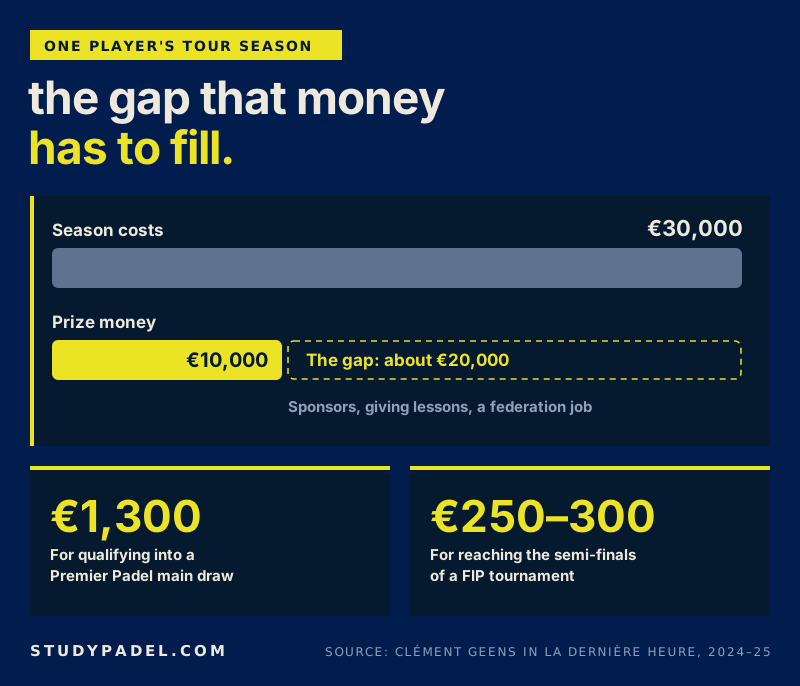
A season costs him about €30,000, mostly flights and hotels. He keeps it that low by paying for no coach; he puts a typical player at his ranking nearer €50,000. His prize money was under €8,000 in 2023 and just over €10,000 the season after. Getting through qualifying at a Premier Padel event paid about €1,300. A semi-final at a FIP tournament paid €250 to €300. In his words, a top-60 player lives comfortably and outside the top 130 it is a real struggle. FIP’s own prize funds show why: a FIP Gold event shares out €50,000 among the whole field.
So below the very top, a career is paid for by something other than results. This is where nationality starts to matter.
Being number one in a small padel country can be worth more than being the 70th-best Spaniard. Spain fills almost half of the top 300, so a Spaniard ranked 150th in the world has roughly 70 compatriots ahead of them. A Belgian ranked 70th is his country’s best player. That status brings a national team place, a national audience and national sponsors. Geens lists about ten sponsors and partners, and works as sporting director of his regional federation’s padel programme.
Tennis federations have money padel federations do not. In France, the Netherlands, Belgium, Italy and Britain, padel sits inside the tennis federation. That means staff coaches, national squads, training centres like Vichy and travel budgets for junior teams. Spain’s padel federation is a stand-alone body with 109,000 licence-holders and no Grand Slam tournament behind it.
Home tournaments are cheaper ranking points. Between 2019 and 2025 Spain hosted 79 FIP Tour events and Italy 68. But the Netherlands hosted 21, Portugal and Brazil 18 each, Sweden 15, France and the UAE 14, Britain 11 and Belgium 9. Each one is a week of points without flights, and often with a wildcard. The same goes for the Premier Padel stops in Paris, Bordeaux, Brussels, Rotterdam and Düsseldorf.
What money cannot buy is the daily level. StudyPadel’s own description of Spain is that the hardest competition in padel is the Spanish domestic circuit. Nearly every player named in this article has had to go there. Valdés left Chile as a teenager. The Portuguese cross the border every week. Funding lets a 19-year-old from Lyon or Gothenburg afford three years of trying. It does not shorten the three years.
The fairest summary: money has changed who can afford to attempt a padel career, and that is one reason the top 300 now has 31 nationalities. It has not yet changed who wins. That will take the juniors now at Vichy, in Lisbon and in Asunción growing up.
Who breaks through first?
- Most likely to win a medal again: Portugal. It already has, and its juniors are the best outside Spain and Argentina.
- Our pick to be a top-four nation by 2030: France. No other country combines that court growth, that federation and that pipeline.
- Best junior depth outside Europe: Brazil, with Paraguay the best per head of population.
- Most organised: the Netherlands and Belgium, which now need a first top-50 man.
- Wildcard: Sweden, if the generation that grew up in the boom stays in the sport.
For where the courts behind all this are being built, see padel courts around the world.
Every country’s ranked players, best man and woman, and national-team results are on our padel by country pages.
Quick answers
Which country is the best at padel after Spain and Argentina? On results, Portugal and Italy. Portugal’s men finished third and Italy’s women third at the 2024 World Championships. On size, Italy, with 10,220 courts.
Is France good at padel? France is improving faster than any other country. It finished seventh in both draws at the 2024 Worlds, took bronze in the boys’ event at the 2025 Junior World Cup and more than doubled its share of the top 300 between 2022 and 2024.
How much does a professional padel player earn outside the top 100? Very little from prize money. Belgium’s number one, ranked around 90th at the time, reported just over €10,000 in prize money against €30,000 in costs for a season.
Which countries have the most junior padel players? By number of juniors with a FIP ranking in 2024: Spain (34 percent), Italy (13.8), Chile (7.1), Brazil (6.9), Argentina (4.7), Belgium (4.1), Egypt (3.1), Sweden (2.8), Ecuador (2.3) and the Netherlands (2.2).
Sources
- International Padel Federation: World Padel Report 2025 (courts, players, licences, top 100 and top 300 by nation, junior rankings, FIP Promises participation, tournaments hosted, junior world championship roll of honour).
- International Padel Federation: Junior World Cup 2025 final report and standings, the 2025 field, the Euro Padel Cup final eight, FIP Platinum and Gold prize funds.
- La Dernière Heure: Clément Geens on what a season costs (April 2024) and his prize money (April 2025).
- Europe 1: the national padel training centre in Vichy. SportMag: why the FFT chose Vichy.
- Fédération Française de Tennis: Boost Padel programme for clubs. L’Express Franchise: the French padel market in 2026. Tennis Majors: the FFT’s 2020 relief plan and budget.
- Modèles de Business Plan: FFT padel licence figures, June 2025.
- LTA: one million padel players in Britain (May 2026).
- StudyPadel: country pages for France, Portugal, the Netherlands, Belgium, Sweden, Brazil, Mexico, Chile, the UK, Germany and the UAE (rankings read in week 41 of 2026). 2024 World Championship standings as in our World Cup history.