


Padel vs Tennis: Key Differences, Rules and Which Is Easier
Padel and tennis share a scoring system and not much else. Padel is played as doubles inside a smaller, glass-walled court, with a solid racket, an underarm serve and walls that stay in play. Tennis is played on a larger open court with a strung racket and an overarm serve. Padel is easier to start and tennis is still far bigger: about 106 million people play tennis worldwide, against 19 to 35 million for padel.
Padel vs tennis at a glance
| Padel | Tennis | |
|---|---|---|
| Court | 20 × 10 m (65.6 × 32.8 ft), enclosed | 23.77 × 10.97 m (78 × 36 ft) for doubles, open |
| Walls | Glass and metal mesh, in play after the bounce | None |
| Net height at the centre | 0.88 m (34.6 in) | 0.914 m (36 in) |
| Players | Doubles | Singles or doubles |
| Serve | Underarm after a bounce, two attempts | Overarm, two attempts |
| Scoring | 15, 30, 40, game; six games win a set | The same |
| Deuce | Advantage, Star Point or Golden Point | Advantage, or a deciding point in some doubles events |
| Racket | Solid and perforated, up to 45.5 cm long, with a wrist cord | Strung, up to 73.7 cm long |
| Ball | 6.35–6.77 cm across | 6.54–6.86 cm across |
| Rallies | Longer, because the walls keep the ball alive | Shorter, with more points ended by a serve or a winner |
| Booking | One court, split between four players | One court, split between two or four |
Is it padel or padel tennis?
The sport is called padel. In the UK it is often called padel tennis, which is understandable, since the Lawn Tennis Association governs both. But padel is its own sport with its own rulebook, written by the International Padel Federation (FIP), and not a variant of tennis.
Two other names cause confusion. Paddle tennis and platform tennis are separate American games, and pickleball is different again. Our padel vs pickleball guide sorts out all four.
The court
A padel court is 20 m long and 10 m wide (65.6 × 32.8 ft) and fully enclosed. A tennis court is 23.77 m long and 10.97 m wide for doubles (78 × 36 ft), with no walls.
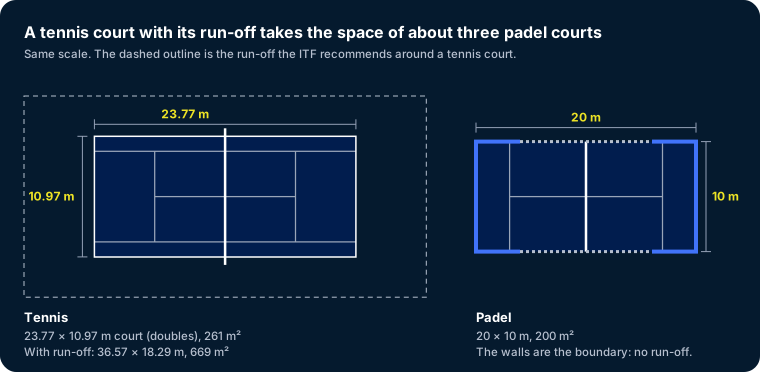
- Padel. The back walls are 4 m high: glass or solid wall topped with metal mesh. The side walls are glass at each end and mesh in the middle. After the ball has bounced it may hit any of them and play continues, so the walls are both the boundary and part of the game.
- Tennis. The lines are the boundary, and the court needs clear space around it. The ITF recommends a total area of 36.57 × 18.29 m for international play and about 34.75 × 17.07 m for clubs.
How many padel courts fit on a tennis court? By area, about three. A tennis court with its run-off covers roughly 590 to 670 m², and a padel court covers 200 m². In practice the shape decides. A padel court is 20 m long, and a tennis court with its run-off is only 17 to 18 m wide, so a single tennis court usually takes one padel court, or two where there is spare space around it. The common conversion is two tennis courts side by side into three padel courts. The playing areas themselves are closer than most people think: 200 m² for padel against 261 m² for a tennis doubles court.
Rules and scoring
The scoring is the same in both sports. Almost everything else is different.
| Padel | Tennis | |
|---|---|---|
| Serve | Underarm: bounce the ball, then hit it at or below waist height | Overarm, hit out of the air from a toss |
| Serve attempts | Two | Two |
| Walls | In play once the ball has bounced | None. A ball past the lines is out |
| Volleys | Anywhere, except the return of serve | Anywhere, except the return of serve |
| Points | 15, 30, 40, game | 15, 30, 40, game |
| Sets | Six games, two clear, tie-break at 6-6 | Six games, two clear, tie-break at 6-6 |
| Match | Best of three sets | Best of three or five sets |
Three differences shape how the games feel:
- The serve. In tennis the serve is a weapon. In padel it only starts the point, which is why beginners can play a proper game on day one.
- The walls. In tennis a ball that gets past you is gone. In padel you can let it pass, wait for it to come off the back glass and still return it.
- Deuce. Tennis usually plays advantage. Padel competitions choose between Advantage, Star Point and Golden Point, where a single point decides the game.
For the detail, see our complete padel rules guide, the scoring guide and the serve rules guide.
Equipment: rackets and shoes
A padel racket is short, solid and has no strings. A tennis racket is long and strung.
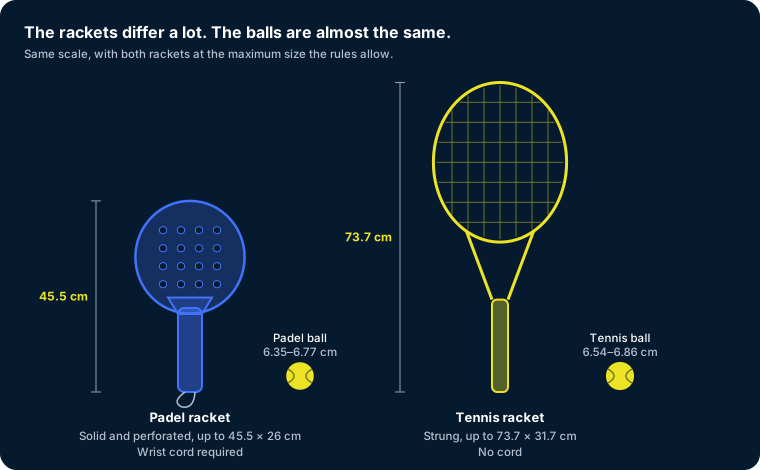
- Padel racket. Up to 45.5 cm long, 26 cm wide and 38 mm thick, with holes drilled through a solid face. A wrist cord is compulsory and must be worn during play.
- Tennis racket. Up to 73.7 cm long and 31.7 cm wide, with a strung hitting surface. Most adult rackets are about 68.5 cm (27 in) long.
- What that means on court. The padel racket's short reach and solid face make it easier to control and harder to hit with power. Timing a tennis racket takes longer to learn, but it rewards you with much more pace and spin.
- Shoes. Most padel courts are sand-dressed artificial turf, so padel shoes have a herringbone or omni sole that grips sand. Clay-court tennis shoes have a similar sole and work well. Hard-court tennis shoes will do for a first session, but they slide more on the sand.
Are padel balls the same as tennis balls?
No, but they are very close. A padel ball is slightly smaller and is allowed a slightly lower bounce.
| Padel ball (FIP) | Tennis ball (ITF, standard type) | |
|---|---|---|
| Diameter | 6.35–6.77 cm | 6.54–6.86 cm |
| Weight | 56.0–59.4 g | 56.0–59.4 g |
| Bounce when dropped from 2.54 m | 135–145 cm | 135–147 cm |
The ranges overlap, so the two balls look and feel almost identical, and the weight is exactly the same. The FIP rules also set the padel ball's internal pressure, at 4.6 to 5.2 kg per 2.54 cm². In practice padel balls are made a touch smaller and less lively, which suits a small court with glass walls.
You can use tennis balls for a casual game of padel. They will come off the glass a little faster. Competitions require approved padel balls.
Is padel easier than tennis?
Yes, at the start. Padel gets beginners into real rallies sooner, mainly because of the serve, the smaller court and the shorter racket. At a high level both are hard, in different ways.
- Complete beginners. In padel most people can serve, rally and play a set in their first session. In tennis the serve and the size of the court mean it usually takes weeks of practice before rallies last.
- Improving. Tennis progress is mostly about technique: the serve, topspin and footwork. Padel progress is mostly about tactics: positioning as a pair, using the lob and reading the ball off the walls.
- At the top. Neither is easier. Elite tennis demands more power and covers more ground. Elite padel demands patience, teamwork and precise use of the glass.
This is our own assessment of how the two games are built, not the result of a study.
Fitness, injuries and age
Both are good exercise. Tennis involves more running in straight lines and more serving. Padel involves shorter sprints, more turning and more overhead shots.
- Intensity. A singles tennis player covers the whole court alone. Padel is always doubles on a smaller court, so the distances are shorter, but rallies last longer and there is little standing still.
- Padel injuries. A 2023 systematic review of eight studies and 2,022 players found about 3 injuries per 1,000 hours of padel training and 8 per 1,000 matches. The elbow was the most commonly reported injury site.
- Tennis elbow. It is common in padel too, despite the name. If you are dealing with it, our article on healing padel tennis elbow shares one player's experience.
- Age. Padel's underarm serve, smaller court and doubles format make it easier on the body for older players. Tennis doubles offers many of the same benefits.
We found no study that compares injury rates in the two sports directly, so neither can be called safer. If you have a joint or heart condition, ask a doctor before you start either one.
Can tennis players switch to padel?
Yes, and they usually pick it up quickly. In Britain, the LTA estimates that two thirds of the one million people who play padel also play tennis.
What transfers:
- Volleys and overheads. Your net game works from the first day. Padel adds overheads of its own, such as the bandeja and the víbora, covered in our padel overheads guide.
- Scoring and court sense. There is nothing new to learn about the score, and you already know how to play doubles.
- Hand-eye coordination. The ball behaves much like a tennis ball.
What you have to unlearn:
- The big swing. Padel rewards a short, compact stroke. A full tennis backswing sends the ball into the back glass.
- Stopping every ball. Tennis players instinctively cut the ball off before it passes them. In padel it is often better to let it go and play it off the wall.
- Hitting winners from the back. Padel points are built with lobs and patience, and are usually finished at the net. Our padel tactics guide explains how.
Several top padel professionals started in tennis. Marta Marrero reached the French Open quarter-finals in 2000 and a career-high tennis ranking of 47 before switching to padel, where she became world number one. Gemma Triay grew up playing tennis, moved to padel in 2013 and also reached number one.
Popularity and growth
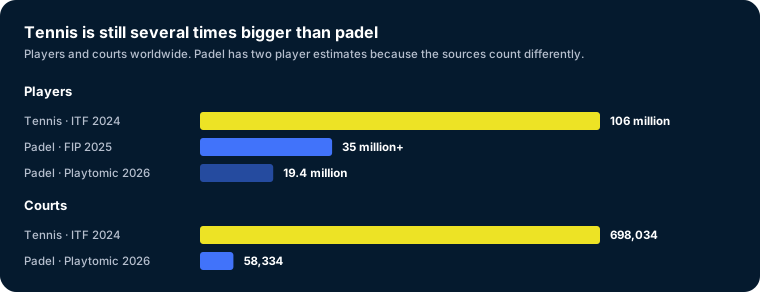
Tennis is still much bigger. Padel is growing much faster, from a far smaller base.
| Padel | Tennis | |
|---|---|---|
| Players worldwide | 19.4 million (Playtomic, 2026) to more than 35 million (FIP, 2025) | About 106 million (ITF, 2024) |
| Courts worldwide | 58,334 at the end of 2025 (Playtomic); 77,300 by FIP's count (2025) | 698,034 |
| Great Britain | 1 million players, 1,825 courts at 551 venues (May 2026) | 5.8 million adults a year (2025) |
| United States | About 1.07 million players (2025) | 23.8 million players (2024) |
| Spain | More than 5.5 million players, about 17,000 courts (2024) and 111,866 federation licences (October 2025) | About 3.3 million players (2024) and 96,413 federation licences (2023–24) |
A few things stand out:
- The gap is large. Tennis has three to five times as many players as padel, depending on which padel estimate you use, and nine to twelve times as many courts, depending on whose padel court count you use.
- Spain is the exception. It is the clearest case of a country where padel is bigger than tennis: about 5.5 million padel players against 3.3 million for tennis, and 111,866 padel federation licences against 96,413 for tennis.
- The two padel figures differ because they count differently. FIP's figure of more than 35 million is the federation's own estimate. Playtomic and PwC's Strategy& put it at 19.4 million using a more conservative method. We show both.
- Padel's growth is real. About 7,900 courts and 5,000 clubs were added worldwide in 2025. In Britain, players went from 15,000 in 2019 to 129,000 in 2023, 400,000 in 2024, 860,000 in 2025 and one million by May 2026.
- It is not growing everywhere. The same Playtomic report puts Sweden, Finland and Chile in a post-boom correction, with too many courts for the demand. Chile saw 80 clubs close in 2024 and monthly bookings fall by 27%.
Is padel replacing tennis? The data does not support that. Tennis participation rose from 84.4 million in 2019 to about 106 million in 2024, during the same years padel boomed. Even in Spain, where padel has overtaken it, tennis federation licences grew by 37% between 2019 and 2024. In Britain most padel players also play tennis, and many clubs are adding padel courts alongside their tennis courts.
For country-level detail on the professional game, see our pages on padel in the UK, Spain and the USA.
Padel or tennis: which is better for you?
Choose by what you enjoy and what is near you.
- Choose padel if you want to be playing real games in your first week, you prefer playing in a four, you like long rallies and tactics, or you want something easier on the body.
- Choose tennis if you want to play singles, you enjoy hitting with power, you want a sport you can play almost anywhere, or you like working on technique.
- Play both if you can. The skills overlap, and most British padel players already do.
If you play tennis and are curious, book a padel court with three friends for an hour. Most clubs hire out rackets, and one session will tell you whether the walls are for you.
FAQ
Is padel harder than tennis?
Not to begin with. Padel is easier to start because of the underarm serve, the small court and the short racket. At an advanced level both are demanding: tennis technically and physically, padel tactically.
Why is everyone suddenly playing padel?
It is quick to learn, it is always played in fours, and courts are opening fast. In Britain the number of courts roughly doubled in under eighteen months, from 870 at the end of 2024 to 1,825 in May 2026.
Why is padel so expensive in the UK?
Mostly because demand is ahead of supply. Britain has one million players and 1,825 courts, and many of those courts are covered, which costs more to build and run. The price is split four ways, which softens it.
Is padel still growing, or is it in decline?
Worldwide and in Britain it is still growing. A few early-boom markets, including Sweden, Finland and Chile, have seen clubs close after building too many courts.
Is padel only for older players?
No. It suits older players because of the underarm serve and the doubles format, but the professional game is fast and athletic, and the LTA counts both adults and juniors among Britain's one million players.
In which country is padel most popular?
Spain, which has more than 5.5 million players and about 17,000 courts, according to the International Padel Federation. It is also one of the few countries where padel has more players and more federation licences than tennis.
What is padel called in the USA?
Padel. The name is the same everywhere. Americans sometimes confuse it with paddle tennis and platform tennis, which are different sports.
Is padel noisy for neighbours?
It can be. The solid racket and the ball striking glass make a sharper sound than tennis, and courts are often used in the evening. If you are planning a court near housing, check the local planning rules first.
Why do so many F1 drivers play padel?
Max Verstappen, Lando Norris, Carlos Sainz and Charles Leclerc have all been filmed playing padel together around race weekends, and Pierre Gasly co-owns a team in the Hexagon Cup, a professional padel team event. It suits a travelling group: four players, one hour, courts in most cities on the calendar.
Sources
Figures were checked on 3 October 2026.
- FIP Rules of Padel, in force since 1 January 2026. Padel court, ball and racket specifications, serve and scoring.
- ITF Rules of Tennis 2026. Tennis court, ball and racket specifications.
- ITF Global Tennis Report 2024. 106 million players, 698,034 courts, 23.8 million players in the USA.
- Playtomic and PwC Strategy&, Global Padel Report 2026. 58,300 courts, nearly 20,000 clubs and 19.4 million players.
- Padel Addict: summary of the Global Padel Report 2026. 58,334 courts, courts and clubs added in 2025, the FIP estimate of 35 million players, and the Chile figures.
- LTA Padel: 1,000,000 padel players in Britain, May 2026. Players, courts, venues, the year-by-year figures since 2019 and the overlap with tennis.
- Golf Post: Britain passes one million padel players. British court numbers at the end of 2024.
- LTA: annual report and accounts 2025, May 2026. 5.8 million adults playing tennis in Britain.
- SFIA: US participation. About 1.07 million US padel players in 2025.
- FIP: Focus on Madrid. Players and courts in Spain. In Spanish.
- FIP World Padel Report 2025. More than 35 million players and 77,300 courts worldwide.
- FIP: padel in Spain in 2024. About 17,000 courts in Spain. In Spanish.
- Tennis Temple: the success of padel in Spain. 111,866 Spanish padel federation licences (October 2025), more than tennis.
- RFET: Spanish tennis licences. 96,413 tennis licences in 2023–24, up 37% since 2019. In Spanish.
- Industria del Tenis: tennis in Spain. About 3.3 million tennis players in Spain (ITF, 2024). In Spanish.
- Dahmen et al., BMJ Open Sport & Exercise Medicine, 2023. Systematic review of padel injuries.
- Wikipedia: Marta Marrero and Padel1969: Gemma Triay. Tennis backgrounds of the two players.