

How to Choose a Padel Racket: Shape, Weight, Balance and Feel
The short answer. Pick the shape for your level first: round for learning and control, teardrop for all-round play, diamond only once you hit the sweet spot nearly every time. Then choose the hardness: soft is easier on the arm and gives easy depth, hard gives control and power on a fast swing. Weight and balance come last. Don't buy a professional's racket. Most beginner rackets cost €60–90 and most club players' rackets €100–170 at the retailer we track.
Padel racket shapes at a glance
| Shape | Sweet spot | Balance | Suits | Median price |
|---|---|---|---|---|
| Round | Large, centred | Low | Beginners, control players, sore arms | €130 (£113 / $134) |
| Teardrop | Medium, a little high | Medium | Most club players | €165 (£142 / $175) |
| Diamond | Small, high | High | Advanced attackers | €186 (£160 / $179) |
Median prices of the 36 round, 39 teardrop and 60 diamond adult rackets in our database, at one retailer on 7 October 2026.
This guide is built on two sets of our own data: the specs and prices of 188 adult rackets, and the rackets used by 100 top professionals. Where a rule of thumb is not backed by that data, we say it is a rule of thumb.
Racket shape: round, teardrop or diamond
Shape is the first decision, because it sets two other things: where the sweet spot is and where the weight sits.
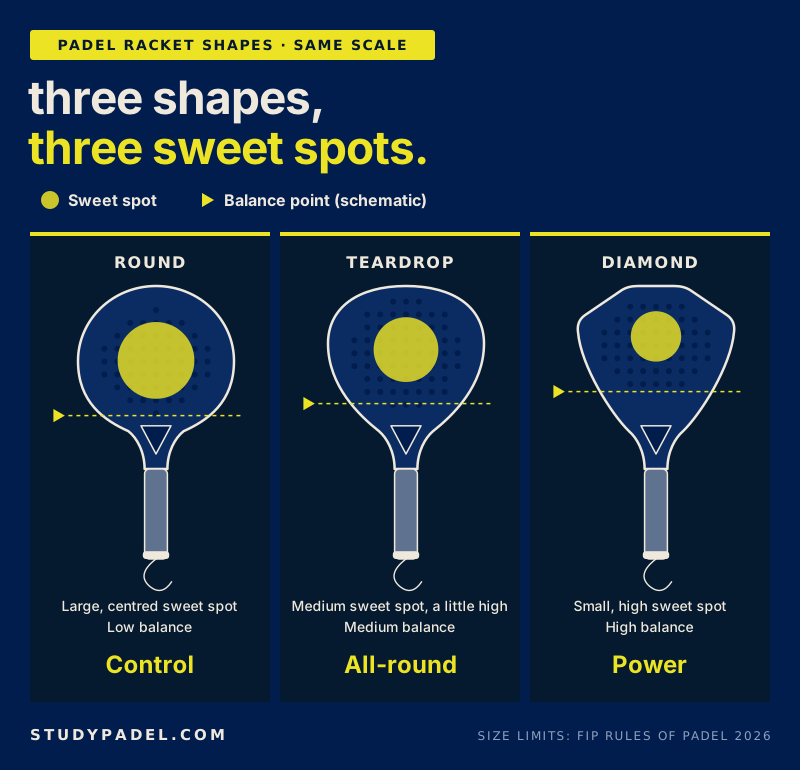
Round. The widest part of the head is in the middle. The sweet spot is large and central, so a ball hit slightly off-centre still goes back. The weight sits low, towards your hand, which makes the racket quick to move. You give up some power on overheads.
Teardrop. The head widens towards the top. The sweet spot is a little smaller and a little higher, and the balance is in the middle. It is the compromise shape: enough forgiveness to defend, enough weight up top to attack.
Diamond. The widest point is high and the top is flatter. The sweet spot is small and near the tip, and so is the weight. Hit it right and the ball leaves fast. Miss it and you feel the difference at once.
Hybrid is not a fourth shape. Brands use the word for outlines that sit between two of the others, usually a teardrop with a slightly flatter top. Only 10 of our 188 rackets carry the label. Read it as “teardrop-ish” and look at the balance instead.
Three questions come up constantly.
- Teardrop or diamond? If you are asking, teardrop. A teardrop is good enough to attack with at any club level. A diamond adds a little power for players who already hit clean overheads.
- Round or diamond? These are opposite ends. Round forgives and diamond punishes. Very few players should move from one straight to the other.
- Can a round racket have power? Some do. Makers add it with a harder core or more weight in the head. Our database has 15 round rackets tagged for advanced players.
Hardness: soft, medium or hard
Hardness comes from the core, the foam in the middle of the racket, and to a lesser degree from the faces.
Most cores are EVA rubber, which is made in many densities. Some are a softer polyethylene foam, usually just called foam. In our database 124 rackets have an EVA core and 22 a foam one.
The honest answer to the most-asked question, which is whether soft or hard gives more power, is that it depends on your swing.
- A soft core acts like a trampoline. On a slow swing or a blocked volley the ball comes off with easy depth. It also absorbs more vibration. On a full, fast swing some of your energy is lost in the foam.
- A hard core gives little back on a slow swing, so the ball can drop short. On a fast, full swing it returns more of what you put in, and the ball goes where you aimed it.
So a beginner gets more “power” from a soft racket and an advanced player gets more from a hard one. That is exactly how the market is built:
| Rackets tagged for | Soft | Medium | Hard |
|---|---|---|---|
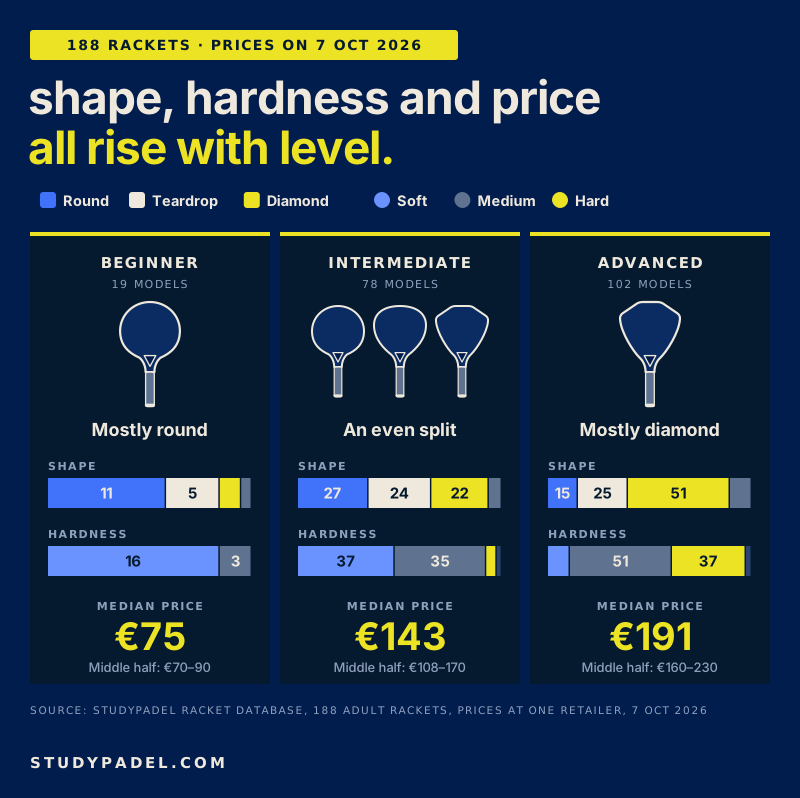
| Beginners (19) | 16 | 3 | 0 |
| Intermediate players (78) | 37 | 35 | 4 |
| Advanced players (102) | 11 | 51 | 37 |
Temperature matters too. The same racket feels harder on a cold morning than on a hot afternoon.
For what the foam names and core technologies really mean, see how padel rackets are made.
Weight
We do not hold weights in our database, so this section rests on what brands publish.
Most adult rackets are listed at between about 350 and 375 grams, and light versions go lower. Brands give a range for each model, not a single figure, because two rackets from the same mould differ by a few grams. Nox, for example, lists its X-One at 360–375 g and its X-Zero at 350–360 g.
- Lighter rackets are quicker at the net and kinder to the elbow and shoulder. They are less stable against a hard ball.
- Heavier rackets are more stable and put more mass behind a smash. They are slower to move and tire the arm sooner.
Ten grams is a difference you can feel. Two things to keep in mind when comparing numbers:
- What you add counts. A frame protector adds roughly 5–10 g at the head, which shifts the balance as well as the weight. An overgrip adds a little at the handle.
- “Light” and women's versions are usually 10–15 g lighter than the standard model. Bullpadel lists its Vertex 05 at 365–375 g and the Vertex 05 W at 350–360 g.
If you are unsure, start light. You can add weight to a racket. You cannot take it off.
Balance: low, medium or high
Balance is where the weight sits along the racket. Two rackets of the same weight can feel completely different in the hand because of it.
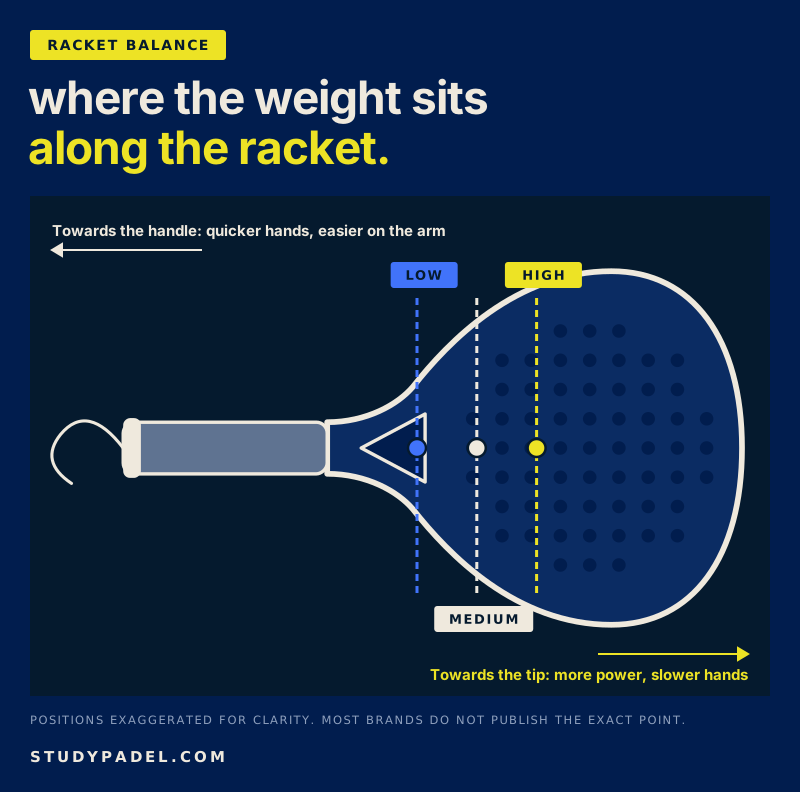
- Low balance (weight towards the handle): easy to move, easy on the arm, less punch.
- High balance (weight towards the tip): more power on overheads, slower hands at the net, more load on the wrist and elbow.
- Medium: between the two.
Shape largely decides balance: round rackets are usually low, diamonds usually high. Most brands do not publish the exact balance point, so the label is what you have to go on. A few rackets have movable weights, which lets you change the balance yourself. Eight in our database are marked adjustable.
The face: glass fibre or carbon, rough or smooth
The faces are thin sheets of glass fibre or carbon fibre. Glass fibre is softer and cheaper, and common on beginner rackets. Carbon is stiffer and lasts longer. Labels such as 3K, 12K and 18K describe the carbon weave. They do not rank quality. A rough face helps with spin. We cover all of this in how padel rackets are made, so we will not repeat it here.
Match the racket to your level
Put shape, hardness and price side by side and one pattern runs through all three.
| Level tag | Rackets | Median price | Middle half | Shapes |
|---|---|---|---|---|
| Beginner | 19 | €75 (£66 / $91) | €70–90 | 11 round, 5 teardrop, 2 diamond |
| Intermediate | 78 | €143 (£124 / $149) | €108–170 | 27 round, 24 teardrop, 22 diamond |
| Advanced | 102 | €191 (£166 / $184) | €160–230 | 51 diamond, 25 teardrop, 15 round |
A racket tagged for two levels counts in both rows.
- Beginner: round and soft. We list eight that fit in the best padel rackets for beginners.
- Intermediate: this is where the choice opens up, with all three shapes almost equally common. See the best padel rackets for intermediate players.
- Advanced: mostly diamond, medium or hard.
- Women: the same rules apply, with lighter versions available. See padel rackets for women.
What the pros use, and why you should not copy it
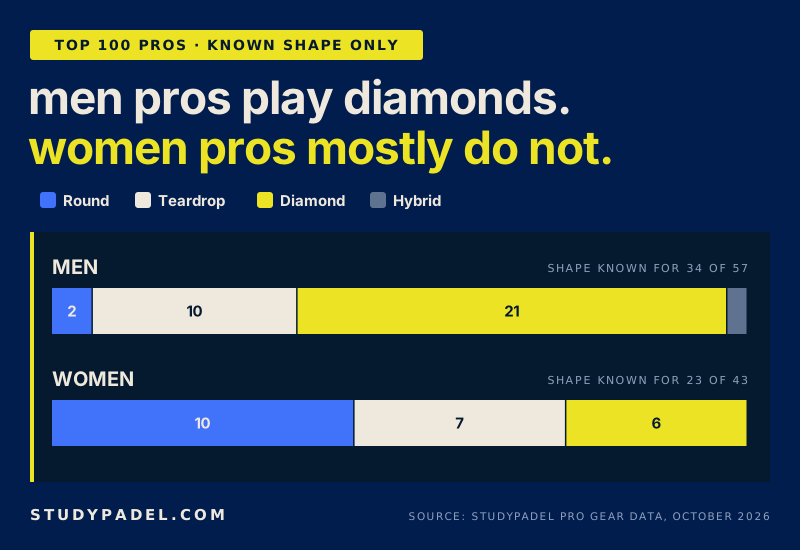
Among the men in our pro data whose racket shape we know, 21 of 34 play a diamond. Among the women it is the other way round: 10 of 23 play a round racket, and only 6 a diamond.
A professional's racket is the far end of the scale, not a target. It is built for someone who trains daily and finds the sweet spot almost every time. The women's numbers make the point: some of the best players in the world choose round. The full list is in what rackets the pros use.
Match the racket to how you play
These are rules of thumb, not data.
- You defend, lob and build the point: round or teardrop, soft or medium.
- You like to finish with overheads: teardrop or diamond, medium or hard.
- You play both ways: teardrop, medium. It is the commonest combination for a reason.
Drive side or backhand side? There is no rule. It is often said that the backhand-side player should use a diamond because they hit more smashes. Our pro data does not support that. Both sides use every shape, and on the men's drive side 11 of the 17 players with a known shape use a diamond.
Your arm: elbow and wrist
If your elbow or wrist complains, go softer, lighter and lower in balance, in that order. A hard, head-heavy racket sends more shock up the arm. The elbow is the most commonly injured joint in padel, so this is worth taking seriously before it hurts. One of our writers describes what worked for him in how I healed my padel tennis elbow.
How much should you spend?
Less than the shops suggest.
- Starting out: €60–90. The middle half of beginner rackets in our data costs €70–90.
- Playing every week: €100–170. That is the middle of the intermediate range.
- Advanced: €160–230 for most models. Only three of the 188 cost more than €300.
A higher price mostly buys carbon, stiffness and a professional's name. Those help a player who can use them and get in the way of one who cannot. A €75 round racket is a better tool for a beginner than a €300 diamond. Last season's models are often cheaper and little different.
You can compare current prices on our racket pages, or browse by brand. If you are buying everything at once, see padel equipment for beginners. And when your racket starts to feel dead, how long a padel racket lasts explains what to look for.
Racket rules
Whatever you buy will be legal as long as it comes from a padel brand. For reference, the FIP Rules of Padel, 2026 edition, set these limits:
| Limit | |
|---|---|
| Total length, head plus handle | 45.5 cm |
| Head width | 26 cm |
| Thickness | 38 mm, with a 2.5% tolerance |
| Handle | 20 cm long, 50 mm wide and thick at most |
| Holes in the hitting surface | 9–13 mm in the central area, any number |
| Face | Flat; smooth or rough |
| Wrist cord | Non-elastic, 35 cm at most, and its use is obligatory |
The cord is the one that affects you. You must wear it, and a player who drops the racket or breaks the cord loses the point. The rest is in our rules guide.
Quick answers
How do I know which padel racket to buy?
Start from your level. A beginner should buy a round, soft racket. A regular club player should look at teardrops with a soft or medium core. Choose a diamond only if you already hit the sweet spot consistently.
Which padel racket shape is best for beginners?
Round. It has the largest sweet spot and the lowest balance, so it forgives off-centre hits and is easy to move. Our picks are in the best padel rackets for beginners.
Is it better to play with a light or heavy padel racket?
Lighter is better for most amateurs. It is quicker at the net and easier on the arm. A heavier racket only pays off if you have the strength and technique to swing it fast for a whole match.
Do more expensive padel rackets make a difference?
Only if your game can use what they add. Expensive rackets are stiffer and more head-heavy, which helps an advanced player and makes the game harder for a beginner. In our data the median beginner racket costs €75 and the median advanced one €191.
How much should I spend on a padel racket?
About €60–90 for a first racket and €100–170 if you play every week. Those ranges match the middle of the beginner and intermediate rackets at the retailer we track.
Which padel racket is the most forgiving?
A round racket with a soft core and low balance. That combination gives the biggest sweet spot and the most help on off-centre hits. Of the 19 beginner rackets in our database, 11 are round and 16 are soft.
What is the 40-40 rule in padel?
It is a scoring rule and has nothing to do with rackets. At 40-40 the game is decided by advantage, by one Golden Point or by the newer Star Point, depending on the competition. See our rules guide.
Sources
- StudyPadel racket database: 188 adult rackets with shape, hardness, balance, level and core. Prices from one retailer (Padel Market), snapshot of 7 October 2026.
- StudyPadel pro gear data: 100 professionals and the rackets they use, October 2026.
- FIP Rules of Padel, 2026 edition, section “The Padel Racket”. Size limits, holes and the wrist cord.
- Nox product pages for the X-One and X-Zero. Published weight ranges.
- Dahmen and others, Incidence, prevalence and nature of injuries in padel, BMJ Open Sport & Exercise Medicine, 2023. The elbow as the most common injury site.