

How Padel Rackets Are Made: Materials, Carbon (12K vs 18K) and Shapes
A padel racket is a slab of foam between two skins of carbon or glass fibre, wrapped in a carbon frame and baked in a metal mould. Much of the work is still done by hand. Most of it is done in Asia, with a few factories in Spain that make a point of being the exception. Most flagship models cost €300 to €390 at launch and arrive with a dozen trademarked technologies each. This guide explains how rackets are built, where, what the money pays for, and which words on the spec sheet change how a racket plays.
The short version
- How: fibre sheets and a foam core are laid into a mould by hand, cured under heat and pressure, then trimmed, painted and drilled.
- Where: mostly China, with Pakistan and India also named by the industry. Spain has a handful of brands with their own factories, led by StarVie and Royal Padel.
- Did brands move offshore? For most big names there was nothing to move. They have always been design and marketing companies that buy from composite factories in Asia.
- Price: flagships listed at €250 to €430 in 2025. The world buys about 4.5 million rackets a year, and the ten biggest brands sell 87 percent of them.
- Marketing: “18K” counts filaments in a bundle of carbon. It does not measure stiffness or quality.
- What matters: shape and balance, weight, how hard the core is, what the faces are made of, the surface texture and the grip.
What a racket is
Every padel racket has the same architecture, because the rules leave little room.
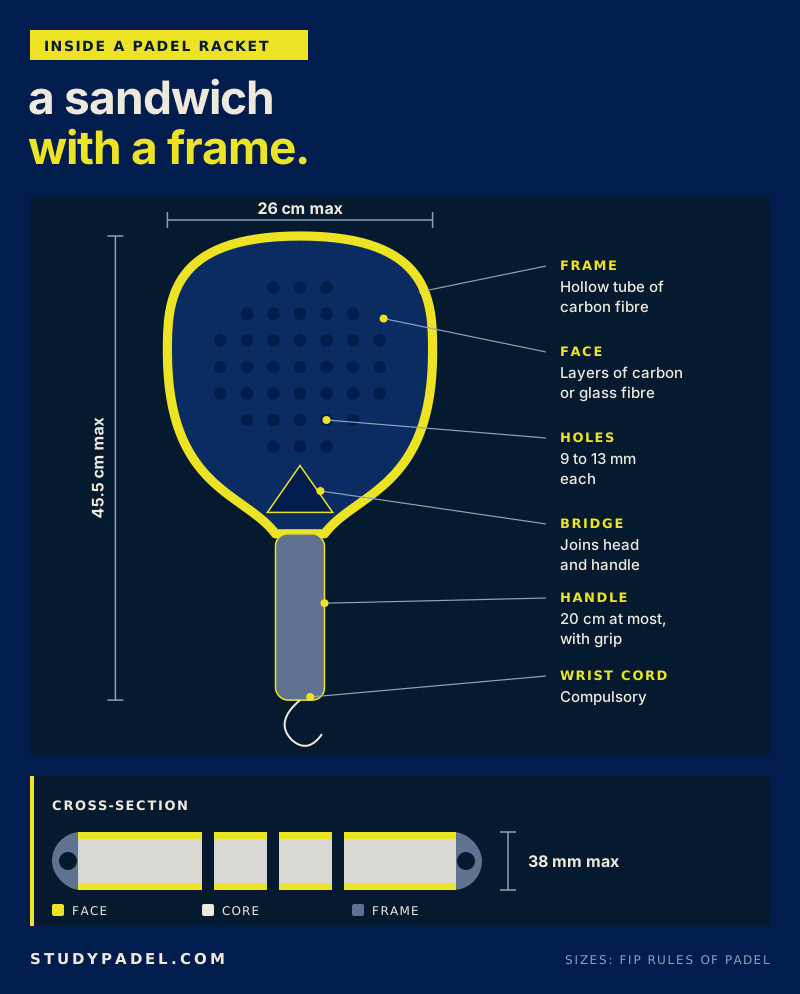
The International Padel Federation’s rules set the limits:
- no more than 45.5 cm long, 26 cm wide and 38 mm thick
- a handle of 20 cm at most
- a hitting surface drilled with holes of 9 to 13 mm in the central area (up to 20 mm within 4 cm of the edge), which may be smooth or rough
- a non-elastic wrist cord of up to 35 cm, which is compulsory
Inside those limits there are four things to choose.
The core is the middle of the sandwich. It is usually EVA rubber, a plastic foam that comes in many densities, and sometimes softer polyethylene foam. A soft core gives easy depth on a slow swing and absorbs vibration. A hard core rewards a fast swing with more power and precision, and lasts longer.
The faces are thin layers of fabric soaked in epoxy resin. Glass fibre is cheaper, softer and more flexible. Carbon fibre is lighter and stiffer for the same strength, which is why it dominates the top of every range.
The frame is a hollow carbon tube that runs around the head and gives the racket its rigidity.
The shape decides where the weight sits.
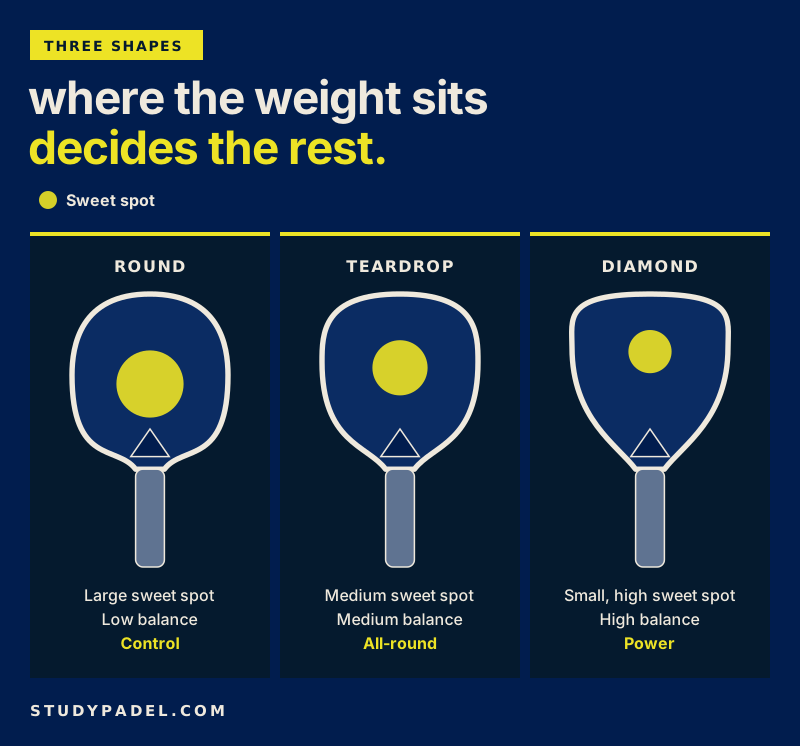
There are three main shapes. Round rackets keep the weight low and the sweet spot large and central, which makes them the most forgiving and the usual choice for beginners and control players. Teardrop rackets sit in between, with a medium balance and an all-round feel. Diamond rackets put the weight high and the sweet spot higher and smaller: more power on smashes, less margin on off-centre hits.
How a racket is made
The process below follows an engineering thesis on racket moulding from the University of Valladolid, published in 2025, which documents each stage.
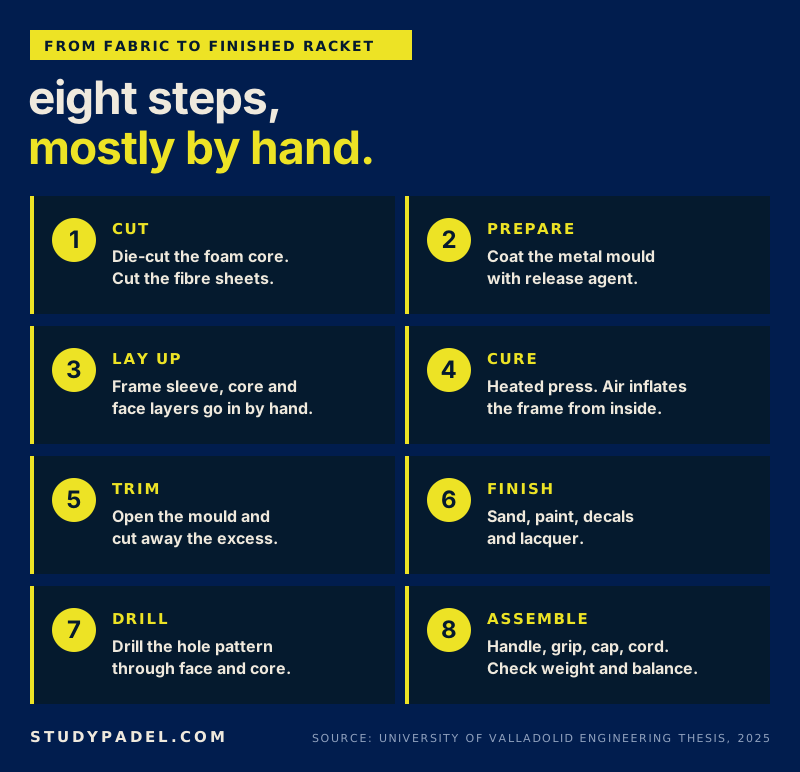
- Cut. The foam core is stamped out of a sheet with a die. The fibre fabrics usually arrive already impregnated with resin and are cut to shape.
- Prepare the mould. A two-part metal mould, shaped like the finished racket, is coated with a release agent so nothing sticks.
- Lay up. A worker places the materials into the mould: a braided carbon sleeve for the frame with an air tube inside it, then the core, then the layers of each face in the right order and direction.
- Cure. The mould is closed and put in a heated press. The air tube is inflated so the sleeve presses outwards against the mould while the resin hardens.
- Trim. The racket comes out of the mould as one piece. Excess resin and fibre are cut away.
- Finish. The surface is sanded, dried, painted, given its decals and lacquered. A rough “sand” finish is added at this stage. A raised 3D texture comes from the mould itself.
- Drill. The hole pattern is drilled through faces and core.
- Assemble. The handle is built up and wrapped, the cap and cord are fitted, and the racket is weighed and checked.
So are they still made by hand?
Largely, yes, and that is true in China as much as in Spain. Laying fabric into a mould in the right order is skilled manual work, and the finishing steps are manual too. A brand may sell thirty models, each needing its own mould, and change them every year. Volumes like that do not justify the kind of automation used for bottles or car parts.
“Handmade” therefore tells you very little. Nearly every racket is handmade. What differs is the materials specified, the care taken and the checking at the end.
Where rackets are made
This is the part the industry talks about least. Here is what can be established.
Most rackets come from Asia. A sourcing guide for the trade describes China as the broadest market for composite rackets, with factories that also make tennis, badminton and pickleball equipment, and names Pakistan as a lower-cost alternative. A Spanish brand that produces in Spain says offshoring to “China, Pakistan or India” is the norm in the sector. The Spanish founder of a racket factory in the United States told the trade press that most companies selling padel rackets import them from China.
One independent analysis of about 180 rackets from eight major brands classed 165 as made in Asia and 15 as made in Spain.
Spain has a small number of real factories.
| Brand | What the brand or the press says | Confidence |
|---|---|---|
| StarVie | Own factory in Azuqueca de Henares, near Madrid, since 2013. Planned output of 120,000 rackets in 2022. Its entry range is labelled “Designed in Spain”, not “Made in Spain”. | High |
| Royal Padel | Says it has designed and built rackets in its own factory for 35 years. | High |
| Babolat | Opened a “Padel Studio” near Barcelona to develop rackets and make high-end models in limited numbers. | Medium |
| Orven | Valencia brand that says, in sponsored content, that its rackets and clothing are made in Spain. | Medium |
For scale: StarVie’s planned 2022 output of 120,000 rackets would be under 3 percent of the roughly 4.5 million sold worldwide in 2024.
Did the brands move production offshore to cut costs?
Mostly the question has the history backwards. The large padel brands did not close Spanish factories and move to China. They started as design, marketing and distribution companies and bought from Asian composite factories from the beginning, exactly as tennis brands were already doing. We found no documented case of a major brand relocating a Spanish racket factory to Asia.
The movement that can be documented runs the other way. StarVie began making its own rackets in Spain in 2013. Babolat opened its studio near Barcelona. A Spanish-founded company now makes padel and pickleball rackets in Connecticut. Production close to the market is slower to scale and costs more per racket, but it shortens delivery times and makes small, premium runs possible.
Does the country matter?
Less than the label suggests. The same analysis of 180 rackets found almost no price difference: an average of €128 for the Spanish-made ones and €131 for the Asian-made ones. A factory in Guangdong and a factory in Guadalajara use the same kinds of fibre, foam and resin. What separates a good racket from a bad one is the specification the brand ordered and how strictly the finished rackets are checked.
If you want to know where a racket was made, read the label. “Made in Spain” means what it says. “Designed in Spain” means it was made somewhere else.
What you are paying for
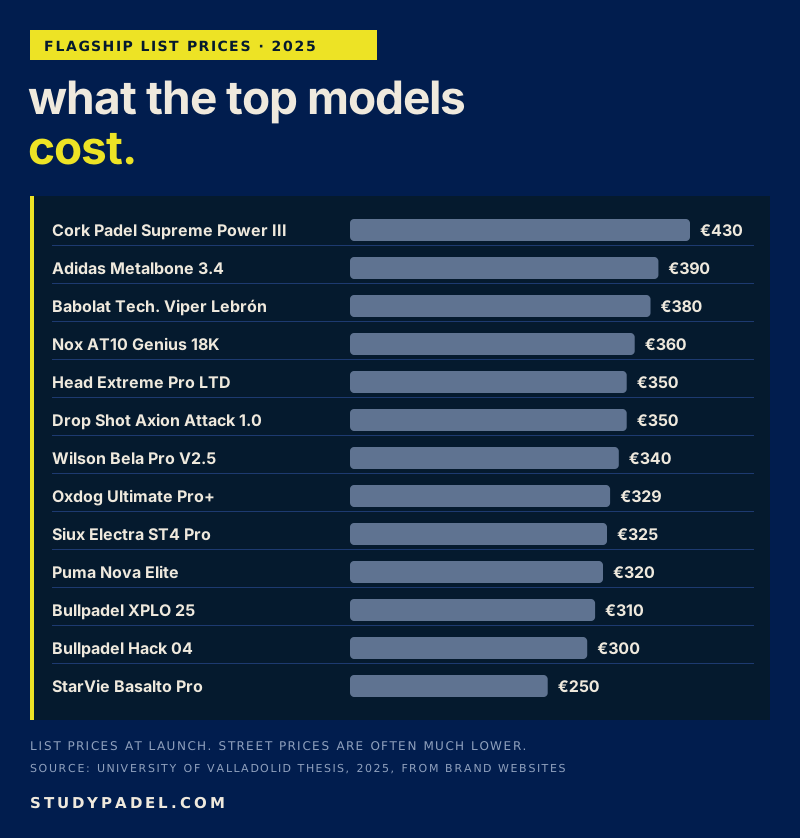
Factories do not publish what they charge brands, so nobody outside the trade can give you a reliable figure for the cost of making a racket. What can be said is where the rest of the price goes.
- Hand labour and slow tooling. Each racket occupies a mould for a full curing cycle and passes through many pairs of hands.
- A new collection every year. Almost every flagship above is described by its maker as designed with a named professional for the 2025 season. New moulds, new graphics and unsold stock from last year all have to be paid for.
- The players. Signature rackets exist because brands pay top professionals to use them.
- The chain. A racket typically passes from factory to brand to distributor to shop, and each takes a margin.
- Small numbers. About 4.5 million rackets were sold worldwide in 2024, a third of them in Spain, spread across hundreds of models.
The list price is also not what most people pay. The same industry data says prices collapsed in recent years as brands cleared excess stock, and that buyers became used to levels that do not reflect what the rackets are worth. The practical conclusion is simple: last year’s flagship, at a deep discount, came out of the same factory as this year’s.
The equipment business as a whole is doing well. It has grown by about 34 percent a year since 2019, and rackets make up roughly two thirds of its value.
Marketing and reality
Padel rackets are sold with a lot of trademarked vocabulary. The flagships in the chart above carry names such as Auxetic 2.0, MLD Black EVA, Tricarbon 18K, X-Tend Carbon, Air React Channel, Vibradrive, Spin Blade and Power Groove. Most of these are trade names for one of six ordinary things: the foam, the fabric, the frame shape, a rough surface, an insert that damps vibration, or a cut-out in the bridge.
3K, 12K, 18K, 24K
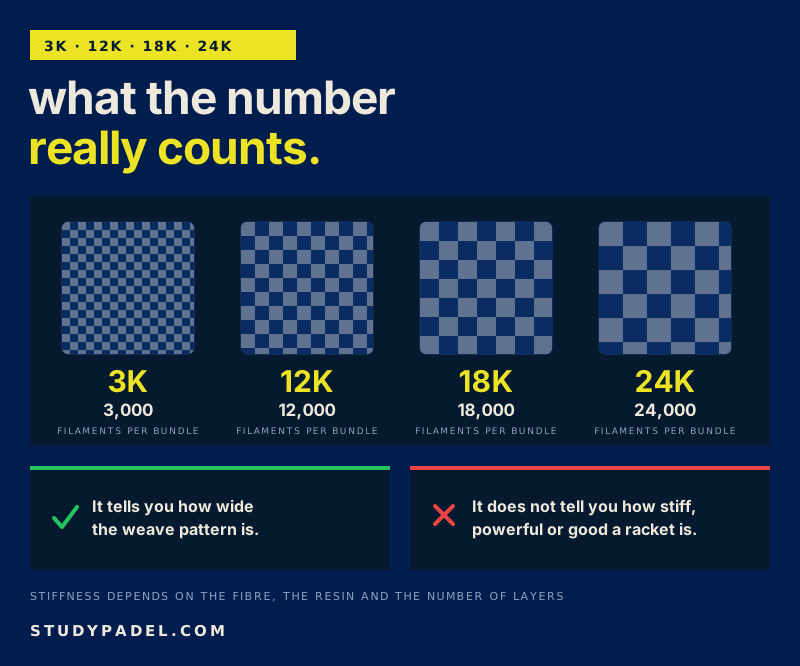
Carbon fabric is woven from bundles of filaments. The K number says how many thousand filaments are in each bundle: 3,000 in 3K, 18,000 in 18K. Bigger bundles give a wider, flatter weave, which is why 18K looks like large squares and 3K like fine ones.
That is all the number tells you. How stiff a face feels depends on the grade of fibre, how many layers there are, which way they run and the resin holding them together. A racket can be made soft or hard in any K.
The brands show this themselves. One sells 3K as the choice for “explosiveness”. Another sells 18K as “solid and comfortable”. A retailer describes a 15K face as more flexible than both 3K and 12K. These cannot all be describing a property of the number.
Aluminised carbon
Carbon fabric with a metallised finish, which gives the silver sparkle. Brands attach performance claims to it, such as being less sensitive to temperature. We found no independent test of these claims; the clearest visible difference is the finish.
Foam names
The real difference is between EVA rubber and softer polyethylene foam, and between soft, medium and hard densities. Names like “MultiEVA” or “Black EVA” usually mean two densities layered together, which is a real construction, but the name does not tell you how the racket feels. The hardness does. Foam also changes with temperature: the same racket feels harder on a cold morning than on a hot afternoon.
Rough surfaces
This one is real. A rough face grips the ball and adds spin. A texture moulded into the face lasts. A sand finish applied with the lacquer wears smooth with use.
Vibration inserts
Rubber pieces in the handle and small plugs in the holes do absorb some vibration, and players with sore elbows often like them. The percentages quoted, such as “up to 49 percent”, are the manufacturers’ own figures.
Aerodynamic channels and cut-outs
Grooves in the frame and openings in the bridge are said to reduce air resistance. They may. We know of no independent test showing a difference an amateur could feel.
Graphene
Added to the frame of some rackets. We found no published figures on how much is used or what it changes.
Adjustable weights
Useful. Screws or plates that move a few grams up or down the racket change its balance, and balance is one of the things you can feel.
What to look at instead
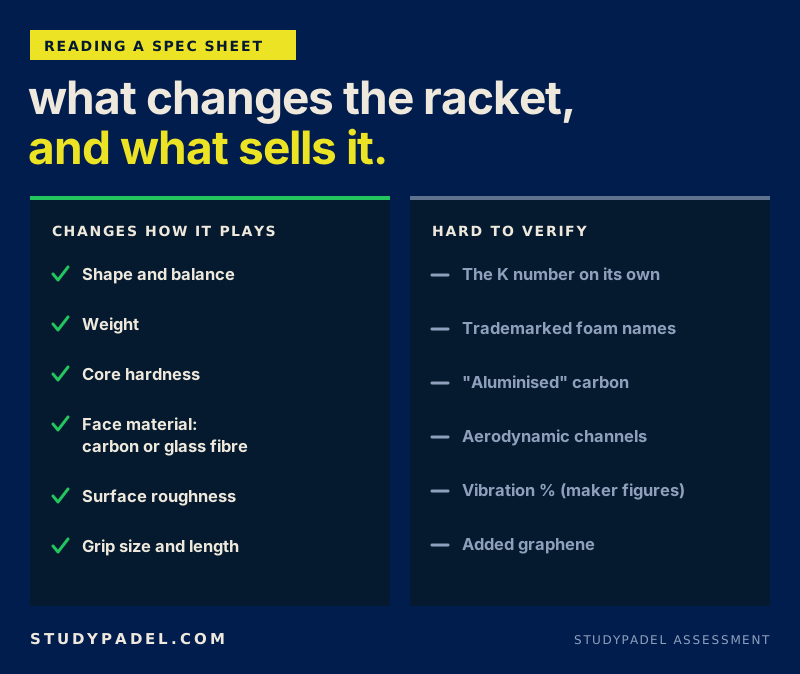
- Shape and balance. Round and low-balance for control and forgiveness. Diamond and high-balance for power, at the cost of a smaller sweet spot. Teardrop in between.
- Weight. Rackets run from about 330 to 400 grams. Ten grams is noticeable. Lighter is easier to move and kinder to the arm. Heavier is more stable and hits harder.
- Core hardness. Soft for comfort and easy depth from the back of the court. Hard if you swing fast and want the ball to go exactly where you aim it.
- Face material. Glass fibre is softer and cheaper, and a good choice for beginners. Carbon is stiffer and more durable.
- Surface. Rough if you play with spin.
- Grip. Thickness and length that fit your hand. A longer handle suits a two-handed backhand.
A beginner is better served by a round, soft, glass-fibre racket at €80 to €120 than by a professional’s diamond at €380. The pro’s racket is built for someone who generates their own power and hits the middle every time.
To compare specific models, see all padel rackets or browse by brand.
A short history of the racket
The first padel rackets were solid wooden paddles, borrowed from the American game of paddle tennis that inspired the sport’s inventor in the 1960s. They were heavy and had no give.
As padel boomed in Argentina and Spain in the 1980s and 1990s, makers moved to the construction still used today: a foam or rubber core between fibre faces, drilled with holes to save weight and move through the air. Glass fibre came first, carbon later as its price fell.
The specialist brands date from that period. Royal Padel was founded in 1991. Varlion started in Argentina in 1993 and moved to Spain in 1999. Bullpadel followed in 1995, StarVie in 2002, Vibor-A in 2011 and Siux in 2012. The tennis and sportswear giants, Head, Babolat, Wilson and Adidas, arrived as the market grew, and now compete with them for the same professional players.
Because the rules fix the size and thickness, rackets have changed less in outline than tennis rackets did. The innovation has gone into materials, balance and surface.
What comes next
- Greener rackets. A cured carbon and epoxy racket is very hard to recycle. Adidas launched a range with flax fibre faces in 2022. A Portuguese brand, Cork Padel, builds faces with cork. Wilson uses a bio-based nylon in its handle caps. Babolat says its Barcelona studio is meant to develop more responsible production. These are early steps, and most are niche products.
- Sensors. Rackets and handle inserts that record swing speed and where the ball hits the face already exist for training. The rules ban any device that lets a player communicate with the outside during a match.
- Tuning. Adjustable weight systems are spreading from the flagships downwards.
- Fewer, bigger brands. The ten largest already sell 87 percent of rackets, and the trade press reports smaller brands disappearing.
- More production close to home. Small premium runs in Spain and the United States will not replace Asian volume, but they give brands something Asian contract factories cannot: speed.
- Calmer prices. After two years of clearance sales, brands have cut production. Expect fewer bargains and fewer models.
Quick answers
What are padel rackets made of? A core of EVA rubber or polyethylene foam, faces of carbon or glass fibre in epoxy resin, and a hollow carbon frame.
Where are padel rackets made? Most are made in Asia, chiefly China, with Pakistan and India also used. A few brands, including StarVie and Royal Padel, have their own factories in Spain.
Are padel rackets handmade? Largely, wherever they are made. The fibre layers are placed in the mould by hand and the finishing is manual.
What does 18K carbon mean? Each bundle in the fabric contains 18,000 carbon filaments. It describes the weave, not the stiffness or quality of the racket.
Is 12K or 18K carbon better? Neither, on that number alone. The K only says how many thousand filaments are in each bundle of the weave. How stiff or powerful a racket feels depends far more on the core, the lay-up and the balance, so compare those first.
Which padel racket shape is best for beginners? Round. Its low balance and large, central sweet spot forgive off-centre hits. Diamond rackets suit experienced players who hit hard and consistently in the middle.
Why are padel rackets so expensive? Hand labour, a new collection every year, payments to professional players, several layers of distribution and small production runs. Street prices are often far below list prices.
Is a racket made in Spain better than one made in China? Not automatically. Materials and quality control matter more than the country. One analysis found almost no price difference between the two.
Sources
- Marcos Alonso Brizuela, Moldeado de una pala de pádel, final-year engineering thesis, University of Valladolid, May 2025 (FIP racket rules, parts, materials, manufacturing steps, brand technologies and 2025 list prices).
- International Padel Federation: rules of padel, summarised in our rules guide.
- El Independiente: the Spanish padel industry and StarVie’s factory (February 2022). Padel Addict: StarVie’s 2022 range, “Made in Spain” and “Designed in Spain” and brand histories.
- Royal Padel: company site. Babolat: Babolat Padel Studio.
- SGI Europe: Rayox, a Spanish-founded racket factory in the United States.
- SourceReady: countries for sourcing padel equipment and racket manufacturers report.
- Padel FYI: State of the racket (180 rackets by place of production and price).
- Tradesport / Interempresas: racket sales in 2024 from DATA PÁDEL.
- Moncloa.com: Orven Sport (sponsored content). Padel USA: Siux’s tenth anniversary. Padel Addict: Vibor-A.
- Padel Market: StarVie Brava Soft 2025 product description (example of 15K marketing copy).
- Playtomic and Strategy&, Global Padel Report 2026, via Padel Addict (equipment market growth).
- Red Bull: History of padel (early wooden paddles).